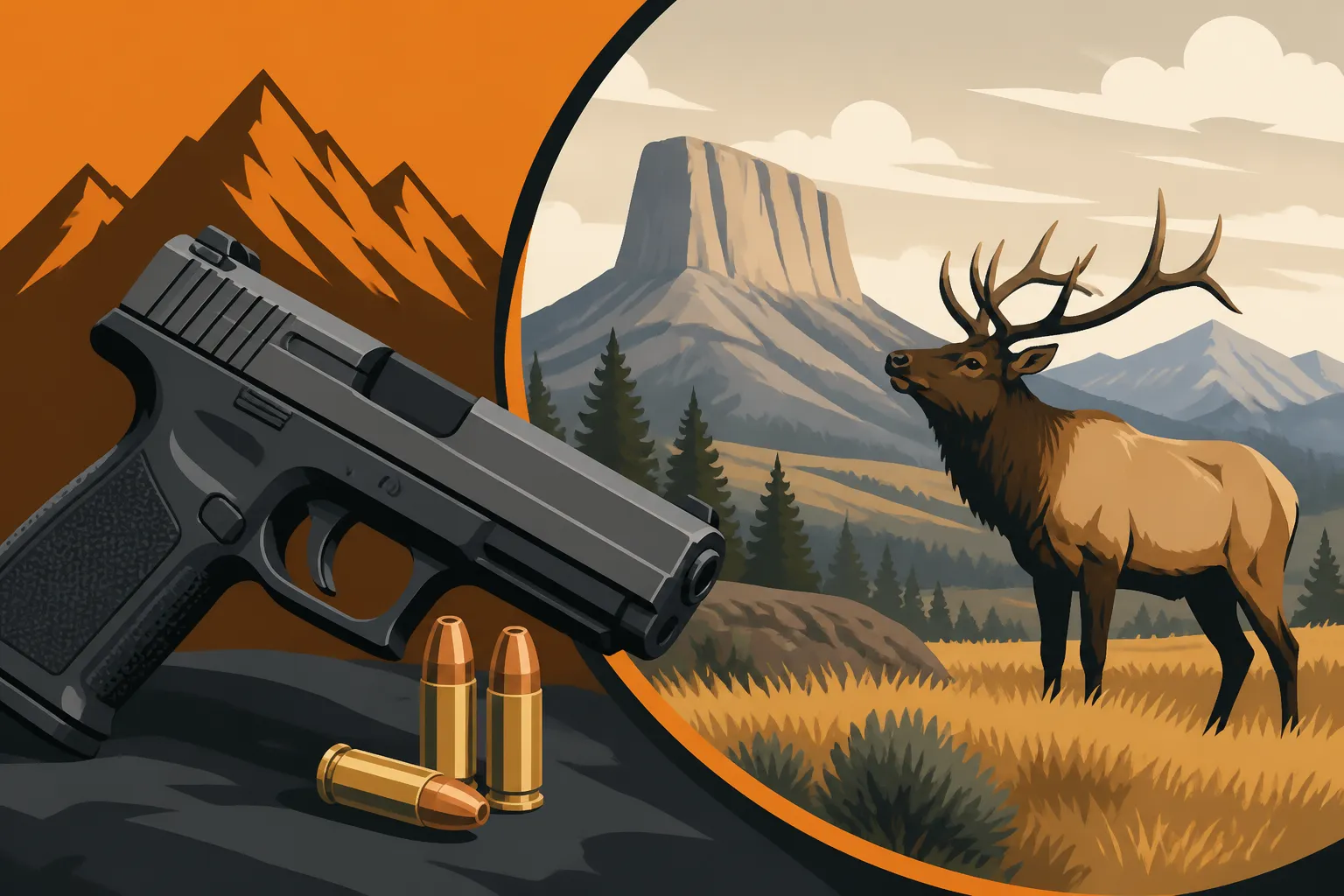
Handgun Hunting Under the .40 Caliber Rule
There’s something incredibly appealing about the challenge of hunting big game with a handgun. It speaks to a different kind of skill, a closer connection, and a deeper understanding of both your weapon and the animal you’re pursuing. However, stepping into Wyoming’s vast, rugged landscapes with a handgun in mind means navigating very specific rules, especially the crucial .40 caliber minimum for big game. This guide is here to unravel those regulations, offering a realistic look at what it takes to succeed ethically and legally.
The Core of Wyoming's Handgun Rule: .40 Caliber Minimum
Hunting big game in Wyoming with a handgun isn't just a matter of picking up your favorite sidearm and heading into the backcountry. The state has clear regulations designed to ensure humane, ethical kills, and one of the most important for handgun hunters is the minimum caliber rule. This often causes confusion for hunters who might be familiar with different rules in other states or who aren't accustomed to the specific demands of big game hunting with a pistol. It’s a regulation that prompts a lot of questions, and rightfully so, as getting it wrong can lead to serious consequences.
Understanding the "Minimum" and What It Means
When Wyoming Game and Fish states a ".40 caliber minimum" for handguns used on big game, they aren't just throwing out a number arbitrarily. This minimum is rooted in ballistics – the science of how bullets perform. The intention is to ensure that the bullet carries enough energy and mass to penetrate deeply and effectively damage vital organs, leading to a quick and humane harvest. It’s not just about the diameter of the bullet, but also its weight and the velocity at which it’s launched, which together determine its kinetic energy and momentum upon impact. A bullet that's too light or too slow, even if it has a decent diameter, simply won't have the knockdown power needed for large animals like deer, elk, or moose. The regulation aims to prevent situations where an animal is wounded and suffers unnecessarily, or worse, escapes only to die a slow, painful death later. Hunters often grapple with the ethical responsibility to make clean kills, and these regulations are a framework to support that. You can learn more about the broader rules in "What Wyoming Counts as a Legal Firearm for Big Game".
Common Cartridges That Meet or Exceed the Requirement
For those looking to responsibly hunt big game with a handgun in Wyoming, there are several popular cartridges that comfortably meet or exceed the .40 caliber minimum. These are typically powerful cartridges designed specifically for hunting or self-defense against large predators, offering the necessary energy and penetration. The venerable .44 Remington Magnum, for instance, is a classic choice, known for its significant power and widespread availability. Many seasoned handgun hunters swear by it for deer, elk, and even bear. Then you have cartridges like the .454 Casull, which steps up the power considerably, offering even greater velocity and energy, making it an excellent option for the largest of game, including elk and moose, for those who can handle its recoil. The .50 Action Express (.50 AE), often associated with the Desert Eagle, also provides immense power, though it’s less common in dedicated hunting revolvers. Even the 10mm Auto, while a semi-automatic pistol cartridge, often meets the energy requirements for deer-sized game, but it's crucial to check specific load data to ensure it crosses that ethical threshold for bigger animals. Resources like the ballistics charts available through platforms like GoHunt can be invaluable for verifying specific cartridge performance and ensuring compliance with state regulations before you ever step foot in the field.
Cartridges That Fall Short
This is where many aspiring handgun hunters run into a roadblock, and it’s a source of genuine frustration. While popular and effective for self-defense or target shooting, many common handgun cartridges simply don't have the raw power or projectile weight required for big game under Wyoming's .40 caliber rule. The most frequent culprit here is the .40 S&W. While it shares the "forty caliber" designation, it is a distinctly different cartridge from the 10mm Auto. The .40 S&W typically operates at lower pressures and velocities, resulting in less muzzle energy and momentum than its 10mm big brother. This often means it falls short of what's considered ethically acceptable for big game. Similarly, the ubiquitous 9mm Luger, despite its widespread popularity and effectiveness for personal protection, is absolutely not legal for big game hunting in Wyoming due to its smaller diameter and insufficient energy. Even cartridges like the .357 Magnum, while powerful for a handgun, are below the .40 caliber minimum, thus making them unsuitable. It's a tough pill to swallow if these are the only handguns you own, but the state's rules are quite clear on these distinctions, prioritizing animal welfare above all else. Understanding these limitations upfront saves a lot of heartache and potential legal trouble down the line.
Beyond Caliber: Ammunition and Firearm Specifics for Handgun Hunting
Meeting the .40 caliber minimum is just the first step. The specific ammunition you choose within that caliber, and even the design of your handgun, play a significant role in your success and ethical execution of a hunt. It’s not enough to simply have a big bore; you need to ensure every component of your setup is optimized for the task at hand. This level of detail is critical when you're dealing with powerful game animals in demanding environments.
Bullet Construction for Big Game
The type of bullet you load into your .40 caliber-plus handgun is arguably as important as the caliber itself. When hunting big game, you need a bullet designed for deep penetration and controlled expansion, not rapid fragmentation. Hollow-point bullets designed for self-defense, while they expand quickly, often don't have the structural integrity to hold together and drive through thick hide, muscle, and bone on an animal as large as an elk or even a robust mule deer buck. Instead, look for bullets specifically marketed for hunting. These usually feature bonded cores, thick jackets, or monolithic (solid copper/brass) construction. Bonded bullets, where the lead core is chemically fused to the copper jacket, are designed to retain most of their weight, expand reliably, and penetrate deeply. Examples include Swift A-Frame, Nosler Partition, or Hornady XTP-MAG (for magnum calibers). Monolithic bullets, like Barnes XPB, offer exceptional weight retention and penetration, often outperforming lead-core bullets on tough game. The goal is to create a wide wound channel that passes through vital organs, rather than a superficial one. Choosing the wrong bullet, even in a legal caliber, can lead to a tragic outcome.
Legal Firearm Design and Features
Wyoming doesn't go into excruciating detail about specific handgun designs beyond the caliber minimum, but practical considerations are paramount. For big game hunting, most successful handgun hunters opt for revolvers. Their robust construction, reliability, and ability to handle potent magnum cartridges make them ideal. Semi-automatic pistols, while gaining popularity with cartridges like the 10mm Auto, can be more susceptible to malfunctions in dirty field conditions and generally offer less inherent accuracy than a well-tuned revolver. Barrel length, while not strictly regulated in Wyoming for hunting handguns, is a critical factor. Longer barrels (typically 6 inches or more) provide a longer sight radius for improved accuracy and allow for more complete powder burn, increasing bullet velocity and energy. This extra velocity can be the difference between meeting or just barely scraping by the minimum energy requirements for some cartridges. Sights are also crucial; adjustable iron sights are common, but many hunters now opt for red dot sights or low-magnification handgun scopes, which can drastically improve accuracy, especially as light fades. A comfortable and secure grip is also essential for managing the significant recoil of magnum hunting cartridges.
Magazines and Capacity Rules
Thankfully, Wyoming's hunting regulations are generally quite accommodating when it comes to magazine capacity for legal firearms used on big game. Unlike some states that have strict limits on how many rounds a rifle or shotgun magazine can hold for hunting, Wyoming does not impose a similar blanket restriction on handguns used for big game. This means that if you're hunting with a semi-automatic handgun, such as a 10mm Auto, you aren't generally limited to a certain number of rounds in your magazine while pursuing elk or deer. However, it's always wise to double-check the current year's regulations from the Wyoming Game and Fish Department, as rules can occasionally change or be interpreted differently for specific hunt areas or species, though this is rare for general magazine capacity. For the vast majority of handgun hunters, who often use revolvers holding 5 to 6 rounds, capacity is rarely a concern. The focus remains on making that first, critical shot count, rather than relying on rapid follow-ups. Still, knowing that you aren't unnecessarily constrained by arbitrary magazine limits offers some peace of mind for those using modern semi-automatic hunting handguns.
Practical Considerations for Handgun Hunters in Wyoming
Handgun hunting is a commitment, a pursuit that demands more from the hunter than many other methods. The intimate nature of the shot, the proximity to the animal, and the sheer skill required mean that success isn't just about drawing a tag; it's about dedicated preparation and a realistic understanding of your abilities. Wyoming's vast and often unforgiving landscape only amplifies these demands, challenging hunters at every turn.
Effective Range and Ethical Limits
This is where the rubber meets the road for handgun hunting. Unlike rifles that can extend ethical killing ranges out to several hundred yards, handguns typically limit hunters to much closer distances. For most proficient handgun hunters, an ethical shot on big game usually falls within 50 to 75 yards, with some highly skilled individuals pushing that to 100 yards under ideal conditions. This isn't a hard and fast rule, but rather a realistic assessment of typical accuracy and bullet energy retention. Beyond these distances, bullet drop becomes significant, wind drift has a greater impact, and it becomes increasingly difficult to place a bullet precisely into the small vital zone of a big game animal. The frustration for many is realizing that even with a powerful magnum, the effective range is still relatively short compared to a rifle. This means you have to become an expert stalker, mastering "Terrain That Hides an Approach" and knowing "How Close a Bowhunter Really Needs to Get" – because, in many ways, you're operating with similar limitations. Pushing past your personal ethical limit drastically increases the chance of wounding an animal, which is every hunter's worst nightmare. Truly understanding and respecting your effective range is the single most important factor in ethical handgun hunting.
Accuracy and Practice Regimens
Becoming proficient with a hunting handgun takes immense dedication and practice. It's far more challenging than achieving similar accuracy with a rifle. You're dealing with heavier triggers, shorter sight radii, significant recoil, and a much smaller platform to stabilize. Your practice regimen needs to be rigorous and realistic. Don't just plink away at a target 25 yards out from a bench rest. While that's a good starting point, you need to practice from field positions: kneeling, sitting, using a tree or rock as a rest, and even unsupported standing shots. Drawing from your holster and quickly acquiring a target, then making a controlled, accurate shot, is a skill that takes hundreds, if not thousands, of repetitions. Simulating hunting scenarios, where your heart rate is elevated and adrenaline is flowing, is also crucial. Many hunters will incorporate cardio into their practice, shooting immediately after a brisk walk or jog. The recoil management of a .44 Magnum or .454 Casull can be brutal, making consistent follow-up shots difficult. Investing in quality training, dry-firing practice, and a significant amount of live-fire range time is non-negotiable for anyone serious about handgun hunting in Wyoming. Without this commitment, you're not just risking a missed opportunity; you're risking an unethical shot.
Holsters and Field Carry
Carrying a large, heavy hunting handgun comfortably and securely in Wyoming's rugged backcountry is a challenge often overlooked until you're actually out there. A flimsy, ill-fitting holster is not only uncomfortable but potentially dangerous. You need a robust holster that keeps the handgun secure during strenuous climbs, bushwhacking through timber, or crawling on stalks. Chest holsters are a popular choice for backcountry hunters, as they keep the firearm accessible, out of the way of hip belts from backpacks, and protect it from debris. They also offer a quick draw, which can be critical for follow-up shots or even defense against dangerous game in certain areas. Hip holsters, especially those with good retention, can also work, but ensure they don't interfere with your pack. Cross-draw or shoulder holsters are other options, depending on your body type and preference. Material matters too; sturdy leather or Kydex are preferred over nylon. The holster needs to protect the firearm from the elements and securely hold it, preventing accidental loss or discharge. For long days on the mountain, a comfortable and reliable carry system is paramount to maintaining focus on the hunt itself, rather than constantly adjusting your gear.
Species-Specific Applications for Handgun Hunting
The type of big game you’re pursuing will significantly impact the viability and challenge of handgun hunting. Each species presents its own set of unique circumstances, from habitat and behavior to size and resilience. What might be a reasonable challenge for one animal could be an extraordinarily difficult, if not irresponsible, undertaking for another. This understanding helps align your expectations with the realities of the field.
Handgun Hunting for Deer and Antelope
Handgun hunting for mule deer and whitetail deer in Wyoming can be incredibly rewarding, especially in areas with broken terrain or dense cover that allows for closer stalks. These animals, while tough, are generally within the ethical limits of well-placed magnum handgun shots at typical handgun ranges (50-75 yards). For mule deer, often found in open country, the challenge becomes closing the distance without being spotted, which requires exceptional stalking skills and patience. You’ll need to master "Playing Wind Direction on an Open Sagebrush Stalk" and "Using Cutbanks and Draws to Close on Antelope" to get within range. Whitetail deer, prevalent in the river bottoms and agricultural areas of eastern Wyoming, can offer more opportunities for close-range encounters due to thicker vegetation.
Antelope, with their incredibly keen eyesight and preference for vast, open plains, present perhaps the greatest challenge for handgun hunters. Getting within 100 yards of a pronghorn buck often feels like an impossible feat. This is where patience, understanding the terrain, and mastering "The Decoy Distance That Actually Pulls Antelope Bucks" becomes critical. While a .44 Magnum or 10mm Auto (with appropriate loads) can ethically take an antelope, the difficulty lies in the stalk itself. Many hunters find success by combining sitting a waterhole blind with strategic decoys, minimizing the need for extensive stalking. Knowing the specific antler point restrictions, as detailed in "Antler Point Restrictions Wyoming Kept for 2026", is also vital when evaluating potential targets.
Taking on Elk with a Handgun
Hunting elk with a handgun is a significant step up in challenge and demands the utmost proficiency and ethical consideration. Elk are large, robust animals with thick hides, heavy bone structures, and an incredible will to live. While legal with suitable calibers like .44 Magnum, .454 Casull, or .50 AE, the margin for error is razor-thin. Bullet choice here is absolutely critical; you need deep-penetrating, heavy-for-caliber bullets designed for maximum integrity and expansion on tough game. Your effective range for elk with a handgun will likely shrink to 50 yards or less to ensure a high-percentage, ethical shot. This requires you to become an absolute master of the close-range stalk, using terrain and wind to your advantage, often needing to get as close as you would with a bow.
A wounded elk can travel an immense distance, leading to a long, difficult, and potentially unsuccessful recovery. This is why few hunters attempt elk with a handgun, and those who do are typically highly experienced and dedicated. They spend countless hours at the range, practicing tough shots under pressure. This isn't a hunt for the faint of heart or the casually prepared. It demands a level of commitment and skill that far exceeds what's needed for deer or antelope. You must be intimately familiar with elk anatomy and shot placement to ensure your bullet finds the vitals effectively.
Moose and Bighorn Sheep
Hunting Shiras moose and bighorn sheep with a handgun in Wyoming falls into the realm of extremely specialized, and often once-in-a-lifetime, opportunities. Moose are enormous animals, arguably the largest and toughest big game animal in North America. While legal if you meet the .40 caliber minimum, the sheer size and resilience of a moose mean that a handgun hunt is an immense undertaking. Most hunters pursuing moose, given the rarity of the tag and the investment involved, opt for powerful rifles to maximize their chances of a clean, ethical kill. The challenge of a close-range handgun shot on a moose in their typically dense, wet habitat is almost unparalleled.
Similarly, bighorn sheep hunts are incredibly rare and highly sought-after, with "Wyoming Bighorn Sheep Random Odds Sit Under One Percent". These animals inhabit some of the most rugged, unforgiving mountain terrain imaginable. Getting within ethical handgun range (again, likely 50 yards or less) of a wary bighorn ram in such open and exposed environments is a monumental task. The risk of a wounded animal escaping into cliffs or unrecoverable terrain is exceptionally high. For these premium tags, most hunters wisely choose a high-power rifle with which they are supremely confident in their long-range accuracy. While technically permissible with a qualifying handgun, the practical and ethical considerations for both moose and bighorn sheep generally push hunters toward more powerful and longer-range rifle options.
Navigating Regulations and Resources for Handgun Hunters
Even the most skilled handgun hunter needs to stay on top of the rules and leverage available resources. Regulations change, and having accurate, up-to-date information is non-negotiable for a legal and successful hunt. The world of Wyoming hunting is complex, and failing to understand the administrative side can be just as detrimental as missing a shot.
Checking Current Regulations
The most critical step for any hunter, especially those using specialized methods like handguns, is to consult the most current Wyoming Game and Fish Department (WGFD) regulations. These are updated annually and are the definitive source for all hunting rules. Assuming last year's rules apply is a common mistake that can lead to serious legal issues. Pay particular attention to the "General Hunting Regulations" section, as well as the specific regulations for the species you intend to hunt. While the .40 caliber rule for handguns has been consistent, other regulations, such as specific hunt area restrictions or season dates, can and do change. For example, "Wyoming Hunt Areas That Limit Your Weapon Choice" might exclude handguns in certain locales, or there could be specific rules about "Wyoming Legal Firearm List for Big Game" that affect you. These comprehensive booklets are available online through the WGFD website and at license vendors throughout the state. Websites like GoHunt also do an excellent job of distilling and presenting this information in an easily digestible format, often with additional tools for planning.
Hunter Education and Safety
Beyond the specific weapon rules, fundamental hunting education and safety remain paramount. Anyone born after January 1, 1965, is required to possess proof of hunter education certification to hunt in Wyoming. This is a non-negotiable requirement that ensures hunters have a foundational understanding of safety, ethics, wildlife conservation, and regulations. Whether you completed "Online and Classroom Hunter Education Compared" or took an in-person course, carrying proof of your certification, such as your hunter education card, is mandatory in the field. This can be directly linked to the requirement in "Anyone Born After 1965 Needs Wyoming Hunter Education". For handgun hunters, the safety aspect is amplified due to the power of the cartridges and the recoil involved. Proper handling, muzzle control, trigger discipline, and understanding safe zones of fire are crucial, especially when moving through challenging terrain or with hunting partners. Never compromise on safety.
Planning Your Hunt
Effective planning is the backbone of any successful Wyoming hunt, and it's even more critical for handgun hunters given their inherent range limitations. This involves meticulous research into specific hunt areas. Platforms like the "The Wyoming Hunt Planner" are invaluable for identifying units that offer suitable terrain for close-range stalking or blind hunting. You'll want to look for areas with good cover, broken topography, or reliable water sources that might concentrate animals, making it easier to get within that crucial handgun range. Utilizing detailed maps, including public land overlays (often available through GoHunt or onX Hunt), will help you scout potential access points, identify natural funnels, and pinpoint areas where animals might feed, bed, or travel. Understanding the "Wyoming General Elk Licenses and Where They Work" or "How Far Wyoming's Mule Deer Have Rebounded" in specific units can also influence your choices. Don't forget to research "Checking Draw Odds Before You Apply" if you're going for a limited quota tag, as some prime handgun units might require preference points. Good planning also involves preparing for all aspects of a Wyoming hunt, including understanding the costs involved, like "Wyoming Nonresident Tags Run $326 to $1,965", and the logistics of meat care in the field.
| Caliber | Big Game Legal in WY (Handgun) | Minimum Bullet Weight (Grains) | Typical Muzzle Energy (Foot-Pounds) | Notes |
|---|---|---|---|---|
| .40 S&W | NO | 155-200 | 350-500 | Falls short of ethical big game requirements. |
| 10mm Auto | YES (w/ appropriate loads) | 180-220 | 550-750 | Check specific load data; heavy for caliber, hardcast are ideal. |
| .44 Remington Magnum | YES | 240-300 | 900-1,200 | Classic big game handgun caliber; powerful and effective. |
| .45 Colt (Ruger Only) | YES (w/ appropriate loads) | 250-325 | 900-1,100 | Only with modern, strong firearms like Ruger Blackhawk. |
| .454 Casull | YES | 240-360 | 1,600-2,000+ | Excellent for all North American big game; substantial recoil. |
| .50 AE | YES | 300-350 | 1,300-1,600+ | Very powerful, typically associated with Desert Eagle. |
| .500 S&W Magnum | YES | 300-500+ | 1,800-2,600+ | Extremely powerful, for the most experienced handgun hunters. |
Disclaimer: This table provides general information. Always consult current Wyoming Game and Fish Department regulations and specific ammunition manufacturer data for the most accurate and up-to-date information. Muzzle energy and bullet weight can vary significantly between different ammunition loads within the same caliber.
Disclaimer
The information provided in this guide is intended for general informational purposes only and does not constitute legal advice. Hunting regulations, including those concerning firearm calibers, species, and specific hunt areas, are subject to change. It is the responsibility of every hunter to consult the most current Wyoming Game and Fish Department regulations and obtain all necessary licenses and permits before engaging in any hunting activities. Failure to do so may result in fines, penalties, or loss of hunting privileges.