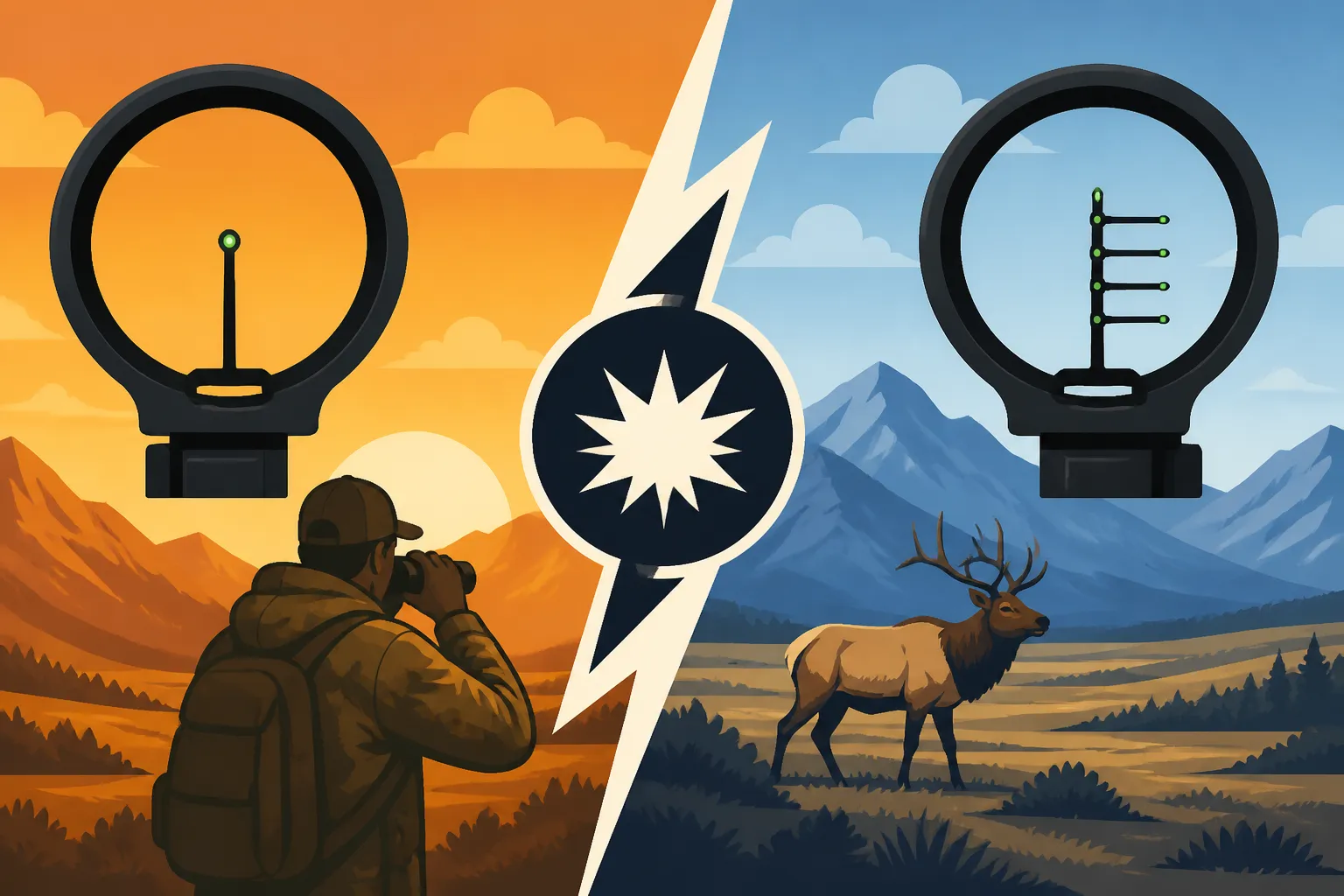
Single Pin or Multi Pin for Open Country
One of the most persistent questions that haunts bowhunters preparing for the vast, open expanses of Wyoming is what kind of sight will truly serve them best. That moment when you finally have a magnificent bull elk or a wary pronghorn buck in your sights, only to realize your pin setup isn't quite right for the distance, is a nightmare no one wants to live. This guide is all about diving deep into the age-old debate between single-pin and multi-pin sights, helping you understand the nuances so you can make an informed choice that boosts your confidence and accuracy in the field.
Understanding the Single Pin Sight Advantage in Open Country
When you're out there, glassing those enormous Wyoming basins or stalking through rolling sagebrush, you quickly realize that "close" can mean 40 yards, 60 yards, or even a bit more. This is where the debate often begins, and for many, the single-pin sight really starts to shine.
The Uncluttered Sight Picture and Precision
Imagine looking through your peep sight, drawing your bow, and seeing just one crisp, bright pin floating on your target. That’s the beauty of a single-pin sight. There’s no stack of pins above or below it to distract your eye, no confusing array to sort through when the adrenaline is pumping. This uncluttered sight picture allows for an incredible level of focus and precision, which becomes absolutely critical when you're trying to hit a relatively small kill zone on a big game animal at longer distances.
In the vast, wide-open country of Wyoming, a shot on a mule deer can easily stretch to 50 or 60 yards. A slight error in aiming at 20 yards might mean a difference of an inch or two; at 60 yards, that same slight error could be the difference between a clean kill and a gut shot. With a single pin, your brain isn't trying to reconcile multiple aiming points, allowing you to concentrate solely on that one luminous dot perfectly placed on the target. This mental clarity can be a huge advantage, especially when you're shaking from excitement and the wind is trying to throw you off. It truly allows for a level of finite aiming that can be harder to achieve when your sight housing is crammed with pins.
Rapid Adjustments for Varying Distances
The magic of modern single-pin sights, often called "slider sights," lies in their ability to be precisely adjusted for virtually any distance. You range your target, typically with a high-quality rangefinder that's become indispensable for western hunting, and then you dial your sight to that exact yardage. Whether it’s 37 yards, 54 yards, or 72 yards, you're not gapping pins or guessing between fixed points. You're putting that single pin precisely where it needs to be.
This process, while requiring a moment for adjustment, offers unparalleled accuracy. For instance, when stalking a pronghorn across a sagebrush flat, you might get a range of 52 yards, then 63 yards as it moves, and finally, it stops at 58. With a single-pin sight, you dial to 58, hold dead-on, and execute the shot. Compare that to trying to aim "a little high" on your 50-yard pin or "a little low" on your 60-yard pin. That kind of guessing game introduces variables that are best avoided when a once-in-a-lifetime animal is standing in front of you. Many hunters find the peace of mind knowing they are dialed to the exact yardage to be worth the extra moment of adjustment.
Now, some might argue that this adjustment takes too long and a game animal won't wait. And that's a valid point in some scenarios. However, with practice, these adjustments become quick and fluid. Modern sights are designed for efficiency, and the critical thing is to always have your rangefinder at the ready, ranging as you stalk or as the animal moves. Knowing your target's range accurately is the first step, regardless of your sight type, but a single pin then allows you to capitalize on that precise range information with an equally precise aiming point. You can learn more about Realistic Archery Practice Distance for Big Game to prepare for these longer shots.
The Multi Pin Sight's Strengths and Weaknesses in Wyoming's Terrain
While the single-pin offers precision, the multi-pin sight brings a different set of advantages to the table, primarily centered around speed. However, this speed often comes with its own set of trade-offs, especially in the unique environment of Wyoming.
Instant Ranging and Shot Execution
The most compelling argument for a multi-pin sight is the sheer speed of target acquisition. With pins set at fixed distances—say, 20, 30, 40, 50, and 60 yards—you can quickly identify the appropriate pin for a given range and let an arrow fly. This can be absolutely critical in fast-breaking situations. Imagine an elk herd moving through a timbered drainage in the Bridger-Teton National Forest. A bull might appear and disappear within seconds, offering only a brief window for a shot. In such a scenario, fumbling with a slider dial could mean missing the opportunity entirely.
With a multi-pin sight, once you've ranged the animal, you simply pick the corresponding pin and shoot. This immediate response is invaluable, especially when hunting species like elk that are notorious for not standing still for long. Even a mule deer, usually slower to react, can take a few steps that put it in a different yardage bracket. Having a spread of pins means you're almost always ready to shoot, drastically reducing the mental and physical steps between ranging and releasing an arrow. For many bowhunters, especially those who prioritize quick target acquisition, the multi-pin system provides an undeniable edge.
The Challenge of Clutter and Pin Gapping
While speed is a significant advantage, the trade-off with multi-pin sights often manifests as visual clutter and the inherent inaccuracies of "pin gapping." When you look through your peep and see four, five, or even seven glowing pins, it can be overwhelming, especially under pressure. Your eye has more to process, and in a high-stress situation, it’s easier to grab the wrong pin or misalign the correct one. This becomes even more pronounced in low light conditions, such as dawn or dusk, when the pins might bleed together or become harder to distinguish quickly.
Beyond the visual distraction, there's the issue of pin gapping. What do you do when that elk steps out at 45 yards, and you have pins for 40 and 50? You have to instinctively "gap" the pins, aiming slightly above your 50-yard pin or slightly below your 40-yard pin. While experienced hunters become adept at this, it's still a form of estimation. That estimation introduces a variable, a potential for error, that a precisely dialed single pin eliminates. Hunting big game in Wyoming often involves shots that are not perfect 10-yard increments, making pin gapping a regular occurrence. The more pins you have, the less gapping you might think you need, but the clutter often increases, creating its own set of aiming challenges. It's a balance, and one that requires consistent practice to truly master.
Practical Considerations for Wyoming Bowhunters
Choosing between a single-pin and multi-pin sight isn't just about the mechanics of the sight itself; it's about understanding the unique demands of hunting in Wyoming and how your personal hunting style and target species will interact with your equipment.
Shot Distances and Target Species
Wyoming is known for its wide-open spaces, which means shots, especially on certain species, can often be longer than what you might be accustomed to in more timbered areas. Consider the species you're primarily pursuing. If your focus is on antelope, known for their incredible eyesight and reluctance to let you get close, you'll likely face more 50-70 yard shots. A single-pin sight, with its ability to dial in exact yardage, might offer a confidence boost for these longer, more precise engagements. Stalking Pronghorn Across Wyoming's Open Sagebrush often means trying to close distance, but always preparing for a longer shot.
However, if you're chasing elk in the dense timber of the Bighorn National Forest, where encounters can be sudden and at closer ranges (think 20-40 yards), the speed of a multi-pin might be more appealing. While elk can certainly be found in open areas, many hunters find them in broken country or dark timber where quick, accurate shots are paramount. Similarly, mule deer in rolling hills might offer varied shot opportunities. Ultimately, the typical shot distances for the species and terrain you hunt most often should heavily influence your decision. It's not about making every shot, but being prepared for the shot you're most likely to get.
Personal Preference, Practice, and Equipment
At the end of the day, there's no single "best" sight for every hunter. It truly boils down to personal preference, how much you practice, and the other gear in your setup. Some hunters simply prefer the clean sight picture of a single pin and are willing to take the extra second to adjust. Others value the instant "point and shoot" capability of a multi-pin. The crucial factor, no matter your choice, is relentless practice. You need to become intimately familiar with your chosen sight system, knowing exactly how it performs at every conceivable distance. This includes knowing your arrow's trajectory, which also depends on factors like Arrow Weight That Gets Through an Elk.
Regardless of whether you choose a single or multi-pin, a high-quality rangefinder is non-negotiable for western hunting. Tools like the RX-2800 from Leupold or a Vortex Fury HD provide accurate ranges quickly, which is half the battle. Furthermore, consider how other aspects of your bow setup, like your chosen Recurve, Longbow or Compound for Western Elk and overall bow tuning, will impact your sight's performance. A well-tuned bow and a sight you trust will dramatically increase your effective range. Exploring resources like GoHunt can also provide valuable insights into specific hunt units, showing you the terrain and average shot distances other hunters encounter, which can further inform your gear choices.
Here's a quick comparison to help visualize the differences:
| Feature | Single Pin Sight | Multi Pin Sight |
|---|---|---|
| Sight Picture | Clean, uncluttered, highly precise | Multiple pins, can be busy, potential for distraction |
| Adjustment Speed | Slower, requires dialing for exact yardage | Instant, no dialing needed for preset distances |
| Accuracy | Pinpoint accuracy at exact dialed ranges | Relies on pin gapping for intermediate distances |
| Typical Use Case | Longer, more precise shots in open country | Fast-breaking, varied shots, closer ranges |
| Learning Curve | Requires practice with quick dialing | Requires practice with pin gapping and target acquisition |
| Ideal for | Wary pronghorn, long-range mule deer in open sage | Elk in timber, fast-moving deer at varied ranges |
No matter which sight you lean towards, remember that your personal dedication to practice will always be the most significant factor in your success. Get out there, shoot frequently, and become one with your bow and your chosen sight. And don't forget the importance of things like Bow Tuning Worth Doing Before a Mountain Hunt.
Disclaimer
Please remember that hunting regulations, seasons, and requirements can change. Always consult the official Wyoming Game and Fish Department regulations for the most current and accurate information before planning any hunting trip. This guide is for informational purposes only and should not be considered a substitute for official legal guidance.