Color Phase Bears and Grizzly Identification
It’s a heart-stopping moment: you’re deep in the Wyoming backcountry, glassing a distant hillside, and suddenly, there it is. A bear. Your heart immediately begins to pound because you know the stakes. Is it a black bear, which you might have a tag for, or is it a grizzly, a federally protected animal where misidentification could lead to serious legal trouble and a lifetime of regret? This isn't just a challenge; it's a profound anxiety for many hunters venturing into the Cowboy State's wild landscapes. This guide is here to walk you through the nuances of distinguishing between black bears and grizzlies, focusing on those tricky color variations that can make identification a true headache, ensuring you can make informed, safe, and legal decisions in the field.
Understanding Wyoming's Bear Landscape
Wyoming is home to both black bears and grizzly bears, but their distribution, populations, and legal hunting status are vastly different. Knowing the lay of the land, both literally and figuratively, is your first line of defense in proper identification.
Black Bears: More Than Just Black
The biggest misconception about black bears is right in their name: they are absolutely not always black. If only it were that simple! This is where a lot of hunters, especially those new to western hunting, can get themselves into a real bind. I’ve seen more than one hunter mistake a cinnamon-phase black bear for a grizzly from a distance, and it's completely understandable why.
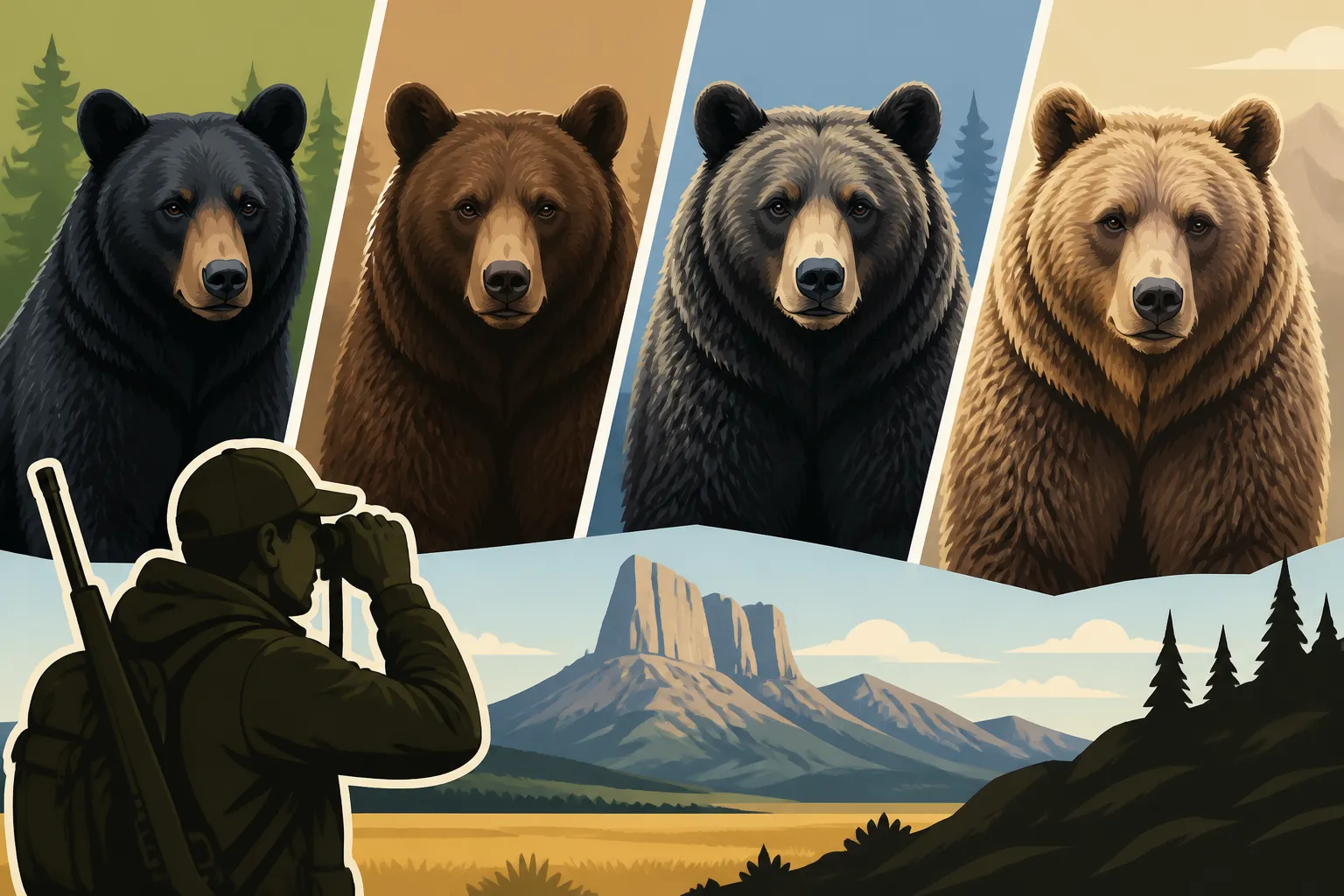
Black bears in Wyoming come in a dazzling array of colors. You'll encounter stunning cinnamon bears, with fur ranging from a light reddish-brown to a deep, rich auburn. Then there are the chocolate bears, which are a darker brown, sometimes so dark they appear black until the sun hits them just right. You might even spot blonde or yellowish-brown individuals, particularly cubs or bears in certain areas. Even bluish-gray bears, often called "glacier bears" though they are rare and typically found further north, technically fall under the black bear species. These color variations are entirely natural and genetic, and they’re what make field identification so challenging. When you see a bear that’s not black, your first thought shouldn't automatically be "grizzly." It should be "What other features can I use to identify this bear?" Their coat color can also change with the seasons, often appearing lighter or faded after a long winter before a fresh molt, or darker and richer in the fall.
The Grizzly Bear Presence in Wyoming
Grizzly bears, on the other hand, evoke a different kind of respect and caution. They are magnificent, powerful animals, and in Wyoming, they hold a federally protected status under the Endangered Species Act in most areas. This means hunting them is strictly prohibited, and accidental take can result in severe fines, imprisonment, and the permanent loss of hunting privileges. Their conservation status is a hot-button topic, but for hunters, the bottom line is clear: know where they are, and know how to avoid them.
Grizzly populations in Wyoming are largely concentrated within and around the Greater Yellowstone Ecosystem (GYE). This includes areas like Grand Teton and Yellowstone National Parks, but their range extends significantly into surrounding public lands. You'll find grizzlies in large portions of the Bridger-Teton National Forest, the Shoshone National Forest, and even into parts of the Wind River Range. While their expansion is closely monitored, it’s crucial to recognize that a grizzly could potentially roam outside these core recovery zones. For anyone considering hunting in these areas, particularly for species like elk or deer that share grizzly habitat, an intimate understanding of grizzly identification is not just recommended, it’s absolutely essential. Always check the current regulations for your specific hunt area, as management zones and bear activity can shift. An excellent resource for understanding the habitat is to explore topics like Hunting the Shoshone in Northwest Wyoming or Access Points Into the Bridger-Teton in Wyoming which detail some of the core grizzly zones.
Key Physical Identifiers: Telling Them Apart
Beyond color, there are several distinct physical characteristics that reliably differentiate a grizzly bear from a black bear. These are the details you absolutely must train your eye to see, often through a spotting scope or binoculars.
The Tell-Tale Shoulder Hump
This is arguably the single most important and distinct feature for grizzly identification. Grizzly bears possess a prominent, muscular hump between their shoulders. It's not just a patch of longer hair; it’s a visible mass of muscle and fat that sits high on their back, just above the front legs. This hump is a powerhouse, providing the incredible strength grizzlies use for digging for roots and rodents, and for excavating dens. When a grizzly walks, this hump is clearly visible, often appearing as the highest point of their body, especially when viewed from the side.
In stark contrast, black bears do not have a shoulder hump. Their back appears relatively flat or slopes gently from their head to their rump. There might be some longer hair on a large black bear, or a visual trick of light and shadow, but it will never have the distinct muscular protrusion of a grizzly. Think of it this way: a black bear's silhouette will generally be a smooth curve from neck to tail, while a grizzly's will have that distinct, pronounced rise over the shoulders. This feature is often visible even at considerable distances, making it one of the first things to look for when glassing a bear on a faraway slope.
Facial Profile and Ear Shape
Take a close look at the bear's head, specifically its profile and ears. These features offer more critical clues to identity. A grizzly bear typically has what’s described as a "dished" or concave facial profile. Imagine a gentle slope from the forehead down to the tip of the nose, with a noticeable indentation or dip. Their snout often appears broader and more robust, giving their face a powerful, almost blocky appearance. Their ears are generally smaller and rounder in proportion to their head, often set further apart on the sides of their head. They might look almost like small, rounded nubs.
Black bears, however, usually have a straighter or "Roman nose" profile, meaning a relatively flat or convex line from their forehead to their nose. Their snout tends to be more pointed, giving their face a sleeker, sometimes more dog-like appearance. Their ears are typically taller, more pointed, and relatively larger in proportion to their head, often standing up more prominently. These differences can be subtle, especially on younger bears, but when combined with other identifiers, they become much more reliable. Don’t rush this observation; take your time and examine the head from multiple angles if possible.
Claw Length and Shape
While you won't always get a clear view of a bear's claws in the field, especially from a distance, understanding their characteristics can reinforce your identification if you get a glimpse or find tracks. Grizzly bears have significantly longer, straighter, and blunter claws on their front paws. These claws are adapted for their prodigious digging habits, allowing them to excavate large amounts of earth with ease. They can be several inches long, and when a grizzly walks, these long claws often register in their tracks, leaving distinct claw marks well ahead of the toe pads.
Black bears, conversely, have shorter, more sharply curved, and darker claws. These claws are ideal for climbing trees, which is a common escape strategy for black bears. In their tracks, the claw marks will be much shorter and typically closer to the toe pads, sometimes even appearing within the toe pad impression itself. While observing claws directly might be difficult unless you're very close (too close!), knowing what to look for can be helpful if you encounter fresh tracks in the area. Pay attention to the overall impression the paw leaves; grizzly front paws are often notably wider than they are long.
Behavioral Clues and Habitat Differences
Beyond the distinct physical markers, understanding a bear's typical behaviors, size considerations, and preferred habitats can add layers to your identification process, especially when you're dealing with tricky lighting or distance.
Size and Track Considerations
It’s tempting to rely on size alone when trying to distinguish bears, but this can be incredibly misleading. A large black bear, especially a mature male, can easily outweigh a young grizzly. Conversely, a juvenile grizzly can look surprisingly small, leading to dangerous misidentification. For instance, a big boar black bear in prime condition can stand as tall as a grizzly and weigh over 400 pounds. Meanwhile, a young grizzly just striking out on its own might only be 200-300 pounds. So, while grizzlies tend to be larger and more heavily built on average, never let size be your sole determinant. It's a contributing factor, but never the definitive one.
However, tracks can offer more consistent clues. When you find fresh tracks, examine them closely. As mentioned before, grizzly tracks will often show distinct, long claw marks well ahead of the toe pads, sometimes an inch or more. Their front paw pads are also generally wider than they are long, giving a "squarish" impression. Black bear tracks, especially their front paws, tend to be more rounded or oblong, with shorter claw marks that are much closer to the toe pads. The stride pattern can also vary; grizzlies often have a wider, lumbering gait. Of course, finding clear, undisturbed tracks is a luxury, but when you do, they provide excellent corroborating evidence.
Habitat and Geographic Distribution
Understanding the geographic distribution of both species in Wyoming is a critical piece of the identification puzzle. Black bears are widespread and can be found in nearly every forested and mountainous region of the state, excluding the highest alpine elevations and the arid sagebrush plains. You'll encounter them from the Black Hills in eastern Wyoming to the vast forests of the Bighorn Mountains, the Absarokas, and the Wyoming Range. Their range is extensive, and they are generally much more common throughout the state. You might find them feasting on berries in dense timber or rooting around in lower elevation river bottoms. You can learn more about The Black Bear Population Estimate Explained and its distribution.
Grizzly bears, conversely, have a much more restricted distribution, primarily concentrated within the Greater Yellowstone Ecosystem (GYE) and its immediately surrounding national forests. This means areas like the Bridger-Teton National Forest, the Shoshone National Forest, and portions of the Wind River and Absaroka mountain ranges are prime grizzly country. While they are expanding their range, particularly along river corridors and into some of the foothills, encountering a grizzly far outside these established zones is less common, though not impossible. For instance, you won't typically find grizzlies in the Red Desert or the eastern plains. Always consult current Wyoming Game and Fish Department maps and regulations for your specific hunt area. Knowing that you're hunting in an area with a high probability of grizzly presence should heighten your alert level immediately. Topics such as Wyoming's National Forests: Bridger-Teton, Shoshone, Bighorn, Medicine Bow provide broader context for these crucial habitats.
Behavior and Diet Hints
While individual bears can vary widely in temperament, there are some general behavioral tendencies and dietary preferences that can offer subtle hints. Grizzlies, due to their powerful build and longer claws, are often more adept at digging for food. They'll excavate ground squirrels, marmots, roots, and tubers, and you might see large areas of disturbed earth where they've been foraging. They are also more likely to be found on open slopes or in high alpine meadows, though they certainly use timber as well. When alarmed, a grizzly might stand its ground or make a bluff charge more readily than a black bear. Their movements can appear more deliberate and powerful.
Black bears, while also opportunistic omnivores, are generally more arboreal – meaning they spend more time in trees. They are excellent climbers, using their curved claws to ascend quickly. You might see them foraging for berries in dense brush or timber, or even eating nuts high in oak or pine trees. They tend to be shyer and more prone to fleeing up a tree when surprised. However, it's absolutely crucial to remember that any bear, regardless of species, can be dangerous, especially if surprised, if cubs are present, or if food is involved. Never rely solely on behavior for identification, but these patterns can be another piece of the puzzle. It’s important to understand the regulations around Wyoming Black Bear Baiting Areas if you are planning on hunting black bears, as it can influence where and how you encounter them.
Real-World Scenarios and Risk Mitigation
Identifying bears in the field is a high-stakes endeavor. Your ability to make a rapid, accurate assessment can mean the difference between a successful, legal hunt and a devastating mistake. Beyond the physical and behavioral clues, your preparation and mindset are equally important.
The "If In Doubt, Don't Shoot" Principle
This is not just a suggestion; it is the golden rule when hunting in bear country. If you have even a sliver of doubt, if you can't definitively identify the bear as a black bear using multiple reliable characteristics, then you do not shoot. The legal ramifications of illegally killing a grizzly bear are severe, often involving hefty fines, potential jail time, confiscation of equipment, and the permanent loss of hunting privileges. Beyond the legal consequences, there's the ethical burden of taking a protected animal. It's simply not worth the risk.
Therefore, when you spot a bear, resist the urge for an immediate shot. Instead, immediately grab your binoculars or spotting scope, slow down your breathing, and systematically work through the identification checklist:
- Shoulder hump? Yes or No. This is usually the quickest, most definitive visual.
- Facial profile? Dished (grizzly) or straight (black bear).
- Ear shape? Small and round (grizzly) or taller and pointed (black bear).
- Claw length (if visible)? Long and straight (grizzly) or short and curved (black bear).
- Location? Are you in prime grizzly country, or an area where they are rarely seen?
Take your time. Use the best optics you can afford. Optics Power for Wyoming's Long Sightlines is a great resource to ensure you have the right gear to make these critical observations from a safe distance. Remember, a missed opportunity is always better than a lifetime of regret and legal trouble.
Preparing for an Encounter
Hunting in Wyoming's bear country, especially in areas like the Bridger-Teton or Shoshone National Forests, means you need to be prepared for an encounter, whether you have a bear tag or not. Proactive preparation is crucial for both safety and successful identification. The first and foremost piece of equipment, besides your weapon, should always be bear spray. Carry it in an accessible holster on your chest or hip, not in your pack. Know how to deploy it quickly and effectively. Practice drawing and aiming a inert can if possible.
Beyond bear spray, cultivate good habits in the backcountry. Make noise, especially when moving through dense timber or around blind corners. Yell "Hey bear!" or clap your hands regularly. This alerts bears to your presence and gives them a chance to move away before a surprise encounter. Always store your food properly, using bear-resistant containers or hanging food at least 10-12 feet off the ground and 4 feet from a tree trunk, far from your camp. This prevents bears from becoming habituated to human food, which can lead to dangerous situations for both bears and people. You can find more detailed information on topics like Bear Safety Practices in an Outfitter Camp and Food Storage Rules in Grizzly Country to ensure you're following best practices.
Leveraging Tools and Resources
In today's hunting world, we have incredible tools at our disposal that can aid in bear identification and safety. Start by reviewing the official Wyoming Game and Fish Department (WGFD) bear identification materials. They often provide excellent posters, brochures, and online resources specifically tailored to Wyoming's bears, often showcasing multiple color phases side-by-side with grizzlies. These resources are invaluable. You can usually find Where the Current Wyoming Regulations Are Posted and other helpful guides on their website.
Utilize modern mapping applications. Brands like GoHunt offer sophisticated mapping tools that can overlay grizzly management zones onto public land maps. This allows you to visually identify areas of high grizzly probability and adjust your hunting strategy accordingly. Knowing that you're stepping into a core grizzly recovery zone should automatically put you on a higher state of alert and reinforce the "if in doubt, don't shoot" principle. These digital tools can also help you understand seasonal closures or specific regulations that might apply to bear hunting in certain units. Always cross-reference with official WGFD regulations, but mapping apps provide an excellent initial overview and aid in planning your approach.
| Feature | Black Bear | Grizzly Bear |
|---|---|---|
| Shoulder Hump | Absent; back appears relatively flat | Prominent, muscular hump between shoulders |
| Facial Profile | Straight or "Roman nose" profile; pointed snout | "Dished" or concave profile; broader snout |
| Ear Shape | Taller, more pointed, relatively larger | Smaller, rounder, often set wider apart |
| Claw Length | Shorter, more curved (for climbing) | Longer, straighter (for digging) |
| Front Paw Tracks | More rounded/oblong; short claw marks close to toe pads | Wider than long; long claw marks well ahead of toe pads |
| Common Colors | Black, brown, cinnamon, blonde, chocolate | Brown (often grizzled/silver-tipped), blonde, dark brown |
| Primary Habitat | Widespread in forested/mountainous areas | Concentrated in Greater Yellowstone Ecosystem (GYE) and surrounding National Forests |
Disclaimer
This guide provides general information for educational purposes. Hunting regulations and wildlife distribution are subject to change. It is the sole responsibility of the hunter to be aware of and comply with all current Wyoming Game and Fish Department regulations, federal laws, and local ordinances. Always confirm specific rules, hunt area boundaries, and bear identification guidelines directly with the Wyoming Game and Fish Department before engaging in any hunting activities. Safety in the field is paramount.