Field Judging a Mule Deer Buck Quickly
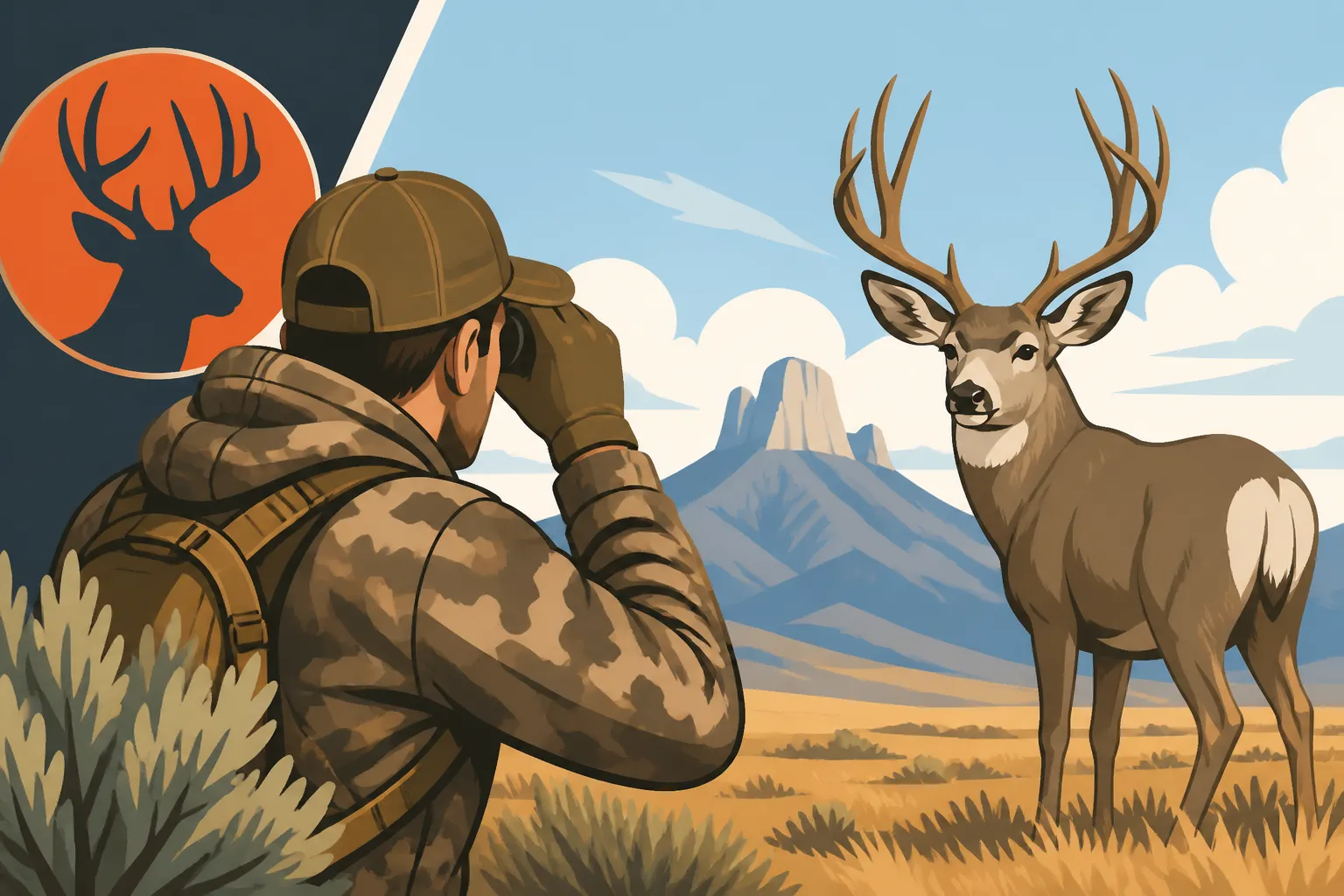
We’ve all been there: that heart-stopping moment when a mule deer buck, the one you’ve been dreaming about, suddenly appears across a vast Wyoming basin or slips through a patch of timber. Your heart pounds, adrenaline floods your system, and you’ve got mere seconds to decide if it’s the one before it vanishes into the landscape. This guide is all about equipping you with the knowledge and strategies to quickly and effectively field judge a mule deer buck, helping you make confident decisions when it matters most.
The Pressure Cooker: Why Quick Field Judging Matters and Why It's So Hard
Hunting mule deer in Wyoming is an experience unlike any other. The landscapes are immense, the air is thin, and the deer are often on the move. When a buck finally presents itself, whether it's a distant glimpse through your spotting scope or a fleeting encounter in the sagebrush, the clock is ticking. You need to be able to assess that animal quickly and accurately, because hesitation can mean a missed opportunity, and a misjudgment can lead to disappointment back at camp.
The Fleeting Moment: When Seconds Count
Mule deer are masters of their environment, especially the mature bucks that have survived multiple hunting seasons. They often don't linger. You might catch a buck crossing a distant ridge, or see it emerge from a coulee for only a few moments before it dips back into cover. In these situations, you don't have the luxury of endless glassing. You have to make a snap judgment based on what you see, often through bouncing binoculars or a quickly deployed spotting scope. The pressure is immense, and that adrenaline surge, while exciting, can actually make it harder to objectively assess antler size. It's easy for every buck to look like a monster when your heart is hammering in your chest.
Compounding this challenge is the sheer size of Wyoming's hunting units. You could be glassing across miles of open country, and what looks like a respectable buck at two miles might appear quite different when you finally get closer. That brief window for evaluation demands a practiced eye, an understanding of key antler characteristics, and a disciplined approach to avoid letting excitement override your judgment. It's a skill that takes time to hone, but understanding the fundamentals is the first step.
The "Ground Shrinkage" Phenomenon
Ah, "ground shrinkage." Every hunter knows it, and most have experienced it. It’s that deflating feeling when the buck you spent hours stalking, the one that looked like a Boone and Crockett contender through your high-powered optics, suddenly appears significantly smaller once you walk up to it. This phenomenon isn't just a mental trick; it's a result of various factors, including distance, lighting, angle, and the sheer exhilaration of the hunt. Our brains want to see the biggest buck, and our eyes, especially when straining at long range, can sometimes oblige.
Minimizing ground shrinkage is precisely why quick, accurate field judging is so crucial. You want to walk up to your buck feeling a sense of satisfaction, knowing that what you saw through the glass translated accurately to what you now hold. It’s about managing expectations and developing a keen eye that can cut through the excitement and the visual distortions of the field. A good judge learns to account for these factors, leading to more consistent and gratifying harvests.
The Core Elements: What to Look For and How to Prioritize
When you've got a mule deer in your crosshairs, or even just in your glass, your brain needs a rapid checklist. You can't spend five minutes pondering every detail; you need to quickly identify the most important characteristics that contribute to a buck's overall size and quality. Focusing on these core elements in a specific order can help streamline your decision-making process, especially under pressure.
Width: The First Impression and the "Ear-Tip" Rule
Width is often the first characteristic that catches a hunter's eye, and for good reason. A wide-racked buck commands attention. It’s usually the easiest dimension to gauge quickly, especially if the buck is standing broadside. Many hunters use the "ear-tip" rule as a quick mental benchmark: if a buck's antlers are noticeably wider than its ear tips, it’s generally considered a good starting point for a mature animal.
However, the ear-tip rule isn't foolproof. A buck's ears can be laid back, perked forward, or oriented differently depending on its mood or what it's focusing on. An older, heavier-antlered buck might not always appear significantly wider than its ears if its ears are fully alert and forward. Still, as a rapid, initial assessment, it provides a decent baseline. When you're glassing, try to envision an imaginary line extending from each ear tip. If the main beams extend beyond this line, that’s a positive sign for width. This quick check can save you from a long, arduous stalk on a narrower buck.
Mass: The Foundation of a Great Rack
While width makes the first impression, mass is arguably the most critical component of a truly impressive mule deer rack and often overlooked by novice judges. Mass refers to the circumference or thickness of the antlers, particularly the main beams. Imagine the difference between a thick oak branch and a thin willow stick; the oak has more mass. A buck with good mass will have main beams that appear heavy and robust, especially at the bases where they meet the skull, and this thickness should carry through the entire length of the beam, even into the forks.
Mass adds significant character and score to a buck. You might see a buck that looks wide, but if the beams are spindly, it will lack that "wow" factor. Conversely, a buck that isn't exceptionally wide but carries incredible mass throughout its antlers will often look much bigger and more impressive than its actual width might suggest. When you're field judging, train your eye to look past just the points and width; focus on the girth of the main beams. A great way to learn this is to look at photos of bucks with documented scores. Websites like GoHunt often feature trophy photos, allowing you to visually compare how mass contributes to overall antler aesthetics. It's a subtle but crucial detail that separates good bucks from great ones.
Tine Length: Counting Points and Assessing Height
Tine length is what most hunters initially focus on, often counting points and immediately assigning a label like "4×4" or "3×3." While tine length absolutely contributes to a buck's score and overall appearance, it shouldn't be the only factor you consider. A buck with many short tines might not be as impressive as a buck with fewer, but exceptionally long and thick tines. Long tines, particularly the G2s (the second points up from the base) and G3s, add height and depth to the rack, making the buck appear taller and more majestic.
When assessing tine length, try to compare the length of the tines to the length of the main beam. Are they proportionate? Are they all relatively uniform, or does one side have particularly stunted tines? For typical mule deer, you're generally looking for well-formed G1s (brow tines), G2s, and G3s, often with a smaller G4 on larger animals. Don't let the sheer number of points distract you from their quality and length. It's a common mistake to get fixated on point count and overlook other crucial elements like mass or width. Remember, a clean, long-tined 4×4 with great mass and width will almost always outscore a junky 5×5 that lacks those other attributes.
Overall Frame and Symmetry: Putting it All Together
Once you've quickly assessed width, mass, and tine length, take a step back (mentally, of course) and look at the buck's overall frame and symmetry. Does the rack appear balanced? Does one side seem significantly different from the other? A symmetrical, well-proportioned rack is often a hallmark of a mature, healthy buck and contributes greatly to its aesthetic appeal and typical score. Even if you're not a trophy hunter strictly adhering to scoring rules, a balanced rack simply looks better.
Sometimes, bucks will have non-typical points – extra tines that don't conform to the typical antler structure. These can add character and appeal for some hunters, but for those interested in a "typical" score, they can actually detract. Regardless of your preference, getting a sense of the overall frame helps confirm your initial impressions. Does the rack rise proudly above its head? Does it have a "basket" like appearance, or is it more spread out? This overall assessment helps you consolidate all the individual elements into a single, comprehensive judgment, allowing you to decide confidently if this is the buck you want to pursue.
Practical Strategies for On-the-Fly Judgement in Wyoming
Wyoming's vastness and the elusive nature of its mule deer require a disciplined approach to field judging. You can't just rely on gut feeling. Incorporating specific techniques and being aware of environmental factors can significantly improve your accuracy when those crucial moments arrive. From knowing your gear to understanding the light, every detail can make a difference.
Practice with Optics, Not Just Photos
One of the best ways to improve your field judging skills is to practice, practice, practice with the actual optics you'll use in the field. Reading articles and looking at trophy photos online is great for learning the theoretical aspects, but it doesn't prepare you for the real-world challenge of spotting a buck at long range, through heat shimmer, or in fading light. Spend time during the off-season, or even during a scouting trip, glassing every deer you see, regardless of its size. Try to quickly identify its width, mass, and tine length.
Focus on comparing animals to each other. How does that young 2×2 compare to a more mature 3×3 you spotted earlier? The more you train your eye to see these nuances through your binoculars and spotting scope, the faster and more accurate you’ll become when a true shooter buck appears. Investing in good glass is paramount for hunting in Wyoming's expansive terrain, where Optics Power for Wyoming's Long Sightlines is a real advantage. The better you know your gear and how it performs in various conditions, the less it will be a variable in your judgment.
Reference Points: What's Nearby?
Mule deer in big country can be incredibly deceptive when it comes to size. A buck standing alone in a vast, featureless basin can look enormous simply because there's nothing around to provide scale. This is where using natural reference points becomes invaluable. If possible, try to compare the buck's antlers or body size to nearby objects. Is there a sagebrush bush that's a known height? A fence post? A rock outcropping? Even distant trees can sometimes provide a vague sense of scale, although this requires careful estimation.
Another effective, though sometimes less available, reference is another deer. If the buck is with does or younger bucks, you can compare its body size and antler development to those animals. A truly mature buck will have a noticeably larger, deeper body, thicker neck, and more developed shoulder muscles than a doe or yearling. This can help confirm that you're looking at a physically mature animal, which typically correlates with larger antlers. Always be mindful that the flatter the terrain, the more distorted your perception of distance and size can become.
Angle and Light: The Deceivers
The angle at which you view a buck, and the available light, can dramatically alter your perception of its antler size. A buck standing perfectly broadside offers the best view for assessing width and the overall configuration of the rack. However, deer rarely cooperate by posing for you. If a buck is quartering towards you or away, its width can be significantly foreshortened, making a wide buck appear much narrower than it is. Conversely, a buck quartering slightly can sometimes create an illusion of depth that makes it seem more massive than it truly is.
Lighting conditions are equally important. Early morning and late evening light, while beautiful for photography, can cast long shadows that obscure mass or hide tines, making it difficult to get a clear read on the rack. Mid-day sun, while bright, can wash out details and create glare, particularly on shiny antlers. Overcast days often provide the most consistent and forgiving light for field judging, as shadows are softer and details are clearer. When you're trying to judge a buck, try to adjust your position if possible to get a broadside view, and be acutely aware of how the light and shadows might be playing tricks on your eyes.
When in Doubt, Pass (or Go for It!)
Ultimately, the decision to take a shot comes down to you. There will be times when, despite all your efforts, you just can't get a clear, confident read on a buck's antlers. Maybe the light is bad, the angle is terrible, or it's simply too far away. This is where setting personal thresholds before the hunt really helps. Do you have a minimum score you're looking for? A specific number of points? Or are you simply looking for a mature, legal buck for the freezer?
If your goal is a specific class of animal and you have doubts, it's often better to pass and hold out for another opportunity. There’s no shame in letting a buck walk if you’re not sure it meets your criteria. The mountains will always hold more deer. However, if your goal is simply a legal mule deer and you have a clear, ethical shot, then don't second-guess yourself too much. Many hunters find immense satisfaction in harvesting any legal animal. The key is to make a conscious decision based on your predetermined goals, not just on adrenaline or fear of missing out.
Tools and Resources for Sharpening Your Eye
In today's hunting world, we have more resources than ever to help us become better, more informed hunters. Leveraging these tools, from digital apps to educational materials, can significantly enhance your field judging capabilities, even before you step foot in the Wyoming backcountry. Knowing what's out there can give you a substantial edge.
Apps and Digital Scouting
Modern technology has revolutionized how we approach hunting, and digital scouting is a prime example. Apps like GoHunt or onX Hunt are incredibly powerful for understanding terrain, identifying potential bedding areas, and mapping out approach routes long before opening day. This pre-season preparation, often called E-Scouting a Unit Before the Season Opens, can indirectly help with field judging. By knowing the typical caliber of bucks in a specific hunt unit, you can adjust your expectations and quickly identify if a sighted buck matches the potential of the area.
Furthermore, some of these apps allow you to mark specific sightings or even take screenshots with estimated distances, which can be reviewed later. While they won't judge a buck for you, they create a framework of knowledge. If you've spent hours virtually scouting a particular canyon and know it consistently holds mature bucks, your confidence in judging a large animal there will naturally be higher. These digital tools are about setting the stage for success, giving you more time to focus on the animal when the moment comes.
Studying Score Sheets and Trophy Photos
Understanding what makes a high-scoring mule deer involves delving into the official scoring systems, like Boone and Crockett or Pope and Young. While you might not be chasing a world record, familiarizing yourself with these score sheets helps you break down a buck's antlers into quantifiable components: main beam length, circumference (mass), tine length, and spread. By studying how these elements are measured and weighted, you'll develop a more critical eye for individual antler characteristics in the field.
Beyond just the numbers, spend time looking at high-quality trophy photos from Wyoming. Focus on bucks of various sizes and scores. Pay attention to how the mass carries, the sweep of the main beams, the length of the tines, and the overall symmetry. Sites like GoHunt often highlight successful hunts and trophy animals, giving you excellent visual examples. The more mental "data" you collect by observing these photos, the more quickly your brain will be able to process and compare when you spot a live buck. For instance, while it focuses on a different species, studying "Boone and Crockett Elk Taken in Wyoming" can still teach you about what contributes to a high-scoring rack in general.
Guided Hunts as a Learning Experience
For those who are serious about quickly improving their field judging skills and are willing to invest, a guided hunt can be an unparalleled learning experience. While the cost of a guided hunt, especially for elk, can be significant (as detailed in "What a Guided Wyoming Elk Hunt Costs"), the value in terms of education is immense. Reputable outfitters and their guides spend countless hours in the field, observing deer, and making split-second decisions. Their experience is a treasure trove of knowledge you can tap into.
During a guided hunt, you'll have the opportunity to ask questions, listen to your guide's commentary as they glass and judge animals, and often get real-time feedback on your own observations. They can point out subtle cues in body language, antler structure, and age that might take years to learn on your own. It's an immersive classroom experience that accelerates your learning curve, helping you understand not just what to look for, but how to look for it efficiently and accurately in the demanding environment of a Wyoming hunt.
| Judging Criteria | What to Look For | Common Mistakes | Why It Matters |
|---|---|---|---|
| Width | Beyond ear tips (broadside view), overall spread | Estimating width from poor angles, letting distance deceive | Initial "wow" factor, contributes to overall score and impressive look |
| Mass | Circumference of main beams, especially bases and forks | Overlooking thickness for tine length/width, shadows obscuring detail | Foundation of a heavy, mature rack, adds significant score and bulk |
| Tine Length | Length of G1s, G2s, G3s (and G4s), proportion to beams | Point counting over quality, ignoring balance with mass | Adds height and depth, contributes to score, aesthetic appeal |
| Overall Frame | Symmetry, balance, typical vs. non-typical | Fixating on one side, ignoring balance, mistaking non-typical for score | Defines the buck's overall appearance, indicative of maturity |
| Body Size | Deep chest, thick neck, mature muscle development | Assuming big antlers mean big body (or vice versa) | Confirms age and maturity, often correlates with antler growth |
Disclaimer
This article is for general informational purposes only and does not constitute professional advice. Laws, prices and regulations vary by location and change over time. Consult a qualified professional for guidance on your specific situation.