Reading Wind on an Open-Country Stalk
There’s almost nothing more frustrating than putting in hours, maybe even days, of scouting, drawing a coveted tag, and finally spotting that trophy animal only to have your entire stalk blown by an unpredictable gust of wind. In Wyoming’s vast, open country, the wind isn't just a nuisance; it's a constant, often bewildering, force that can make or break your hunt. This guide is dedicated to helping you decipher those invisible currents, understand how they interact with the landscape, and ultimately, use them to your advantage on every open-country stalk.
Understanding the Unseen: The Basic Principles of Wind
Before we can even think about stalking, we need to get a handle on the very basics of how wind behaves, especially in the unique environment of Wyoming. It’s not just a steady breeze; it's a complex dance of air currents influenced by temperature, topography, and even the time of day. Ignoring these fundamentals is like trying to navigate a dark timber elk hunt without knowing how to read fresh elk sign in dark timber.
Updrafts and Downdrafts: The Thermal Dance
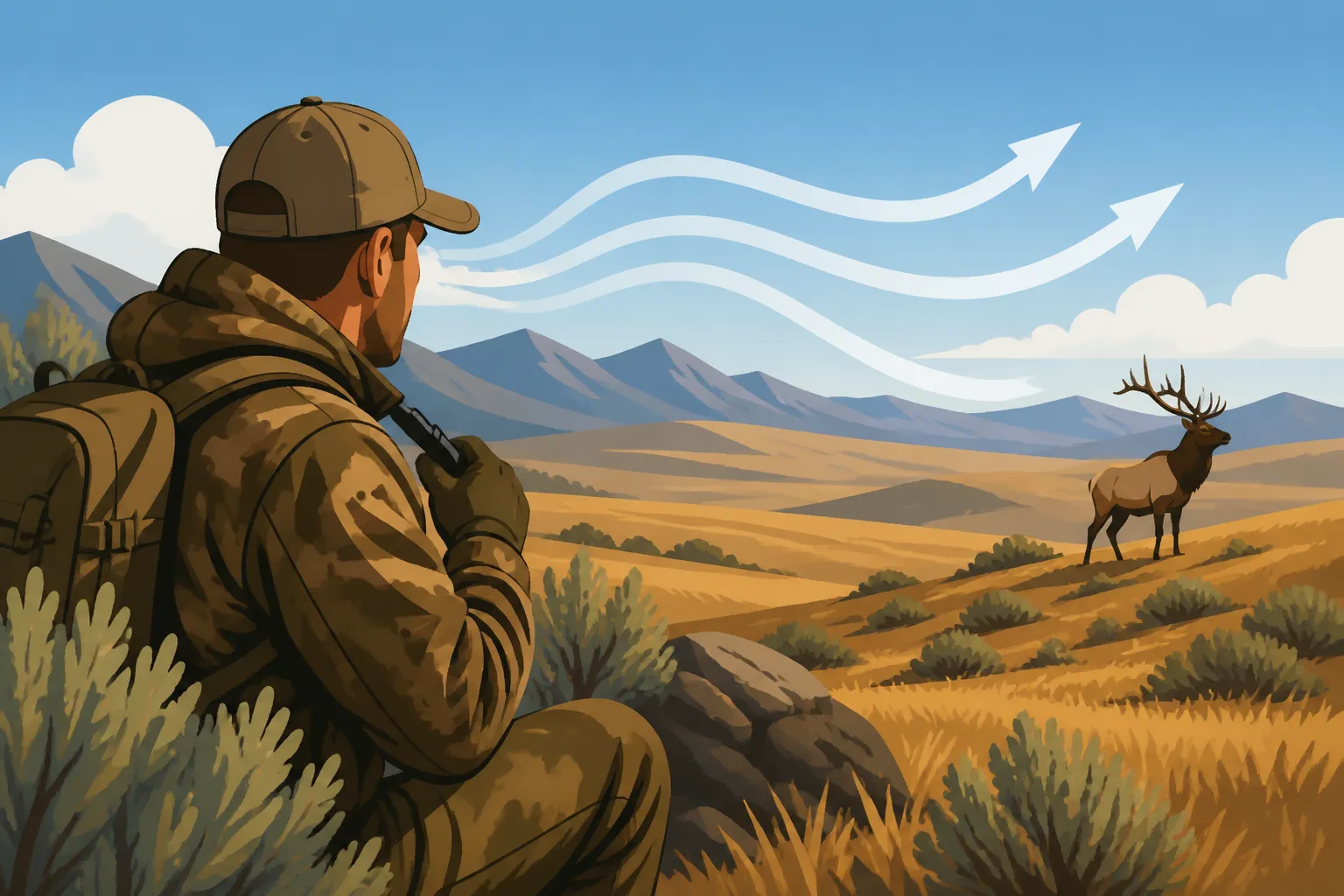
Anyone who has spent time in the mountains knows that the wind doesn't just blow from one direction all day. As the sun rises, the ground and air begin to warm, especially on sun-exposed slopes. This warming air rises, creating an updraft. You'll notice this in the mornings, where the wind tends to blow uphill. It's often subtle, a gentle lift that carries your scent up and away from animals below you. A good rule of thumb is that if the sun is warming the ground, the air is likely rising.
Conversely, as evening approaches and the sun dips below the horizon, the earth cools much faster than the air. This cooler, denser air sinks, creating a downdraft that pushes wind downhill. This thermal shift is a critical piece of information for any hunter, as it completely reverses the direction of scent dispersal. A downdraft can carry your scent directly to animals below you, which might have been safe during the morning's updraft. Understanding this daily cycle is paramount when planning your approach or even deciding where to set up for an evening glassing session. You might find that the very ridge that offered a perfect crosswind earlier in the day becomes a scent-bombing hazard in the afternoon.
Crosswinds and Swirling Winds: The Hunter's Nemesis
Crosswinds, where the wind blows perpendicular to your line of travel, seem like a safe bet on paper. You’re not blowing scent directly at or behind the animal. However, in open country, a "true" crosswind is a rare gift. What often happens, especially around broken terrain, hills, or even large rock formations, is that these crosswinds turn into swirling winds. These are the true hunter's nemesis, the invisible currents that seem to mock your best efforts. They can shift direction abruptly, creating unpredictable eddies that carry your scent in all directions, sometimes even back towards you.
Swirling winds are a particular challenge in areas with varied topography, such as the mixed sagebrush and rocky outcroppings you find in much of Wyoming's deer and antelope country. They can also be prevalent when the overall wind speed is low, allowing smaller, localized thermals and obstructions to have a greater influence. When you encounter these conditions, a good stalk becomes less about a direct approach and more about a series of short, carefully executed moves, constantly checking the wind and adjusting. It's in these moments that patience isn't just a virtue; it's a survival skill for your hunt.
Practical Tools and Techniques for Wind Assessment
Knowing the theory of wind is one thing, but actually reading it in the field is another challenge entirely. Wyoming’s vast landscapes offer few visual cues, making accurate wind assessment a crucial skill. You can’t just guess; you need reliable methods to confirm what the air currents are doing at any given moment.
Wind Checkers and Powders: Your Best Friend in the Field
When you’re out there on an open-country stalk, especially when you're trying to figure out playing wind direction on an open sagebrush stalk, commercial wind checkers are truly indispensable. These little bottles typically contain super-fine, odorless powder that, when squeezed into the air, floats along with the slightest breeze. The beauty of these tools is their immediate feedback. You can see precisely which way the air is moving at your exact location, and often, how it might be swirling or changing direction due to nearby terrain features.
I’ve had countless moments where what I thought the wind was doing based on distant flags or even what I felt on my face was entirely different once I puffed a little powder. That powder might show the wind carrying my scent left for a second, then swirling slightly right, giving me the critical insight needed to adjust my angle or even pause the stalk. Keep it easily accessible in a chest pocket or on a lanyard, because you’ll be using it constantly, especially as you get closer to your target.
Reading Vegetation and Dust: Natural Indicators
While manufactured wind checkers are fantastic, nature itself provides a wealth of subtle clues if you know how to look. Observe how tall grasses or the tips of sagebrush move. Even a gentle ripple through a field of native grasses can indicate direction, and more importantly, how strong the wind might be. Pay attention to the underside of leaves on trees; a sudden exposure can mean the wind is picking up or shifting.
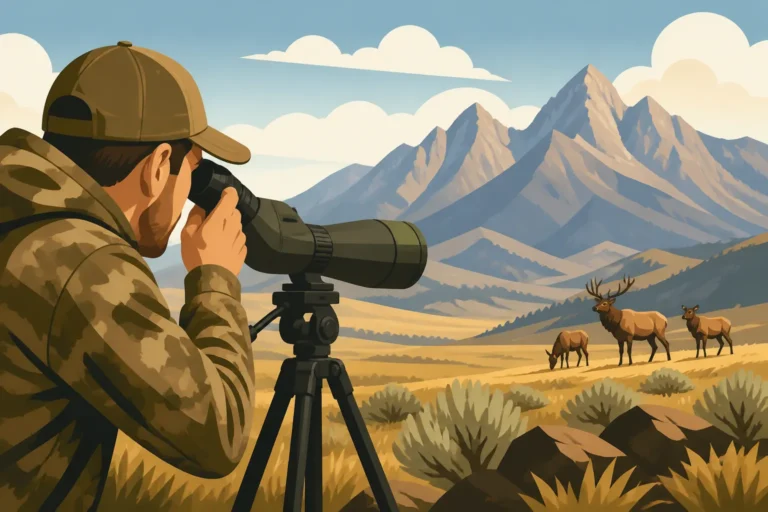
Dust is another powerful indicator. On dry, exposed areas, a small puff of dust lifting off the ground, or even a visible haze moving through the air, will show you exactly what the wind is doing. This is particularly useful in wide-open basins or on a flat expanse. While not always present or as precise as a powder, learning to constantly scan the natural environment for these subtle movements will make you a much more observant and effective hunter. It’s about becoming attuned to the landscape, much like learning to spot distant animals when glassing Wyoming basins before you take a step.
Using Weather Apps and Topography Tools
In this day and age, technology offers a huge advantage, especially when planning your approach. While you should never rely solely on an app once you're in the field, they are invaluable for pre-hunt planning and understanding the general conditions. Apps like GoHunt provide detailed wind forecasts, including speed and direction, often broken down by hour and even elevation. They can also integrate with mapping features, showing you how wind might interact with the specific topography of your chosen hunt area.
Before you even leave your truck, you can pull up your map, identify your target animal's location, and then use the app to predict how the wind might behave around that particular ridge or draw throughout the day. This allows you to plan multiple approach routes, each tailored to different wind scenarios. However, remember that these are forecasts. Once you're on the ground, always verify with your wind checker and natural indicators, as micro-climates and localized thermals can create variations not captured by broad weather models.
How Topography Dramatically Influences Wind Patterns
Wyoming's diverse landscape is a master at redirecting, intensifying, and confusing wind patterns. What looks like a gentle breeze from a distance can be a violent gale on a ridge or a swirling vortex in a canyon. Understanding how different terrain features sculpt the wind is arguably the most critical lesson for success in open country.
Wind Across Open Basins and Plains
The vast, expansive basins and plains that define so much of Wyoming—think the Red Desert or the Carbon County plains—present unique challenges for wind. Here, the wind often has nothing to slow it down, leading to consistent, high-speed gusts that can be brutal. However, even in these seemingly flat areas, subtle topographical features can create havoc. Small rises, shallow coulees, or even patches of taller sagebrush can create localized turbulence, making your scent swirl unexpectedly.
When you're stalking across these wide-open spaces, anticipate that the wind will generally follow the broadest contours of the land, but be prepared for it to pick up speed and potentially become less predictable as it sweeps over small obstructions. This is where those short, patient bursts of movement, interspersed with frequent wind checks, become absolutely vital. You might plan to move with a prevailing crosswind, only to find it suddenly shifting into a headwind or even a tailwind as you drop into a subtle depression or crest a small, unassuming rise.
Navigating Draws, Valleys, and Canyons
Draws, valleys, and canyons are natural funnels for wind, but they don't always behave predictably. In the morning, as the sun warms the slopes, you'll often experience strong updrafts pushing air (and your scent) uphill. This can be an excellent opportunity to approach from below if your target is higher on the slope. However, as the day progresses and especially in the evenings, these same draws become conduits for cold, heavy air to drain downhill, creating powerful downdrafts.
What’s more, the shape of the canyon or draw can create Venturi effects, where the wind accelerates as it's squeezed through a narrower opening. It can also cause wind to "bounce" off one side and swirl back up the other. When working along a draw or through a canyon, always be mindful of which side the sun is hitting, as this will heavily influence thermal drafts. Using cutbanks and draws to close on antelope, for example, requires an acute awareness of these shifting air currents; what provides cover might also funnel your scent directly to your quarry if you're not careful.
Timber and Treeline Effects
While much of Wyoming is open, many huntable areas feature pockets of timber or extensive treelines, especially in the mountains like the Bridger-Teton National Forest or the Bighorn National Forest. These forested areas act as significant windbreaks, creating calm pockets on their leeward side (the side protected from the wind). This can be a double-edged sword: while it might offer a quieter, less exposed approach, the abrupt transition from calm air to high wind at the treeline can be jarring, and your scent could still be picked up by animals just outside the calm zone.
Conversely, wind hitting a dense treeline can be forced upward, creating a "dome" effect where air actually flows over the trees before dropping down again. This can be an advantage if you're approaching from directly downwind of a timbered area, as your scent might be carried high above the animals. However, winds can also funnel through gaps or saddles in the timber, creating concentrated blasts that are incredibly difficult to predict. When hunting near timber, observe how the trees themselves react to the wind; their swaying branches and rustling leaves are direct indicators of both wind direction and intensity.
Stalking Strategies with Wind as Your Ally
The goal isn't just to avoid getting busted by the wind; it's to actively use it to your advantage. A truly successful hunter in Wyoming understands how to integrate wind assessment into every step of their stalk, turning an invisible enemy into a silent partner.
The "Wind Clock" Approach: Master Your Angle
One of the most effective strategies in open country is to visualize your target animal at the center of a clock face. Your approach should always aim to keep your scent at the "six o'clock" position relative to the animal. This means you’re either directly downwind or slightly quartering downwind. However, the wind rarely cooperates perfectly. Instead of aiming for a fixed six o'clock, think of it as a flexible zone.
If the prevailing wind is a steady breeze from, say, the west, and your animal is facing north, you'll want to approach from its east or southeast. You’re aiming for an angle that keeps your scent moving away from the animal, not towards its nose. This often means taking a longer, more circuitous route that might feel inefficient at first. Resist the urge to go straight at the animal. A successful stalk might involve a mile-long loop to gain a hundred yards on your target, simply to stay in that safe wind window. This is where scouting a Wyoming unit from your kitchen table with tools like onX can really help you plan these elaborate approaches.
Waiting Out Unfavorable Winds
Sometimes, the best stalking strategy is no strategy at all—it’s patience. If you’ve spotted an animal in a promising spot, but the wind is absolutely wrong for an approach, don’t force it. Trying to push through swirling winds or a direct tailwind is a recipe for disaster and will likely educate the animal, making a future stalk even harder. Instead, evaluate your options:
- Wait for a shift: Thermals change, and sometimes a stronger, more predictable wind will materialize later in the day. Settle in, observe the animal, and keep checking your wind.
- Relocate: Is there another animal in a better position relative to the wind? Can you back out and try a different area entirely?
- Set up an ambush: If the animal is on a predictable travel route, can you get ahead of it and wait for it to move into a favorable position, utilizing available cover?
- Re-evaluate the target: Sometimes, that "trophy" just isn't worth the impossible wind conditions. There might be other opportunities with better odds.
This level of patience requires discipline, but it’s a hallmark of experienced hunters. The mountain isn't going anywhere, and often, neither is the animal for a few hours.
Adjusting on the Fly: Dynamic Stalking
Even with the best pre-planning, Wyoming's wind can be incredibly dynamic. You might start a stalk with a perfect crosswind, only to have it shift unexpectedly halfway through. This is where your ability to adjust on the fly becomes critical.
- Constant Wind Checks: Don't just check the wind once; check it every time you pause, every time you change elevation, and every time you emerge from behind cover. A quick puff of a wind checker takes seconds and can save your hunt.
- Micro-Adjustments: If the wind shifts slightly towards the animal, don't panic. Can you angle yourself a few degrees more downwind? Can you drop into a shallow depression for a few yards, creating a temporary barrier for your scent?
- Utilize Terrain: Use every available piece of terrain—a small hill, a rock outcropping, a patch of thick sagebrush—to break up your outline and, just as importantly, to create temporary wind shadows or redirect your scent. Remember, terrain that hides an approach might also alter wind direction.
- When to Retreat: Know when to fold 'em. If the wind becomes truly unpredictable and consistently carries your scent towards the animal, sometimes the smartest move is to back out quietly and try again another day, or approach from an entirely different direction. It's better to preserve the opportunity than to blow it trying to force an impossible stalk.
Common Wind Mistakes and How to Avoid Them
Even seasoned hunters can fall prey to subtle wind mistakes, especially when the adrenaline kicks in. Recognizing these common pitfalls and consciously working to avoid them will significantly increase your odds of success in Wyoming’s challenging conditions.
Ignoring Subtle Changes and Micro-Thermals
One of the biggest mistakes is assuming the wind is static once you've checked it. Open country, particularly with varied terrain, is a mosaic of micro-climates and localized thermals. A subtle shift in sun exposure on a hillside, a small rock face warming up, or even a sudden patch of shade can create miniature updrafts or downdrafts that completely override the prevailing wind for a few dozen yards.
The danger lies in the hunter's natural tendency to focus intensely on the animal and overlook these more nuanced environmental cues. You might feel a consistent breeze on your face, but a small puff of wind powder could reveal a swirl directly at the deer just 50 yards ahead. It’s imperative to maintain situational awareness, constantly scanning for natural indicators like grass movement, dust, or even the subtle shivering of aspen leaves, in addition to frequent mechanical wind checks. Never assume. Always verify.
Relying Solely on Digital Tools
While modern hunting apps like GoHunt are incredibly useful for planning and understanding regional weather patterns, they are not a substitute for real-time, on-the-ground observation. An app might predict a steady 10 mph breeze from the north, but that forecast doesn't account for the localized downdraft created by a shaded canyon you're about to cross, or the swirling current that bounces off a sheer rock wall.
Over-reliance on digital tools can lead to a false sense of security. You plan your approach based on the predicted wind, commit to it, and then find yourself busted because the actual conditions were completely different at your precise location. Use technology as a planning aid, but once you’re out of the truck and actively hunting, your senses, your wind checker, and your understanding of how terrain influences wind should be your primary guides. The most accurate wind report is the one you get from nature itself, right where you stand.
Not Having a Backup Plan or Alternative Routes
Perhaps the most common mistake when it comes to wind is committing to a single approach without considering alternatives. You spot an animal, identify what seems like the "perfect" route, and fixate on it. But what happens when you’re halfway there and the wind unexpectedly shifts 90 degrees? If you haven't thought about a backup plan, you're left scrambling, making rushed decisions that often lead to failure.
Before you even start a stalk, take a moment to look at the surrounding topography and consider two or three potential routes, each accounting for different wind directions or shifts. What if the wind shifts from a crosswind to a headwind? Can you drop into a depression or circle wide to stay out of the animal's line of scent? What if it switches to a tailwind? Is there a piece of terrain you can quickly get behind to buy yourself time or make a strategic retreat? By mentally mapping out these contingencies, you’ll be much better equipped to adapt to Wyoming's notoriously fickle winds and maximize your chances for a successful, ethical shot. This is a crucial aspect of overall hunt planning, much like understanding whether suppressors are legal for big game or knowing how to identify mountain lion quotas by hunt area.
| Wind Type | Characteristics | Terrain Effects | Stalking Strategy |
|---|---|---|---|
| Updraft | Gentle upward movement, common mornings | Sun-exposed slopes, open ridges | Approach from below, use rising thermals to carry scent up and away. |
| Downdraft | Downward movement, common evenings, shaded areas | Shaded canyons, steep valleys, after sundown | Avoid approaching from above; your scent will sink directly to animals below. |
| Crosswind | Perpendicular to target, seems ideal | Can become swirling around obstacles, subtle terrain | Maintain angle, be ready for shifts, use terrain to enhance crosswind. |
| Swirling Wind | Unpredictable, shifts rapidly, localized | Broken terrain, draws, timber edges, low overall wind | Frequent wind checks, slow movements, short bursts, utilize micro-terrain for cover/direction. |
| Prevailing Wind | Consistent, dominant direction, often strong | Open basins, long ridges, high elevations | Plan long loops to stay downwind, use terrain to block or redirect strong gusts. |
| Funnelling Wind | Intensified wind through narrow passages | Canyons, saddles, gaps in timber | Anticipate increased speed; these can be predictable but also amplify your scent dispersal. |
Disclaimer
Hunting in Wyoming involves inherent risks. The information provided in this guide is for informational purposes only and is not a substitute for professional guidance, thorough preparation, or adherence to all Wyoming Game and Fish Department regulations. Always prioritize safety, respect wildlife, and obtain the necessary licenses and permits before venturing into the field. Conditions can change rapidly, and responsible hunting requires constant vigilance and adaptation.