Spotting Scope Power for Open Country Glassing
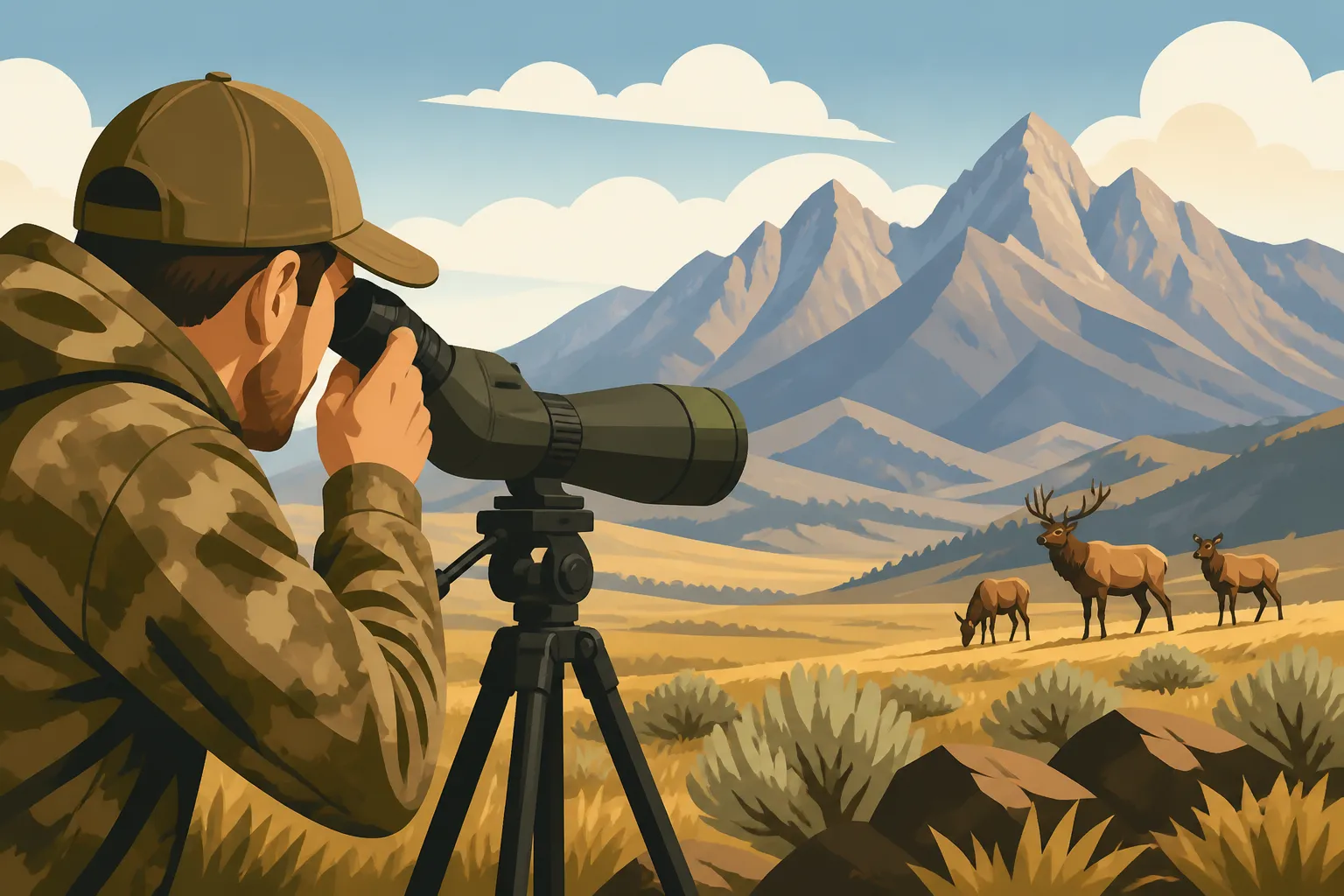
There’s nothing quite like the immense, wide-open country of Wyoming, is there? You step out of the truck or crest a ridge, and the landscape just stretches forever. It’s breathtaking, but as hunters, we all know that awe can quickly turn into frustration when you’re trying to spot a bedded mule deer or a distant herd of elk in that vastness. Binoculars, even good ones, often leave you wanting more, struggling to resolve a distant flicker of movement or confirm if that brown patch is truly a buck. This guide is all about cutting through that frustration, helping you understand how spotting scope power works and what magnification you truly need to conquer Wyoming’s long sightlines.
Understanding the Lay of the Land: Why Wyoming Demands Specific Optics
Wyoming's hunting landscape is a beast of its own, far different from the thick timber or smaller, more broken terrain you might find elsewhere. Here, your eyes are your most powerful tool, but they need some serious help to reach out and touch the horizon.
The Sheer Scale of Wyoming's Terrain
You know the feeling. You’re sitting on a high vantage point, maybe somewhere in the Red Desert or overlooking a massive basin in the Bighorn Mountains, and the sheer scale of it all hits you. You can see for miles, literally tens of thousands of acres laid out before you. A deer or an antelope that would be a clear, identifiable animal at 300 yards in a smaller state becomes a barely perceptible speck at a mile or two. The sagebrush, the distant timber, the rock outcroppings – they all conspire to swallow up game.
It’s easy to get discouraged when you spend hours grid glassing, sweeping your optics across distant hillsides, only to feel like you’re staring at a painting rather than a landscape teeming with life. That sense of "Are they even out there?" is a common one, driven by the challenge of discerning fine details over massive distances. The flat light, the heat shimmer rising off the plains, or the deep shadows in a canyon only compound the problem, making an already difficult task feel almost impossible without the right tools.
This immense visibility means your initial spot might be at an incredible distance, far beyond what you'd consider a shooting range. You might see a flash of antler or a rump patch two or three miles away. That's not just "far," that's "requires specialized equipment to even begin to process." Without the right magnification, that distant animal remains just a blurry potential, a tantalizing hint of what might be there, forever out of clear focus.
The Limitations of Binoculars in Open Country
We all love our trusty binoculars. For quick scans, for getting on an animal after it's been spotted, or for shorter-range work in denser cover, they're indispensable. A good pair of 10×42 or even 12×50 binoculars are fantastic for all-day glassing sessions and are often enough for initial identification, especially if you're close enough. But in Wyoming's expansive landscapes, there's a definite ceiling to their utility.
Trying to use binoculars to repeatedly resolve fine details on an animal two miles away is a recipe for eye strain and a splitting headache. That big mule deer buck you just spotted across the valley might look like a deer, but you won't be able to count points, judge tine length, or assess its overall size and age. Is it a legal buck? Is it the one you've been dreaming of? Your binoculars simply can't provide that level of clarity at such extreme ranges. They blur the lines between a trophy and a "maybe." If you're often finding yourself squinting, trying to make out just a little more detail, that's your signal that your binoculars have hit their limit.
This is where the transition to a spotting scope becomes not just a luxury, but a necessity for serious Western hunters. While binoculars help you find the "haystack," a spotting scope allows you to find the "needle" – the specific animal you're looking for, with enough detail to make an informed decision. For more on how to pick appropriate binos, check out our guide on Binocular Size That Survives an All-Day Glassing Session.
Deciphering Spotting Scope Magnification: What the Numbers Mean
Understanding the numbers on a spotting scope can feel a bit like reading a foreign language, but it's crucial for making an informed choice for your Wyoming adventures. It’s not just about bigger numbers; it’s about how those numbers translate into real-world performance in the field.
Variable vs. Fixed Power: Finding Your Sweet Spot
Spotting scopes primarily come in two flavors: variable power and fixed power. Most hunters gravitate towards variable power, and for good reason, especially when hunting in a state like Wyoming. A variable power scope, often denoted as something like 20-60x, gives you incredible flexibility. You can start at the lower end, say 20x, for a wider field of view to efficiently scan large areas, almost like an super-powered binocular. Once you spot something promising – that distant brown blob or a subtle movement – you can crank up the magnification to 40x, 50x, or even 60x to zoom in and examine it in painstaking detail.
This versatility is invaluable for tasks like grid glassing a basin without missing bucks, where you need to cover ground quickly but then instantly switch to high magnification for detailed inspection. While fixed power scopes (e.g., a straight 30x or 40x) often boast marginally brighter images and perhaps a touch more optical purity at their single magnification, they lack the adaptability that a variable scope offers. The trade-off with variable scopes is that at their absolute highest magnifications, you might notice a slight dimming of the image or a reduction in clarity compared to a fixed power scope designed specifically for that single magnification. However, modern optics have narrowed this gap significantly, making variable power the undisputed champion for most Western hunters.
The Objective Lens Diameter: Gathering All That Light
Beyond magnification, the objective lens diameter is the second most critical number on your spotting scope. This is the large lens at the front of the scope, and its size, measured in millimeters (e.g., 65mm, 85mm), directly impacts how much light the scope can gather. Think of it like the pupil of your eye – the larger it is, the more light it lets in.
Why is this so important? Because as you increase magnification, the image naturally gets dimmer. A larger objective lens compensates for this, ensuring that even at high magnifications, you still get a bright, clear image. This is particularly crucial during those golden hours of dawn and dusk when game animals are most active, but light is at a premium. In Wyoming, where you'll often be glassing into deep shadows or trying to resolve details in the hazy light of early morning, a larger objective lens means the difference between seeing an antler and seeing nothing. An 85mm objective scope, for instance, will perform noticeably better in low light conditions than a 65mm model when both are zoomed to 60x. It allows you to maintain resolution and contrast, which are vital for identifying game at long range.
Here’s a quick overview of common spotting scope specifications:
| Feature | Magnification Range (Typical) | Objective Lens (Typical) | Ideal Use Case | Considerations |
|---|---|---|---|---|
| Compact/Lightweight | 15-45x | 50-65mm | Backcountry backpack hunting, quick glassing sessions, when weight is paramount. Good for general observation of mule deer and antelope at moderate distances. | May struggle in low light or at extreme long ranges (2+ miles). Less detail for trophy judging at max zoom. |
| Mid-Range/Versatile | 20-60x | 65-80mm | Most common choice for Western hunting. Excellent balance of magnification, light gathering, and portability. Perfect for extended glassing sessions of all big game species, allowing for detailed trophy assessment. | A good all-arounder, but still a significant investment in weight compared to just binoculars. |
| High-End/Performance | 20-70x or 25-80x | 85-95mm | Dedicated long-range glassing, particularly for sheep, goats, or trophy elk/mule deer at extreme distances. Exceptional low-light performance and detail resolution. | Heavier, larger, and significantly more expensive. Less portable for deep backcountry hunts. |
| Fixed Power (Less Common) | 20x, 30x, 40x | 60-80mm | Specialized applications where a consistent magnification is always preferred. Often chosen for digiscoping or target shooting due to optical purity. | Lacks versatility for scanning and zooming. Not ideal for varying distances and different game identification needs. |
Optimal Magnification for Wyoming's Diverse Game and Terrain
Choosing the right spotting scope power isn't a one-size-fits-all situation. The species you're hunting and the specific terrain you're in will heavily influence what magnification truly gives you an advantage.
Pronghorn and Mule Deer: When Distance is Your Only Friend
When you're chasing pronghorn across Wyoming's vast, open sagebrush flats, distance is not just a factor; it's the defining characteristic of the hunt. You'll routinely spot these speedsters at distances of 1 to 3 miles, sometimes even further. At such ranges, a 20x or 30x setting on your scope is excellent for initial spotting and identifying basic body shape, but if you want to determine if that's a mature buck, count his points, or check for curl, you'll need to crank it up. Magnification in the 45x to 60x range becomes absolutely essential. This allows you to discern horn length, mass, and prong formation, which are critical for making ethical and legal decisions. Without this detail, you're just guessing, and in Wyoming, a missed opportunity or, worse, a mistaken identity, can be costly.
Mule deer often present similar challenges, especially in the more open, high-desert country or when they are bedded far up a canyon wall in units like the Wyoming Range. They blend in remarkably well, often appearing as just another rock or shadow. After hours of looking through a 15x binocular, a high-power spotting scope like the Zeiss Victory Harpia or Swarovski ATX system lets you pick apart the landscape. The ability to zoom in from 20x for a wide scan to 60x or even 70x means you can meticulously check every clump of timber, every cutbank, and every distant ridge line. It's not uncommon to spot a tiny glint of antler in a shaded ravine two miles away and then spend several minutes evaluating it at maximum magnification. This detailed scouting is often the difference between success and going home empty-handed. Our article on How Far to Stalk a Bedded Pronghorn highlights the importance of detailed glassing before planning your approach.
When you're trying to figure out if that barely visible antler tip belongs to a three-point or a four-point, or if a buck has the width you're looking for, the highest practical magnification is your friend. This is where tools like GoHunt's Insider research can really shine, helping you identify units known for bigger bucks where this level of detail is non-negotiable for target selection. You'll often use the lower powers for initial scanning and finding the animal, but the higher powers are reserved for the critical task of field judging.
Elk and Bear: Timber's Edge and Far-Off Basins
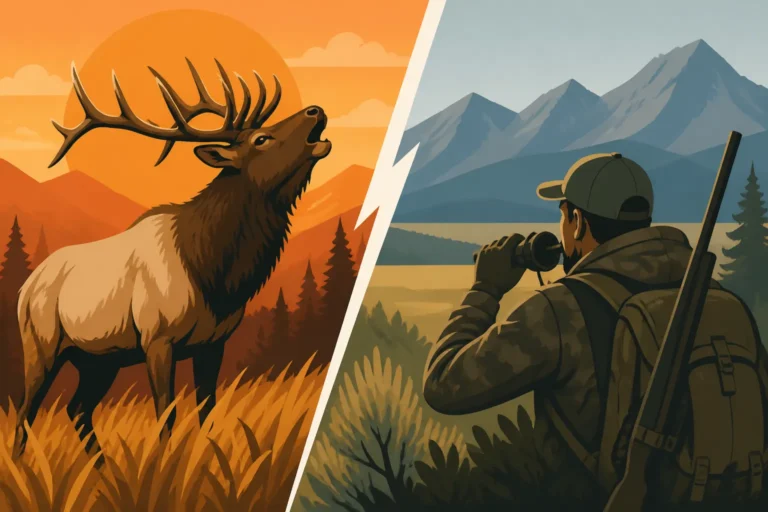
Elk, while often found in or near timbered areas, also spend considerable time in open parks, vast sagebrush basins, or on distant, exposed slopes, especially during the rut when they're vocal and moving. When they're in those open areas, or feeding on a distant hillside a mile or more away, the same high magnification principles apply as with mule deer and pronghorn. You'll need 40x to 60x to judge a bull's antlers, assessing tine length, mass, and overall score. Trying to pick out a legal spike from a cow or a raghorn at 1,000 yards without sufficient power is a recipe for frustration and potential mistakes. This is particularly true when determining if a bull meets specific antler point restrictions Wyoming kept for 2026.
However, when elk are on the fringes of dark timber, or moving through more broken country, your approach might shift slightly. While high power is still good for confirming details, sometimes a more moderate 20x to 40x setting is better for quickly scanning the timber edge for movement or identifying a subtle outline. For bears, whether black bears in a clear-cut or a distant grizzly on a mountainside (remembering where Wyoming's Gray Wolf Trophy Game Area exists and where grizzlies roam!), they often appear as dark blobs against a varied backdrop. Identifying distinguishing features, color phases, or even determining if it's a legal bear to harvest (if in a black bear unit) requires the ability to zoom in tightly. A scope capable of 60x magnification will help you discern subtle differences that confirm what you're seeing. Our comprehensive guide on Wyoming's Elk Herd Units and Winter Range can help you understand the varied terrain where you might encounter these magnificent animals, each requiring a different glassing approach.
Practical Considerations Beyond Just Power
While magnification and objective lens size are paramount, a spotting scope is only as good as the platform it sits on and the comfort it provides during long hours of observation. These practical considerations can make or break your effectiveness in the field.
Tripods: The Unsung Hero of High Magnification
Let's be brutally honest: without a solid, stable tripod, even the most expensive, highest-magnification spotting scope is next to useless. Holding a 20x scope steady freehand is challenging; trying to resolve details at 60x is impossible. The slightest wobble, a faint tremor from your hands or the ground, will render your image blurry and unusable. A good tripod is not an accessory; it’s an absolute necessity for effective long-range glassing.
For Wyoming's diverse terrain, from rocky mountain slopes to open plains, a lightweight yet sturdy carbon fiber tripod with a fluid head is often the ideal choice. Brands like Vortex, Manfrotto, or Gitzo offer excellent options that balance weight for packing into the backcountry with the stability needed for pinpoint precision. The fluid head is critical because it allows for smooth, controlled panning and tilting, which is essential when you're sweeping vast landscapes or tracking an animal's movement. Imagine trying to follow a distant pronghorn moving across a flat with a cheap, jerky tripod – you'll miss half the action. Investing in a quality tripod is just as important as investing in the scope itself, ensuring your Tripod Setup for Glassing From a Vehicle or on foot is rock-solid.
Angled vs. Straight Eyepieces: Comfort in the Field
Spotting scopes typically come with either an angled or a straight eyepiece, and while it might seem like a minor detail, it significantly impacts your comfort during extended glassing sessions. An angled eyepiece (where the eyepiece is set at a 45-degree angle to the scope body) is overwhelmingly preferred by most Western hunters for one simple reason: comfort. When you're spending hours behind the glass, sitting or lying down, an angled eyepiece allows for a more natural head position, reducing neck strain and fatigue. This is especially true when glassing uphill or from an awkward position on uneven terrain.
A straight eyepiece, on the other hand, means you're looking straight through the scope. Some hunters prefer this for quicker target acquisition, as it's more intuitive to "point and shoot" the scope at a distant object. However, for long periods, it often forces you to crane your neck or adopt uncomfortable postures, particularly if your tripod isn't perfectly adjusted. The choice often comes down to personal preference, but if you anticipate long, methodical glassing sessions – which are common in Wyoming – the ergonomic benefits of an angled eyepiece usually outweigh the initial learning curve.
Weight, Portability, and Durability for Wyoming Hunts
Finally, you have to consider the practicalities of carrying your spotting scope into the field. A massive 95mm objective scope might offer incredible optical performance, but if it weighs 5 pounds and you're planning a multi-day backcountry hunt in the Bridger-Teton National Forest, that weight can quickly become a liability. There's always a balance to strike between optical power and portability. For serious backpack hunters, a compact 65mm or even a high-quality 50mm objective scope might be a more realistic choice, sacrificing a little bit of low-light performance for significantly reduced weight.
Regardless of size, durability is non-negotiable. Wyoming weather is famously unpredictable, swinging from sunshine to blizzard conditions in a matter of hours. Your spotting scope needs to be waterproof and fog-proof, capable of withstanding rain, snow, and rapid temperature changes. Nitrogen or argon purging prevents internal fogging, keeping your view clear no matter the conditions. Look for robust construction, armored exteriors, and well-sealed optics to ensure your investment stands up to the rigors of a demanding Western hunt. After all, the best optics in the world are useless if they fail when you need them most out in the vastness of Wyoming.
Disclaimer
Please remember that hunting regulations and seasons in Wyoming can change. Always consult the latest Wyoming Game and Fish Department regulations before planning any hunt. This guide is for informational purposes only and does not supersede official regulations or expert advice from licensed professionals.