Still Hunting Timber for Bedded Mule Deer
If you've spent any time hunting mule deer in Wyoming, you know the frustration of watching them vanish into a dense patch of timber, leaving you wondering how you're ever going to get a shot. Most of us are conditioned to glass vast open country, spot a buck miles away, and then plan an elaborate stalk. But what happens when that majestic animal decides to live its life inside the dark timber, only poking its nose out at dawn and dusk? This guide is for every hunter who's felt that specific brand of helplessness, offering a deep dive into the effective, albeit challenging, art of still hunting for bedded mule deer in the woods.
Understanding Mule Deer Behavior in Timber
Mule deer aren't just in timber by accident; they're there for very specific reasons that directly influence how we should hunt them. Understanding their motivations is the first step to becoming a more effective timber hunter.
Why Mule Deer Bed in Timber
When a mule deer slips into the timber, it's not simply looking for cover; it's seeking sanctuary. These animals, especially mature bucks, are masters of self-preservation. Dense timber provides thermal regulation, keeping them cool on a warm day and sheltered from biting winds or heavy snow. It offers unmatched security, breaking up their silhouette and making them incredibly difficult to spot. Think about it: a patch of thick pines or a stand of aspens with heavy undergrowth offers a deer multiple escape routes and allows them to disappear silently. They often choose bedding sites that provide a commanding view downwind, with thick cover to their backs, allowing them to detect danger approaching from any direction. Often, these bedding areas are close to prime feeding grounds, allowing them to conserve energy by minimizing travel between food and security. Look for north-facing slopes in the warmer months for shade, and south-facing slopes with good sun exposure during colder periods.
Reading the Sign: Tracks, Rubs, and Scrapes
Success in still hunting timber often comes down to detective work. You’re not just walking; you’re reading the forest floor like a book. Fresh tracks, especially larger ones, are your first clue. Pay attention to how fresh they are—are they crisp, or have the edges started to crumble? Are there leaves or debris in them? This tells you if the deer is likely nearby. Rubs, where bucks strip bark from small trees or saplings with their antlers, are another critical piece of the puzzle. The height and diameter of the rub can give you an idea of the buck's size, and fresh rubs indicate recent activity. While less common in dense timber than in more open areas, scrapes—patches of ground cleared by a buck, often urinated in—can also be found and signal a buck actively working an area, especially during the rut. As you're e-scouting a unit before the season opens, pay close attention to timber edges and fingers that extend into open areas, as these are often hotbeds of activity.
Seasonal and Daily Movement Patterns
Mule deer utilize timber differently throughout the year and even throughout a single day. In early fall, as temperatures are still mild, they might seek the shade of the north slopes during the day and move to open feeding areas at dawn and dusk. As the rut approaches, their patterns become more erratic, driven by the urge to breed. Bucks will move more, cruising timber edges and checking doe groups. After the rut and into late season, timber becomes vital thermal cover, especially when harsh Wyoming winter storms roll in. During the middle of the day, when most hunters are taking a break, mule deer are often bedded down, sometimes for hours. This midday lull is precisely when still hunting dense cover can be most productive. Understanding these shifts helps you target your still hunt to the most likely areas at the most opportune times. For example, if you're curious when the mule deer rut actually starts, knowing that information can help you focus on timbered areas that might hold cruising bucks.
Essential Gear and Preparation for Still Hunting
Still hunting requires a specific mindset, but it also demands specific gear that supports that patient, methodical approach. What works for open-country glassing might actually hinder you in the quiet, tight confines of timber.
Footwear and Clothing for Stealth
Your feet are your primary tool for communication with the forest floor, and what you put on them matters immensely. Quiet, flexible footwear is paramount. Heavy, stiff mountaineering boots, while great for rugged climbs, can be clunky and loud. Look for boots with soft, grippy rubber soles that allow you to feel the ground beneath you, helping you avoid snapping twigs or shuffling leaves. Many hunters prefer a lightweight hunting boot or even a hiking shoe designed for quiet movement. I've found that a good pair of soft-soled leather or felt-bottomed boots can make a world of difference when you're trying to move silently.
For clothing, layers are key, not just for warmth, but for noise reduction. Avoid noisy fabrics like stiff nylons or crinkly synthetics. Think wool, fleece, or soft, quiet technical fabrics that won't rustle against branches or your skin. Merino wool is often a favorite for its warmth-to-weight ratio and natural odor-fighting properties, which are always a plus when you're working hard in close quarters with an animal. Remember to strip down as you exert yourself to avoid sweating, as sweat can lead to chills and make you uncomfortable, potentially rushing your hunt. If you're moving through dense brush, an outer layer that resists snagging yet remains quiet is ideal.
Optics for Close-Range Detection
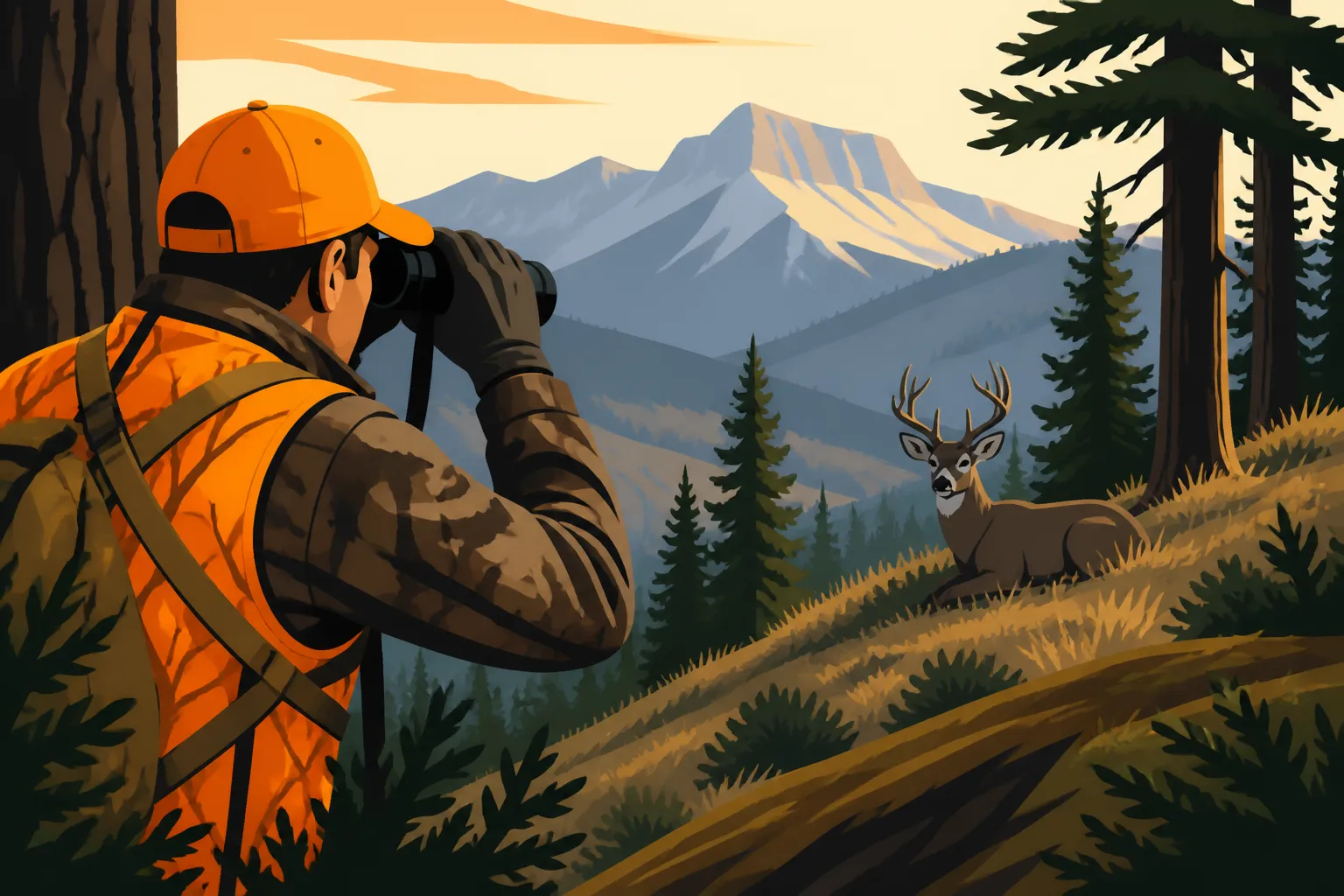
Forget your high-power spotting scope for this kind of hunting; it's practically useless in the timber. Instead, focus on quality binoculars, ideally in the 8x or 10x range. The wider field of view offered by these lower magnifications is a huge advantage when you're trying to pick apart dense cover. You're not looking for an entire deer; you're looking for parts of a deer—an ear twitch, a horizontal line of a back, the dark shadow of an eye, the glint of an antler. High-quality glass is crucial here because you'll be examining shadows and dim light conditions. Think about the clarity and light transmission. A good pair of 8×42 or 10×42 binoculars from a brand like Vortex, Leupold, or Swarovski will serve you well. Some hunters even find a monocular useful for a quick scan without raising bulkier binoculars. The goal is to maximize your ability to see subtle details in a cluttered environment. When you're glassing Wyoming basins before you take a step, those same principles apply, just on a grander scale.
Weapon Choice and Readying for Quick Shots
Your weapon choice for still hunting timber should prioritize quick, decisive action. For rifle hunters, a shorter barreled rifle is often preferred. A 20-inch or 22-inch barrel is much easier to maneuver through thick brush and tighter spaces than a 26-inch magnum. Caliber selection is less critical than shot placement, but something in the .30-06, .308, or .7mm-08 family offers plenty of knockdown power for mule deer at the shorter ranges typical in timber. If you're a bowhunter, a compact bow that's easy to draw in tight quarters can be a significant advantage. Regardless of your weapon, practice quick, off-hand shots. You won't always have time to set up a perfect rest.
Many hunters also consider the use of suppressors for big game hunting. A suppressor can significantly reduce the sound signature of your shot, which is not only beneficial for your hearing but also less likely to spook other animals in the vicinity. This can be especially helpful in timber where sound travels differently. Always check Wyoming's specific regulations regarding suppressors and lighted nocks before heading afield. Make sure your rifle is zeroed correctly, and if you're used to a long-range zero, consider if a more moderate zero is appropriate for the shorter, more sudden shots you might encounter in the timber.
The Art of the Still Hunt: Techniques and Tactics
Still hunting isn't just walking slowly; it's a deliberate, almost meditative practice that requires immense patience, keen observation, and a deep respect for the subtle nuances of the forest.
Pacing and Pausing: The Slow Crawl
This is the cornerstone of still hunting: move slowly, then stop. Repeat. Many seasoned timber hunters advocate for the "five steps, five minutes" rule, or even slower. Take a few steps, then pause, sometimes for several minutes, and thoroughly scan your surroundings. During those pauses, don't just glance around. Systematically pick apart every bit of cover with your binoculars. Look through the trees, not just at them. Train your eyes to identify what doesn't belong – a horizontal line in a vertical world, a patch of brown that's too uniform, a flicker of white, the dark, reflective surface of an eye.
When you move, do so deliberately. Lift your feet, don't shuffle. Place your foot down slowly, testing the ground for crunching leaves or snapping twigs. If you step on something loud, freeze. Wait. Listen. Often, a deer will detect your movement or sound and hold tight, trying to identify the threat. If you stop and remain motionless, it might assume the danger has passed and relax, or even move, giving you a chance to see it. Use every tree, every rock, every dip in the terrain as cover. Blend into your surroundings.
Using Wind and Terrain to Your Advantage
The wind is your best friend and your worst enemy in the timber. Always hunt into the wind or with a slight crosswind. A mule deer's nose is its primary defense mechanism, and if your scent drifts ahead of you, your hunt is over before it begins. In mountainous timber, pay close attention to thermals. In the mornings, cold air drains downhill, creating a downdraft. As the sun warms the slopes, the air rises, creating an updraft. Time your movements to coincide with favorable wind and thermal directions. Often, this means hunting uphill in the morning and downhill in the afternoon.
Terrain that hides an approach is also invaluable. Use ridge lines, draws, and benches to your advantage. Moving along the top of a ridge allows you to look down into drainages or across to opposite slopes, while still providing cover. Skirt around thick, impenetrable patches of brush, but don't ignore their edges – deer love to bed just inside these areas. Walking just below the crest of a ridge can keep you out of sight from animals on the other side, allowing you to peek over quietly. Learning to read the subtle changes in elevation and vegetation using tools like GoHunt's mapping features can greatly enhance your planning before you ever step foot in the woods.
Scanning for Antlers, Ears, and Body Parts
This is where your observational skills truly come into play. In dense timber, you almost never see an entire deer. Instead, you're looking for fragments. Train your eyes to spot the curve of an antler tip poking above a log, the dark outline of an ear twitching against a patch of shadows, or the horizontal line of a mule deer's back in a sea of vertical trees. Sometimes it's just a patch of hide, a glint of an eye, or even a subtle flick of a tail.
Take your time. Slowly scan from side to side, then up and down, systematically dissecting the cover in front of you. Pay extra attention to areas of varying density – where thickets meet more open timber, or where fallen logs create natural bedding pockets. Mule deer are experts at blending in, so you need to be even better at picking them out. Don't let your eyes glaze over. The moment you rush is the moment you'll walk right past that bedded buck. Think of it like a game of "Where's Waldo," but with much higher stakes.
Overcoming Challenges in Wyoming's Timber
Still hunting timber for bedded mule deer in Wyoming presents unique challenges, from the sheer noise of the forest floor to navigating unforgiving terrain. Being prepared for these obstacles will improve your chances of success.
Dealing with Noise and Thick Cover
One of the biggest frustrations in timber hunting is the noise. Every dry leaf, every fallen twig, every snapping branch seems to echo through the quiet woods. It's enough to make you feel like a clumsy elephant. The key here is not to eliminate all noise, but to minimize it and control it. As mentioned, soft-soled boots are a must. When you place your foot down, do so heel-to-toe, slowly. If you hear a crunch, stop. Wait. Let any deer in the vicinity settle down.
Sometimes, the best strategy is to embrace the elements. A light rain, falling snow, or even a steady breeze can be your best friend, masking your sounds and movements. These are often the ideal days for a deep timber push. When moving through thick brush, try to push branches aside slowly, or step over them, rather than forcing your way through with loud rustling. The thickest patches of cover are often where the biggest bucks choose to bed, so learning to navigate them quietly is a critical skill.
Navigating Steep and Uneven Terrain
Wyoming's mule deer timber often means steep, unforgiving terrain. Whether you're in the Bridger-Teton National Forest or hunting the Shoshone, you'll encounter vertical climbs, rocky scrambles, and slippery slopes. This type of hunting is physically demanding. You need to be in decent shape to maintain the slow, deliberate pace required for still hunting over hours, sometimes days.
When moving across steep slopes, try side-hilling or using game trails if they exist, as they often follow the path of least resistance. Be mindful of loose rock and scree, which can create significant noise. Use natural features like fallen logs or rock outcrops for balance and brief rests. Mentally, it can be draining to move so slowly over such challenging ground, but remember that every foot gained quietly is a victory. It’s also important to stay hydrated and fueled throughout the day to combat fatigue, which can lead to carelessness and increased noise. Planning your routes carefully with mapping tools can help you identify less strenuous paths or areas where terrain might offer better cover.
Post-Shot Recovery in Dense Woods
The moment of truth arrives, you make a clean shot, and the deer bounds off into the thick timber. This is where dense cover can become a nightmare for recovery. Losing an animal is every hunter's worst fear, and in thick timber, it's a very real possibility if you don't proceed carefully.
First, mark the exact spot where the deer was standing when you shot, and the exact spot where you last saw it disappear. Use a bright piece of flagging tape, a hat, or a glove. Don't rush in immediately. Give the animal time to lay down and expire. Depending on the shot, waiting 30 minutes to an hour, or even longer, is often prudent. When you begin tracking, go slowly. Look for blood, broken branches, disturbed leaves, and tracks. If the blood trail is sparse, move in a grid pattern around the last sign, expanding your search. It’s a painstaking process, but absolutely essential. Remember to always carry sufficient lighting, even during the day, as the timber can get dark quickly, and you might be tracking into the evening.
Still Hunting in Timber vs. Open Country: A Quick Comparison
| Feature | Still Hunting in Timber | Still Hunting in Open Country |
|---|---|---|
| Pace | Extremely slow, 5 steps then pause for minutes | Slow and deliberate, but often covers more ground |
| Optics | 8x-10x binoculars, focus on detail, close range | High-power binoculars (10x-15x), spotting scope, long range |
| Visibility | Very limited, focused on fragments, shadows, movement | Expansive, scanning for full animals, distant features |
| Shot Distance | Typically 20-100 yards, quick target acquisition | Often 200-500+ yards, requires stable rest |
| Movement | Emphasis on absolute silence, meticulous footing | Focus on staying hidden, using terrain for cover |
| Key Challenge | Noise, thick cover, spotting partial animals | Long distances, wind, managing visibility |
Disclaimer
Please be aware that hunting regulations, seasons, and requirements can change. Always consult the most current Wyoming Game and Fish Department regulations before planning any hunt. This guide provides general information and should not be considered legal advice. Stay safe, be ethical, and hunt responsibly.