How Close a Bowhunter Really Needs to Get
The vast, open landscapes of Wyoming offer some of the most challenging yet rewarding bowhunting experiences in the country. But let's be honest, staring across an endless sagebrush flat at a trophy antelope or trying to sneak through timber on a bugling bull, a critical question always pops into a bowhunter's mind: just how close do I really need to get to make an ethical shot? It's a question that can make or break a hunt, filled with the anxiety of pushing too far or not closing enough distance. This guide is all about dissecting that crucial "bow close" range for Wyoming's big game, helping you understand not just your equipment's capabilities, but your own limitations and the unique demands of hunting out here.
Understanding Your Effective Range: It's Not Just About How Far You Can Shoot
Every bowhunter I know dreams of that perfect 20-yard shot, broadside, no wind, no distractions. But in the real world of Wyoming, that ideal scenario is often just that – a dream. Your effective range isn't simply the maximum distance you can hit a target on a calm afternoon at the range. It's a dynamic, ever-changing calculation that factors in your personal skill, the hunting conditions, and the animal itself. Failing to acknowledge this distinction is a common pitfall that leads to missed opportunities and, unfortunately, unethical shots.
The Difference Between Practice Range and Ethical Hunting Range
At the archery range, things are pretty controlled, right? You've got your steady stance, maybe a rangefinder reading, and a nice, stationary foam target. You can probably stack arrows pretty well out to 60 or even 80 yards if you're dedicated. That's your practice range. It's a fantastic measure of your raw shooting ability under ideal circumstances.
However, your ethical hunting range is a completely different beast. This is the maximum distance at which you can consistently, without a shadow of a doubt, place a broadhead into a vital zone on a live animal under unpredictable field conditions. Think about it: that involves an elevated heart rate from a stalk, a potential crosswind, varying terrain, an animal that might be slightly quartering, and the immense pressure of the moment. If you can only consistently hit an 8-inch plate at 40 yards at the range, your ethical hunting range in the field is likely closer to 25-30 yards. It’s about building a buffer for those unexpected variables. Many experienced bowhunters will tell you to cut your maximum range by at least 10-20 yards when you're actually hunting, just to account for the adrenaline and unknowns.
Factors That Shorten Your Effective Range in the Field
Wyoming throws a lot of curveballs that can quickly reduce your effective range, even if you're a seasoned archer. Wind, for starters, is almost a constant companion out here. A 15-20 mph crosswind can push an arrow several inches off target at 40 yards – enough to turn a lethal shot into a wound. Then there's terrain: uneven footing on a rocky hillside or trying to shoot around a scrubby juniper bush adds complexity. Animals themselves contribute to this reduction. Unlike a static target, a live animal can flinch or "jump the string" at the sound of a bow, especially at longer distances where the arrow takes more time to reach its mark.
Light conditions also play a huge role. Early morning or late evening light can make range estimation trickier, and diminish your sight picture. Fatigue after a long day of hiking steep country can also impact your form and consistency. For a nonresident hunter, the altitude itself can even be a factor in how your body performs, which trickles down to your shot execution. These aren't excuses for poor shooting; they're realities that demand a conservative approach to shot distance.
Recalibrating Your Expectations for Western Game
When we talk about Wyoming big game, we're talking about some seriously tough, smart, and often incredibly wary animals. Pronghorn antelope have eyesight that rivals a 10x binocular. Mule deer are masters of broken, rocky terrain, and elk in the timber are ghosts one moment and charging bulls the next. This isn't your whitetail stand hunting in a dense woodlot. You're often dealing with vast, open country where cover is sparse, and an animal can spot you from hundreds of yards away.
Because of this, you often have to accept that getting to that "chip shot" 20-yard range might be incredibly difficult, if not impossible, on certain animals or in certain units. Recalibrating your expectations means understanding that a 40-yard shot on a nervous antelope might be the absolute best you can get, and you need to be proficient and confident at that distance. It also means recognizing when the conditions or the animal's behavior simply aren't going to allow for an ethical shot, and being willing to wait for another opportunity or move on. This realistic assessment is key to both success and ethical hunting in Wyoming.
The Unique Challenges of Bowhunting Wyoming's Big Game
Wyoming's diverse landscape means that "how close you need to get" isn't a one-size-fits-all answer. Each species and habitat presents its own set of hurdles for the dedicated bowhunter. What works for an elk in the Shoshone National Forest might be disastrous for a pronghorn out on the Red Desert.
Wary Antelope and Wide-Open Spaces
Ah, pronghorn. The speedsters of the prairie, with vision that can feel almost supernatural. Getting within bow range of a pronghorn buck across the wide-open sagebrush flats of Carbon or Sweetwater County is arguably one of the toughest bowhunting feats in the West. There's often nowhere to hide, and they'll spot any movement from incredible distances. Their natural defense mechanism is to run, and they're built for it.
For antelope, "bow close" often means something different than for other species. While a 20-yard shot is still ideal, many successful antelope bowhunters practice extensively out to 50 or 60 yards, because that might be the absolute closest they can consistently get using natural terrain, a decoy, or a waterhole ambush. The key is to understand that even at these longer distances, the shot needs to be rock-solid, as a slight miscalculation means a long tracking job in unforgiving terrain. The Decoy Distance That Actually Pulls Antelope Bucks is a great resource for understanding how to use those fake fawns or bucks to entice them closer, often making those 40-50 yard shots possible.
Elk in Timber and on the Move
Elk hunting, especially during the rut, presents a different dynamic. You might be deep in the timber of the Bridger-Teton or Bighorn National Forest, and suddenly a bull is 30 yards away, screaming. Or you might be chasing them across open parks where a 70-yard shot seems like a gift. Elk are large animals, but they are incredibly tough, and their vitals, while sizable, are protected by heavy bone and muscle. An improperly placed arrow can lead to a long, fruitless tracking effort.
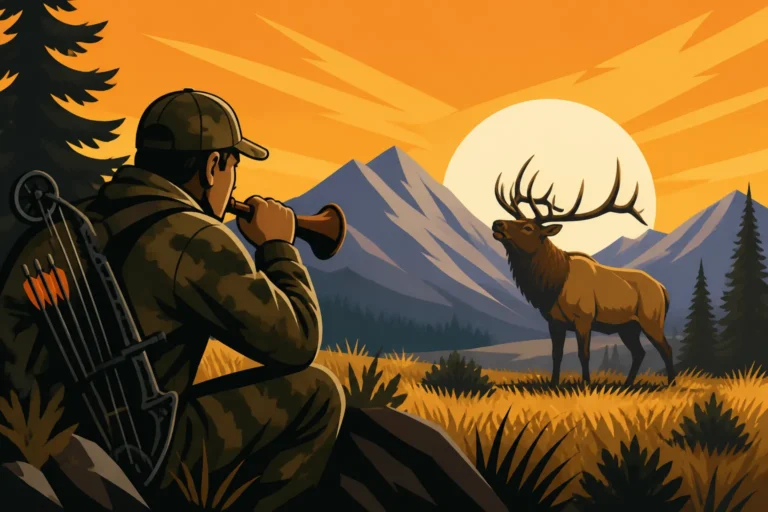
The key with elk is often getting them to commit. Whether you're calling them in or intercepting them on a travel corridor, the goal is to get them to stop, broadside, within your ethical range. In thick timber, this might be 20-30 yards because of obstructed shooting lanes. In more open parks, you might have a clean shot at 40-50 yards. Understanding their behavior, especially how they react to calls, can be crucial. Sometimes, a screaming bull will come charging in, presenting a 10-yard shot; other times, he'll hang up at 60 yards, and you have to decide if you can close the distance or if the shot is too risky. Timing your calls through the rut is critical for pulling bulls into that bow range.
Mule Deer in Broken Country
Mule deer are creatures of broken country – rimrocks, draws, sagebrush hills, and dark timber. They use the terrain to their advantage, appearing and disappearing as if by magic. This makes stalking a mule deer an intricate chess match. They don't have the acute eyesight of an antelope across a flat, but their hearing and sense of smell are exceptional, and they're masters of using cover to evade detection.
When hunting mule deer with a bow, your effective range is often dictated by the shot opportunity the terrain provides. You might crawl for an hour to get within 60 yards, only to find a branch blocking the vitals, forcing you to wait or try to get closer. The goal is often to catch them moving between bedding and feeding areas, or to pinpoint their bedded location and execute a precise stalk. Using features like cutbanks and draws to close on antelope can also apply to mule deer in similar habitats. For a mule deer, a 30-45 yard shot is often considered a good opportunity, allowing for some margin of error in varying terrain and wind conditions.
Strategies for Closing the Distance: Getting "Bow Close"
Knowing your ethical range is one thing; actually getting within it is another. This is where the art and skill of bowhunting truly shine. It's a blend of woodsmanship, patience, and adaptability that will consistently put you in position for those close-range shots.
Utilizing Terrain and Cover for a Stalk
Stalking is the quintessential bowhunting method, especially in the West. It’s about becoming part of the landscape, using every dip, rise, and patch of brush to conceal your movement. In Wyoming, this means carefully studying the topography with tools like GoHunt maps or paper topo maps to identify natural corridors, draws, and ridgelines that can provide cover for an approach.
When you spot an animal you want to stalk, the first step isn't to rush in. It's to analyze the wind direction, the animal's behavior, and the available cover. You need to identify a definitive "stalking lane" that keeps you out of sight and downwind. This can sometimes mean walking a mile out of your way just to get on the right approach. Every step needs to be deliberate, quiet, and slow. Think about how Terrain That Hides an Approach can be used to your advantage, whether it's a deep coulee or a dense patch of timber. Getting within 100 yards is a victory; getting within 50 is monumental. Practice your slow, quiet walking at home, even if it feels silly. It pays dividends when you're 70 yards from a bedded buck.
Decoying and Calling Tactics
Decoys and calls can be absolute game-changers, particularly for species like pronghorn and elk. For pronghorn, a decoy can often be the only way to bridge that final, impossible 100-yard gap in open country. Setting up a decoy, then moving behind it (or having a partner hold it) can draw an inquisitive buck in for a closer look. They're territorial, and a "rival" entering their space often triggers a challenging response. Just be aware of other hunters in the area when using decoys, and always wear blaze orange when legally required.
For elk, calling during the rut is an intoxicating experience. Locator bugles can help you find bulls at dawn, and then a series of cow calls and challenge bugles can often pull a bull right into your lap. The key is to know when to be aggressive and when to be subtle. Too much calling can sometimes spook a pressured bull, while too little might not generate interest. Two-hunter calling setups that actually work on bulls often involve one caller drawing the bull's attention while the shooter sneaks into position. Often, bulls will hang up just outside what they perceive as their comfort zone, sometimes 60-80 yards. Your calling needs to convince them that coming closer is safe or necessary.
Patience and Persistence: Sitting Waterholes and Travel Corridors
Sometimes, the most effective strategy isn't to chase, but to wait. This is where patience and persistence come into play. Setting up a blind or finding natural cover near a waterhole, especially in dry parts of the season or in arid areas known for mule deer and antelope, can be highly productive. Animals have to drink, and if you've done your scouting, you can often predict their patterns. This allows you to set up for those perfect 20-30 yard shots.
Similarly, identifying travel corridors – the paths animals routinely use between bedding, feeding, and water – can provide excellent ambush opportunities. These might be game trails through thick timber for elk, or draws and saddles used by mule deer. It takes careful e-scouting using a tool like GoHunt to pinpoint these pinch points, followed by on-the-ground verification. You might sit for hours, but when an animal finally walks into your setup, you're usually presented with a high-percentage shot opportunity at close range. Always ensure your setup gives you a clean shooting lane and good concealment.
Equipment Considerations for Close-Range Shots
While getting close is paramount, your equipment plays a critical supporting role. The right gear, properly maintained and tuned, ensures that when you finally get that shot opportunity, your arrow flies true and performs as expected.
Broadhead Selection for Optimal Performance
The broadhead is the business end of your arrow, and its performance is directly tied to a clean kill. In Wyoming, with large, tough animals like elk and mule deer, you want a broadhead that is known for penetration and creating a wide wound channel. Fixed-blade broadheads are often favored for their reliability and deep penetration, especially on bone. They offer consistent performance regardless of impact angle, provided they are razor sharp and your bow is well-tuned. For those concerned about Broadheads That Fail the 7/8-Inch Ring Test in Wyoming, fixed blades generally pass with flying colors.
Mechanical or expandable broadheads can also be effective, but their design relies on blades deploying on impact. While many modern mechanicals are incredibly reliable, some hunters prefer the peace of mind of a fixed blade, especially when hunting species with heavy bone structure. Regardless of your choice, ensure your broadheads are field-tested with your specific arrow and bow setup to confirm flight accuracy at all your intended hunting distances. A well-tuned bow and a sharp broadhead are non-negotiable for ethical bowhunting.
Bow Tuning and Arrow Selection for Accuracy
Even the most expensive bow won't shoot accurately if it's not properly tuned. Bow tuning is the process of adjusting your bow and arrow setup to achieve perfect arrow flight, ensuring your broadheads hit where your field points do. This involves checking cam timing, arrow rest alignment, nocking point height, and string serving. A professional archery shop can help with this, or you can learn to do it yourself. Poor tuning can cause arrows to "porpoise" or "fish-tail," leading to erratic flight, especially at longer ranges or in windy conditions. This significantly reduces your ethical hunting range.
Arrow selection is also crucial. Matching arrow spine to your bow's draw weight and length, along with choosing the right fletching and total arrow weight, impacts accuracy, speed, and penetration. Heavier arrows generally offer better penetration and are less susceptible to wind drift, which can be a huge advantage in Wyoming's blustery conditions. A good starting point for Arrow Weight That Gets Through an Elk is often considered 450-500 grains, but consult with an expert to find the right balance for your specific setup and target animal.
Rangefinders and Sights for Precision
A reliable rangefinder is an indispensable tool for any Western bowhunter. Estimating distance accurately in wide-open country or broken terrain is incredibly difficult, and a few yards off can mean a complete miss or a poor hit. Modern rangefinders with angle-compensating technology are particularly useful in hilly or mountainous terrain, giving you the "shoot-to" distance rather than the line-of-sight distance. Practice with your rangefinder constantly, integrating it into your shooting routine so using it becomes second nature.
For sights, most Western bowhunters opt for multi-pin sights, allowing for quick target acquisition at varying distances. A single pin sight can also work, especially a slider, but requires more adjustment in a high-pressure situation. Many hunters prefer to set their pins at 20, 30, 40, 50, and 60 yards. Knowing exactly where each pin hits under various conditions is developed through consistent practice. Combine this with a good e-scouting tool like GoHunt to pinpoint potential shooting lanes and distances before you even step foot in the field.
Mental Game and Ethical Responsibilities
Beyond the physical skills and equipment, bowhunting demands a strong mental game and an unwavering commitment to ethical hunting practices. The "close enough" question isn't just about mechanics; it's about character.
Knowing When to Let the Animal Walk
This is perhaps the hardest lesson for any hunter, especially when you've invested countless hours, miles, and dollars into a hunt. But truly knowing when to let an animal walk is the hallmark of an ethical bowhunter. It means resisting the urge to take a marginal shot simply because it's the only one you've been offered. If the animal isn't broadside, if the distance is beyond your comfortable ethical range, if the wind is swirling, or if there's an obstruction you can't clear, the correct decision is to hold your shot.
It's easy to get caught up in the excitement, the "buck fever," and convince yourself that "this is it." But a wounded animal is a tragic outcome that every bowhunter strives to avoid. Replaying the scenario in your head, asking yourself honestly if you can make a clean, ethical kill, is crucial. Remember, harvesting an animal is a privilege, not a right, and that privilege comes with immense responsibility. It’s better to go home empty-handed than to make a poor shot.
The Pressure of the Moment and Shot Execution
The surge of adrenaline when a big game animal steps into bow range is unlike anything else. Your heart pounds, your hands might shake, and time seems to slow down or speed up. This is "buck fever," and it can wreak havoc on your shot execution if you're not prepared for it. Controlling your breathing is key: take a deep breath, hold it, and slowly exhale before you draw. This helps calm your nervous system.
Focus on your shot sequence: anchor point, sight picture, proper grip, and a surprise release. Don't rush the shot. Let your pin float, trust your aiming, and execute a smooth release. Many bowhunters develop target panic when faced with a live animal. This is a mental block that causes them to punch the trigger or flinch. Consistent practice, especially under simulated hunting pressure, can help mitigate this. Practice visualizing the moment, going through your shot sequence mentally, and reinforcing good habits.
Post-Shot Procedures and Tracking
Your ethical responsibilities don't end the moment the arrow leaves the string. In fact, they intensify. After the shot, it's absolutely critical to observe the animal's reaction, the direction it runs, and where your arrow hit. Did it kick, stumble, or run off normally? Did you see the arrow impact? What was the color of the blood on the arrow (if you can recover it)? These are all vital clues for the tracking job ahead.
Resist the immediate urge to pursue. Give the animal time, usually 30 minutes to an hour for a well-placed shot, and sometimes 4-6 hours or more for a less-than-ideal hit, especially if it's a gut shot. This allows the animal to bed down and expire peacefully. Then, begin tracking slowly and methodically. Look for blood, broken branches, disturbed leaves, or tracks. Have a plan for Post-Shot Procedures and Tracking before you even head into the field. A good headlamp, flagging tape, and a hunting partner can be invaluable. Every effort must be made to recover the animal you've shot.
Real-World Scenarios and Practical Tips
Let's dive into some practical tips that can truly make a difference in your Wyoming bowhunting experience, bringing all these elements together into actionable advice.
Wind, Thermals, and Animal Behavior
Wyoming is famous for its wind, and understanding its impact is non-negotiable for bowhunters. Wind not only affects arrow flight, but it also dictates thermals and how animals will react. Early mornings often have rising thermals (air moving uphill), while evenings have falling thermals (air moving downhill). Mid-day can be chaotic. Always hunt with the wind in your favor, especially on a stalk. A sudden swirl can carry your scent directly to your target, ending your hunt instantly.
Animals are masters of using wind and thermals to their advantage. They will often bed down in locations that allow them to smell downwind and see any threats approaching from upwind. When planning a stalk, think about how to approach from a direction where your scent won't carry, and where you can use the topography to stay out of sight. A small wind checker is an essential piece of gear; use it constantly to confirm wind direction. Observing how Playing Wind Direction on an Open Sagebrush Stalk can make all the difference for a pronghorn hunt applies equally to other species.
Dealing with Adrenaline and Target Panic
Adrenaline is a double-edged sword: it sharpens your senses but can also ruin your shot. To combat this, mentally rehearse your shot sequence repeatedly, both at home and in the field. Visualize a successful shot, focusing on your form and release. When an animal presents, take a moment to breathe, settle your nerves, and then consciously execute each step of your shot. Don't look at the antlers; focus on a small spot behind the animal's shoulder.
If you struggle with target panic, consider practicing without a target, focusing solely on a smooth release. Or use a blank bale at very close range. Sometimes, practicing with your eyes closed, focusing only on the feel of the shot, can help retrain your mind. It's a mental battle, and consistent, deliberate practice is the only way to overcome it. Remember, it's okay to feel the excitement, just don't let it control your trigger finger.
Continuous Improvement: Practice Beyond the Backyard
The backyard range is a great start, but true preparation for Wyoming bowhunting requires more. Practice shooting from awkward positions – kneeling, sitting, or from a steep incline or decline. Simulate the environment: place obstructions in front of and behind your target. Shoot in varying light conditions, including early morning and late evening. Practice in the wind.
Practice estimating distances without a rangefinder, then verify with the device. This builds your "mental rangefinder" and quickens your ability to react. Consider shooting at 3D animal targets to better visualize vital zones. And most importantly, practice, practice, practice at your ethical hunting range – the distance at which you can confidently and consistently make a killing shot under pressure. For many, that might mean setting realistic archery practice distance for big game at 50 yards or less, focusing on accuracy over maximum distance.
Ultimately, "how close a bowhunter really needs to get" in Wyoming isn't a fixed number on a range chart. It's a deeply personal and ethical decision, informed by your skill, your equipment, the environment, and the animal itself. Strive for that perfect 20-yard shot, but be prepared for the reality of 40-50 yards. And always, always err on the side of caution. Your commitment to ethical hunting is what truly defines you in the field.
Disclaimer
Hunting carries inherent risks, including injury and death. This article provides general information and recommendations. It is crucial to consult and comply with all current Wyoming Game and Fish Department regulations, federal laws, and local ordinances before engaging in any hunting activities. Always prioritize safety, ethics, and responsible outdoor practices.