Shooting Sticks or Bipod in Deep Sagebrush
Hunting Wyoming's vast, open country can be an incredible experience, but it also presents a unique set of challenges, especially when you're trying to get a stable shot in unpredictable terrain. Often, you'll find yourself needing to take a shot over undulating ground choked with deep sagebrush, leaving you wondering if a bipod or shooting sticks are truly up to the task. This guide is here to walk you through the pros and cons of each, helping you decide which tool will give you the steadiest aim when that trophy animal steps out.
The Unique Challenge of Wyoming Sagebrush
Imagine cresting a small rise, spotting a mature mule deer buck or an antelope feeding peacefully a few hundred yards out. Your heart rate quickens, adrenaline surges, and then you realize the only shot you have is over a sea of sagebrush that seems to be exactly shoulder-height, blocking any clear line of sight from a prone position. This scenario is incredibly common in Wyoming, and it’s precisely why your choice of shooting rest matters so much.
Understanding Sagebrush Terrain and Its Impact
Deep sagebrush isn't just an aesthetic feature of the Western landscape; it's a significant tactical consideration for hunters. We're talking about bushes that can easily reach three or four feet tall, often growing in dense patches, on uneven ground. This creates a natural barrier that makes getting a clear, ethical shot incredibly difficult if you're trying to shoot from a kneeling or prone position without an elevated rest. The ground itself might be rocky, sandy, or sloped, making it tough to get comfortable or find a level spot.
Beyond the height, the sheer density of sagebrush can make tracking an animal with your scope tricky, and it can conceal smaller undulations in the terrain that might otherwise offer a natural rest. The frustration of finally locating a target, only to have your view constantly obstructed by a stubborn bush, is something every Wyoming hunter has experienced. It’s not just about getting over the brush, but also finding a stable, consistent platform that allows for precise shot placement in varying conditions.
Why a Stable Rest is Non-Negotiable Out West
In Wyoming, shots often happen at longer distances than in many other parts of the country. A 300-yard shot, which might be considered long elsewhere, is often par for the course when hunting antelope on the open plains or mule deer in the expansive basins. When you're "Holding for Wind Past Four Hundred Yards," every tiny wobble or movement is magnified downrange, turning a potential heart shot into a gut shot or a complete miss. This magnification of error means that a rock-solid shooting platform isn't just a nice-to-have; it's an ethical imperative.
Moreover, Western hunting often involves significant physical exertion. You might have just climbed a steep hill, stalked for an hour, or hiked miles in preparation for a shot. When adrenaline is pumping and your lungs are burning, your body's natural stability diminishes. Trying to hold a heavy rifle steady freehand after such an effort is a recipe for inaccuracy. A good shooting rest acts as an extension of your body, providing the critical stability needed to counteract fatigue, adrenaline, and the inevitable effects of the wind that constantly whips across the Wyoming landscape. It allows you to focus on your breathing, trigger pull, and target acquisition, rather than fighting to keep your crosshairs from dancing.
Navigating the Bipod's Role in Sagebrush
Many hunters swear by bipods, and for good reason. They offer a certain level of convenience and quick deployment that can be very appealing. However, like any tool, they have their limitations, especially when faced with the specific challenges of deep sagebrush country.
When a Bipod Shines and When It Struggles
A bipod truly shines when you're able to get into a prone position on relatively flat, open ground. It provides an incredibly stable platform, virtually eliminating vertical movement and allowing for precise shot placement. They're quick to deploy – just fold out the legs and you're good to go – and because they're typically attached directly to your rifle, they're always with you. If you're hunting an open prairie for antelope or have a bedded deer in shallow grass, a bipod can be your best friend. Brands like Harris Bipods or the more versatile Atlas Bipods are popular choices for their durability and stability in these ideal conditions.
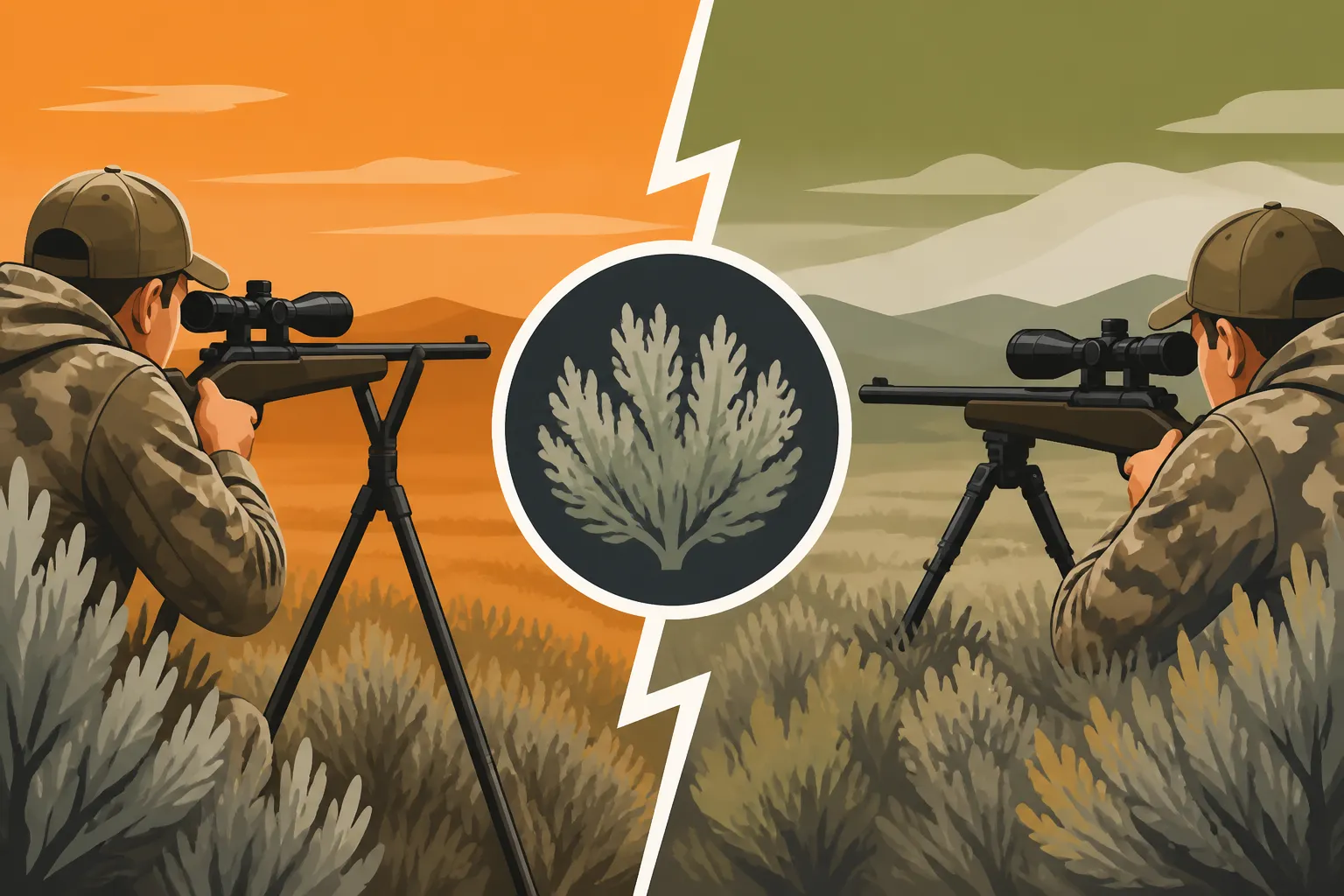
However, the moment you encounter the reality of deep sagebrush, a standard bipod often falls short. Their fixed or limited height adjustment simply isn't enough to clear the tops of three or four-foot tall bushes. You'll find yourself trying to peer through the brush, unable to get a clear sight picture. On uneven ground, one leg might be much shorter than the other, forcing you into an awkward, unstable cant. And if you're moving through dense cover, a bipod can snag on branches, making quiet stalks more difficult and potentially alarming game. This struggle often leads to frustration and missed opportunities, as you're forced to try an unstable freehand shot or pass on an animal because you can't get clear.
Optimizing Your Bipod for Western Terrain
If you're committed to using a bipod in Wyoming's varied terrain, there are ways to optimize its performance. Firstly, consider a taller bipod model. While most standard bipods are designed for prone shooting, some models offer extended leg lengths that allow for kneeling or even sitting shots. While still not ideal for all deep sagebrush, a bipod with legs that extend to 13-27 inches, for example, offers more versatility than a standard 6-9 inch model.
Beyond height, look for bipods with features like cant and pan. Cant allows you to level your rifle on uneven terrain, preventing your shot from being pulled left or right. Pan allows you to smoothly track a moving animal without lifting your rifle. These features, common in higher-end bipods, become critical when the ground isn't perfectly flat. When using a bipod in thick sage, you might have to get creative. Sometimes, you can find a small depression or a low spot to sit or kneel in, effectively using the ground to gain a bit more height over the surrounding brush. Other times, you might have to stack rocks or use your backpack to prop up the rear of your rifle, allowing the bipod to clear the front. Remember, a stable shooting position is paramount for an ethical shot, especially when you're thinking about your Rifle Zero Distance for Open Country Shooting.
Deploying Shooting Sticks in Tall Sagebrush
For many Western hunters, shooting sticks have become the preferred tool, precisely because they address the shortcomings of bipods in varied and often tall vegetation. Their adaptability and ability to provide height make them incredibly valuable in country dominated by deep sagebrush.
The Adaptability of Shooting Sticks
The primary advantage of shooting sticks is their superior height and adjustability. Unlike most bipods, quality shooting sticks can easily be extended to accommodate standing, kneeling, or sitting positions, allowing you to clear even the tallest sagebrush with ease. This means you don't have to contort your body into awkward positions or search endlessly for a low spot; you can set up where the animal is, not where the terrain dictates. This adaptability is crucial when you're trying to take a shot in an unexpected scenario, which happens often in the West.
While perhaps not as instantaneously stable as a rifle-mounted bipod on a perfectly flat surface, modern shooting sticks, especially tripod designs, offer excellent stability. They demand a bit more coordination to deploy and get steady, but with practice, this becomes second nature. They are also typically lighter than a rifle-mounted bipod, which can be a relief on long hikes, particularly if you're also packing optics for "Glassing Wyoming Basins Before You Take a Step." Their free-standing nature also means your rifle isn't permanently weighed down or snagging on brush during a stalk.
Types of Shooting Sticks and Their Best Use Cases
Shooting sticks come in several configurations, each with its own benefits and drawbacks for different hunting scenarios:
- Monopods: These are single-leg sticks, the lightest and quickest to deploy. They offer moderate stability, mainly by reducing vertical movement, and are excellent for quick, standing shots where you need just a little extra support. Think of them as a personal steadying device rather than a truly free-standing rest. They are fantastic for hunters who prioritize speed and minimal weight, but won't give you the stability needed for extremely long shots or high winds.
- Bipod Sticks: These two-legged sticks offer a much-improved balance of stability and portability. They create a "V" or "X" shape when deployed, providing two points of contact with the ground and allowing for significant stability. They are great for kneeling or sitting shots, and many models can extend tall enough for standing shots over moderate sagebrush. Brands like Primos and Bog-Pod offer a range of bipod stick options that are relatively quick to set up and quite stable, perfect for a hunter who needs more stability than a monopod but doesn't want the bulk of a tripod.
- Tripod Sticks: For the ultimate in stability and versatility, tripod shooting sticks are king. With three points of contact on the ground, they offer rock-solid support for standing, kneeling, or sitting shots, even on uneven terrain. Many feature adjustable legs that can splay out to different angles, adapting to steep hillsides or rocky ground. Some models even double as tripod mounts for spotting scopes or binoculars, which is a huge bonus when you're trying to achieve Optics Power for Wyoming's Long Sightlines. While they are the heaviest and most cumbersome to carry, the stability they provide for precise, long-range shots makes them indispensable for many Western hunters. Carbon fiber models can significantly reduce weight, making them a more viable option for backcountry hunts.
Making the Choice: Bipod or Shooting Sticks?
The decision between a bipod and shooting sticks isn't about one being inherently better than the other; it's about matching the tool to your hunting style, the terrain you expect to encounter, and your personal preferences for stability and mobility.
Considering Your Hunting Style and Preferred Terrain
Think about how you typically hunt in Wyoming. Are you someone who prefers to find a high vantage point, settle in, and glass for hours, hoping for a prone shot on an animal grazing across an open basin? In that case, a well-deployed bipod might be perfectly sufficient. Its inherent stability when prone is hard to beat. However, if your strategy involves more dynamic spot-and-stalk tactics, moving through varied terrain, often having to quickly assess and take shots from standing or kneeling positions over tall cover, then shooting sticks—especially a versatile bipod or tripod set—will likely serve you better. They give you the flexibility to adapt to whatever the Wyoming landscape throws at you, whether you're "Playing Wind Direction on an Open Sagebrush Stalk" or navigating a steep cut.
Your preferred shooting position also plays a huge role. If you're most comfortable and accurate shooting prone, and the terrain allows for it, a bipod might be your go-to. But if you find yourself needing to stand to clear obstructions, or prefer the quickness of a kneeling shot, shooting sticks offer far more options. Consider the type of big game you're after too; hunting elk in dense timber might call for different considerations than hunting pronghorn on the vast plains. Each species and habitat presents its own unique challenges and opportunities for a stable shot.
The Hybrid Approach: Combining the Best of Both Worlds
For many seasoned Western hunters, the ideal solution isn't an either/or; it's a "why not both?" approach. Carrying a lightweight bipod mounted to your rifle for quick prone shots on open ground, and also having a set of lightweight, collapsible shooting sticks in your pack for those moments when you need to shoot over tall sagebrush or from an awkward standing position, offers the ultimate versatility. This hybrid approach ensures you're prepared for almost any scenario you might encounter in Wyoming's diverse landscapes.
This strategy requires a bit more gear, but the peace of mind knowing you have a stable rest for any situation is often worth the extra ounces. When you're doing your research, maybe with scouting tools like GoHunt, and you're E-Scouting a Unit Before the Season Opens, really think about the terrain you'll be covering. Are there wide-open flats, or is it mostly rolling hills with dense, waist-high sage? Understanding your chosen hunt area will help you tailor your gear, ensuring you have the right tool for the job. Remember, a stable shooting platform is one of the most critical elements for ethical hunting, right up there with knowing What Wyoming Counts as a Legal Firearm for Big Game and understanding "The Powder Charge a Legal Muzzleloader Needs." Don't skimp on this crucial piece of equipment.
| Feature | Bipod (Rifle-Mounted) | Shooting Sticks (Standalone) |
|---|---|---|
| Primary Use | Prone, Bench Shooting, Flat Ground | Kneeling, Sitting, Standing, Uneven Terrain |
| Stability | Excellent on flat ground (prone), less stable elevated | Good to excellent (especially tripods), highly adaptable to terrain |
| Deployment Speed | Very Fast (attached to rifle) | Moderate (requires setting up, often quicker with practice) |
| Height Adjustment | Limited (usually 6-27 inches, prone/kneeling height) | Extensive (can be adjusted for standing shots over 4 feet tall) |
| Portability | Always attached to rifle (can add bulk/weight to rifle) | Carried separately (can be clipped to pack, often lighter overall) |
| Terrain Adaptability | Struggles with tall vegetation, very uneven ground | Excellent for tall sagebrush, rocky terrain, steep slopes |
| Best For | Open plains, designated shooting lanes, static positions | Spot-and-stalk hunting, varied Western terrain, dynamic shooting |
Disclaimer
Please note that hunting regulations, seasons, and access rules can change frequently. Always consult the official Wyoming Game and Fish Department regulations and land management agency rules before planning any hunting trip. This guide is for informational purposes only and does not constitute legal advice or replace official documentation.