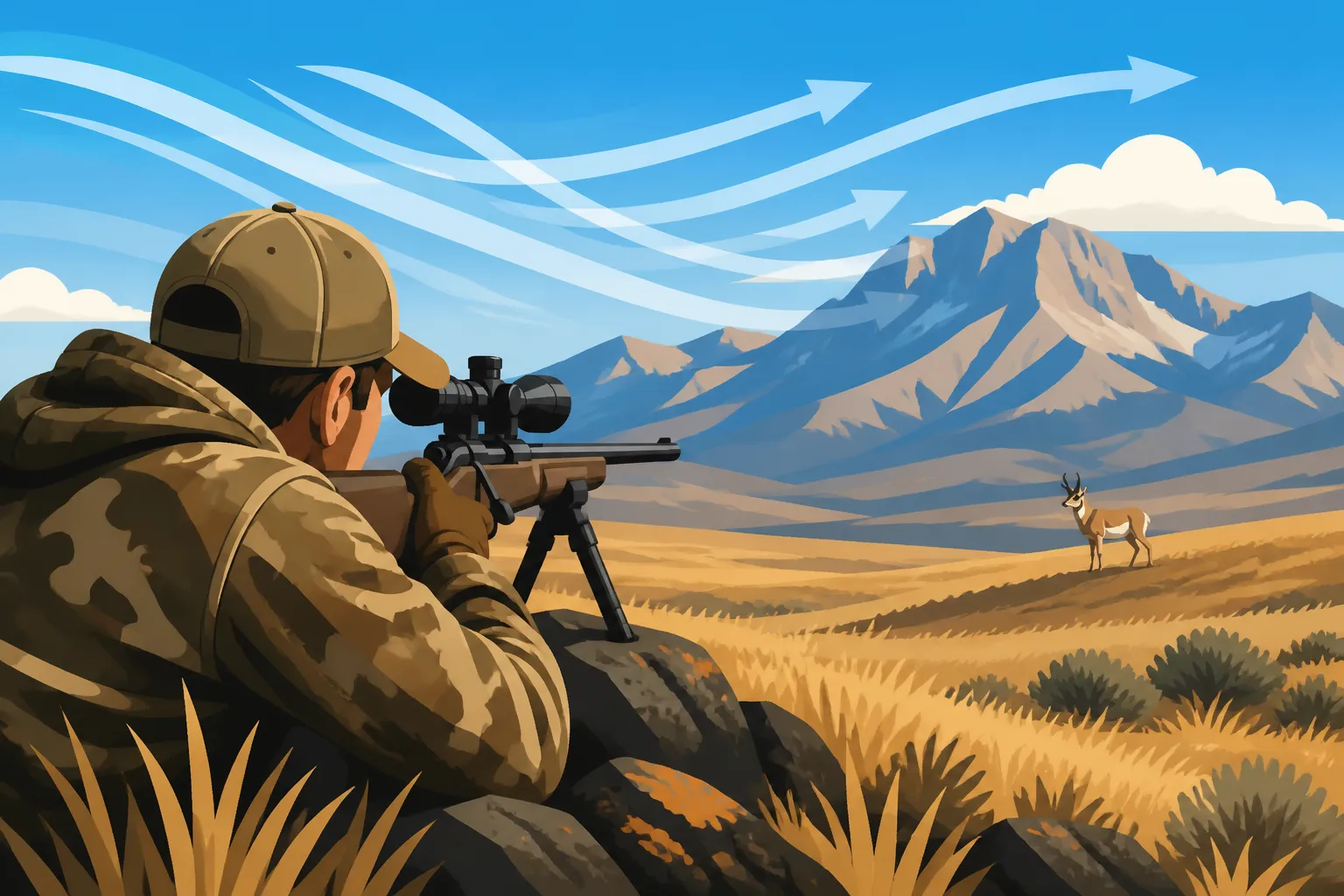
Holding for Wind Past Four Hundred Yards
There's nothing quite like the feeling of seeing a magnificent animal in your crosshairs at a distance, especially out here in the vastness of Wyoming. But that excitement can quickly turn to frustration when the wind starts playing tricks, making a clean shot seem impossible beyond 400 yards. This guide is all about demystifying how to accurately account for wind when you're taking those longer shots in our wild country, giving you the confidence to make ethical decisions.
The Unpredictable Challenge of Wyoming's Wind
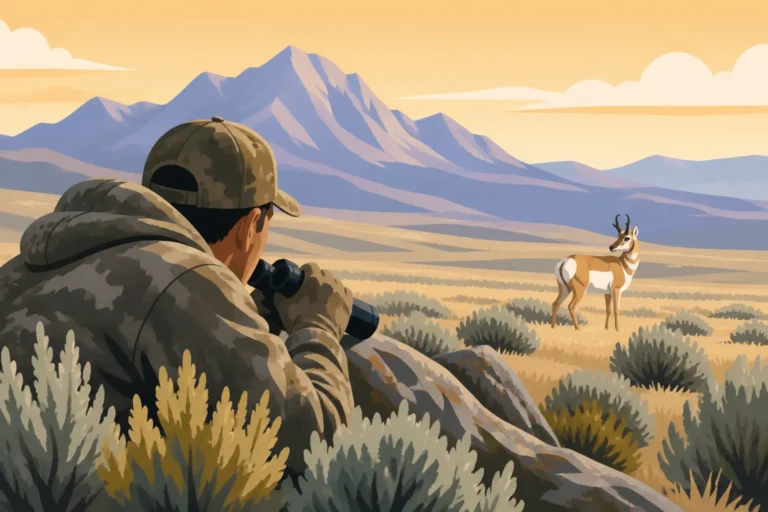
Hunting in Wyoming means embracing vast, open landscapes, often with views that stretch for miles. It's exhilarating, but it also means dealing with an omnipresent factor: the wind. Unlike hunting in dense timber, where wind effects might be mitigated or localized, the open sagebrush flats, rolling hills, and expansive basins of Wyoming offer little shelter. A slight breeze at your position can be a full-blown gale 400 yards away, and knowing how to read and compensate for it is arguably the most critical skill for long-range success. Many hunters struggle to even get close enough to game, which is why understanding How Close a Bowhunter Really Needs to Get is paramount for archery, but for rifle hunters, the challenge shifts to precision at distance in the elements.
Understanding Ballistic Drift from Wind
The moment your bullet leaves the barrel, gravity starts pulling it down, and wind begins to push it sideways. While bullet drop is relatively predictable and can be precisely calculated, wind drift is a dynamic force that constantly changes. Ignoring wind past four hundred yards isn't an option; even a modest 5 mph crosswind can push a typical hunting bullet several inches off target, and at 10-15 mph, you're looking at foot-plus deviations.
This lateral movement isn't linear either. As the bullet slows down, it becomes more susceptible to wind, meaning the last 100 yards of its flight path can see more drift than the first 300. This is why a thorough understanding of your chosen Best All-Around Caliber for a Western Hunt and its ballistic coefficients is so important. Heavy-for-caliber, high-BC bullets generally resist wind drift better than lighter, less aerodynamic projectiles.
The Role of Wind Direction and Speed
It’s not just if the wind is blowing, but how and how fast. A true 90-degree crosswind from left to right will have the maximum effect on your bullet. However, rarely do we encounter such a perfect scenario in the field. Quartering winds, head-on winds, and tailwinds all have different impacts. A quartering headwind, for instance, might both push your bullet sideways and increase its drop slightly due to increased drag. Conversely, a tailwind could slightly reduce drop and still cause lateral drift if it’s not perfectly aligned with your shot.
Estimating wind speed is a skill developed over time. You might feel a gentle breeze on your face, but see sagebrush bending noticeably further out. A good rule of thumb is to look for indicators. If leaves or grass are barely moving, it's probably 1-3 mph. If small branches are swaying and flags are extended, you're likely in the 8-12 mph range. If trees are swaying and dust is blowing consistently, you're looking at 15-20+ mph, which significantly complicates long shots.
Reading the Wind in Wyoming's Expansive Terrain
Wyoming's vastness means wind is rarely consistent across your entire shooting lane. It can swirl, eddy, and change direction multiple times between you and your target. This is where the art of "reading the wind" truly comes into play, requiring keen observation and a lot of practice. Understanding Reading Wind on an Open-Country Stalk applies just as much to shooting as it does to approaching game.
Interpreting Environmental Cues for Wind
The ground around you, the vegetation in between, and even the air itself offer clues. Mirage, the shimmering heat waves rising from the ground, can be an excellent wind indicator. If the mirage is leaning consistently in one direction, that's a direct visual of wind movement. The speed at which it moves can also help estimate wind velocity. Pay close attention to different layers of mirage; sometimes ground wind is different from mid-range wind.
Beyond mirage, look at the sagebrush, grasses, and any other vegetation. Are they bending? How much? Is it consistent? Dust, if present, is a phenomenal indicator of both direction and speed. Even faint ripples on a distant waterhole can give you a clue. If you're hunting near a canyon or a significant cut, remember that Terrain That Hides an Approach can also create wind tunnels or dead air pockets, completely altering the wind conditions compared to open ground.
Using Technology and Tools for Wind Assessment
While old-school observation is crucial, modern tools can significantly enhance your ability to read and compensate for wind. A Kestrel wind meter, for example, can give you precise wind speed and direction at your shooting position. Many Kestrel models integrate directly with ballistic calculators, providing real-time solutions.
Speaking of ballistic calculators, these are non-negotiable for long-range shooting. Apps like Applied Ballistics or Kestrel Link, or even those often integrated into platforms like GoHunt, allow you to input your specific bullet, muzzle velocity, scope height, and environmental factors (temperature, altitude, humidity, and crucially wind) to get a precise holdover and windage solution. Some advanced rangefinders, such as those from Vortex or Sig Sauer, now include built-in ballistic solvers that even factor in wind data from a connected Kestrel. Always ensure your Rifle Zero Distance for Open Country Shooting is correctly inputted into your calculator for accuracy.
Practical Wind Holding Strategies and Gear
Once you've assessed the wind, the next step is deciding how to compensate for it. This typically involves either "holding off" the target or "dialing" your scope's windage turret. Both methods have their place, and often, a combination is used.
Holding Off vs. Dialing Your Scope
Holding Off: This involves aiming a certain distance into the wind from your target. If the wind is blowing from left to right, you'd aim to the left of your animal. This is fast and effective for smaller corrections or when you don't have time to dial. The downside is that it's less precise than dialing, and it relies on your ability to accurately estimate the hold. For instance, if your ballistic calculator says you need a 10-inch hold at 400 yards in a 5 mph crosswind, you'd simply aim 10 inches into the wind.
Dialing Your Scope: This involves adjusting your scope's windage turret to physically shift your reticle's point of impact. If your calculator tells you to dial 1.5 MOA (Minutes of Angle) of windage, you turn your turret 1.5 MOA. This is generally more precise, especially for larger corrections or when you have ample time. The best practice for dialing is to zero your rifle with your Rifle Zero Distance for Open Country Shooting, then use your ballistic calculator to give you exact turret adjustments for various distances and wind conditions. The major drawback is the time it takes, which isn't always available in a hunting scenario, especially when stalking skittish animals like pronghorn where How Far to Stalk a Bedded Pronghorn is already a tight window.
Many hunters use a hybrid approach: dialing for elevation and holding off for smaller wind corrections, or dialing for elevation and significant wind, then holding off for minor, real-time adjustments as the shot breaks.
Essential Gear for Wind Management
Beyond your rifle and ammunition, several pieces of gear are indispensable for managing wind at long range:
- Spotting Scope: A good spotting scope is vital for long-range observation, not just for spotting game but for reading mirage and distant wind flags. With the right Spotting Scope Power for Open Country Glassing, you can discern subtle wind shifts far downrange. Brands like Vortex, Swarovski, and Kowa offer excellent optics that perform well in challenging conditions.
- Rangefinder with Ballistic Capabilities: As mentioned, some modern rangefinders integrate ballistic solutions, making on-the-fly calculations faster and more accurate. Even without integrated ballistics, a quality rangefinder is paramount for knowing your exact distance, which directly impacts your wind solution.
- Tripod/Shooting Support: Stability is key to long-range accuracy. Whether it's a sturdy bipod, Shooting Sticks or Bipod in Deep Sagebrush, or a shooting tripod, minimizing wobble allows you to focus on your breath control and trigger pull, rather than fighting to hold steady against movement from wind.
- Wind Meter/Ballistic Calculator: A Kestrel wind meter, often paired with a robust ballistic app like that from GoHunt, is invaluable. Inputting precise wind data rather than guessing dramatically increases your chances of success.
Practice, Practice, Practice
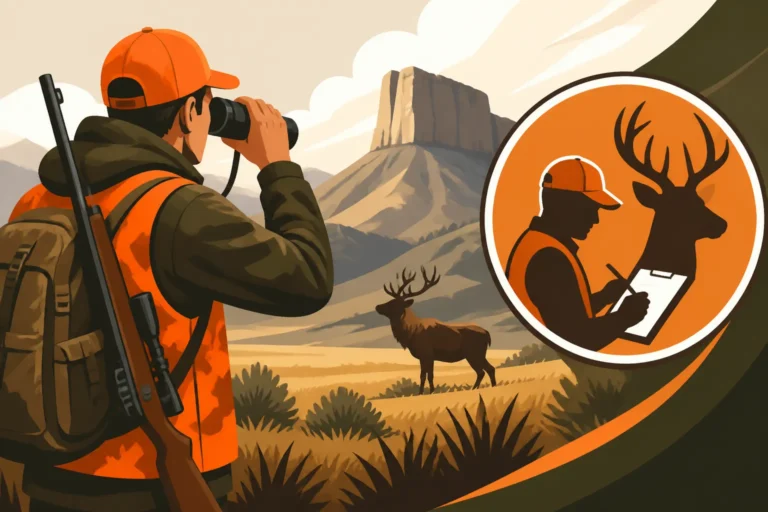
No amount of gear or theoretical knowledge can replace practical experience. You need to shoot your rifle in windy conditions, repeatedly, at varying distances. Start at shorter distances, 200-300 yards, and gradually extend to 400, 500, and beyond. Observe how your bullet impacts the target relative to your hold or dial. Keep a log. What did a 5 mph wind at 400 yards actually do to your point of impact with your specific setup? How did it change at 10 mph? This direct feedback is the best way to build confidence and develop an intuitive feel for wind.
It's also important to understand your rifle's limitations and your own. Don't push shots beyond your ethical range, regardless of how well you think you can dope the wind. A clean kill is always the priority. While a .22 WMR is legal in some limited situations, understanding Where the .22 WMR Is Legal for Hunting reminds us that bullet energy and ballistic performance are critical for ethical long-range hunting. For larger animals, knowing The Effective Range of a Muzzleloader on Elk also highlights how different weapon systems handle wind very differently.
Here's a quick reference table showing approximate wind drift for a common .30-06 180-grain bullet (BC of ~0.5) at 400 yards in a full value (90-degree) crosswind:
| Wind Speed (MPH) | Approximate Wind Drift (Inches at 400 Yards) | MOA Adjustment (approx.) |
|---|---|---|
| 5 | 14 inches | 3.3 MOA |
| 10 | 28 inches | 6.6 MOA |
| 15 | 42 inches | 9.9 MOA |
| 20 | 56 inches | 13.2 MOA |
Note: These are approximations. Actual drift will vary based on bullet specific ballistics, muzzle velocity, altitude, temperature, and atmospheric pressure. Always use a ballistic calculator for precise data for your specific setup.
The vast, beautiful landscapes of Wyoming demand respect, and that includes the powerful, often unpredictable wind. By understanding how wind affects your bullet, learning to read environmental cues, utilizing modern technology, and most importantly, practicing consistently, you can increase your chances of making a clean, ethical shot when the opportunity presents itself, even past four hundred yards.
Disclaimer
The information provided in this guide is for informational purposes only and is not a substitute for official Wyoming Game and Fish Department regulations. Hunting laws and regulations can change, and it is the responsibility of every hunter to review the most current regulations before heading afield. Always prioritize safety and ethical hunting practices.