Crossbow Hunting in Wyoming: 90 Pounds and a 16-Inch Bolt
It can feel overwhelming trying to keep up with all the specific regulations for hunting in Wyoming, especially when it comes to specialized equipment like crossbows. You've heard whispers about draw weight limits and bolt length requirements, and it's easy to get bogged down in the details, worrying if your gear is even legal before you ever set foot in the field. This comprehensive guide is here to untangle those rules, specifically addressing the 90-pound minimum draw weight and 16-inch bolt length, ensuring you're fully prepared and compliant for your next Wyoming crossbow hunt.
Understanding Wyoming's Crossbow Regulations
Wyoming has very clear, non-negotiable rules when it comes to using crossbows for big game hunting. These aren't just suggestions; they are legal mandates designed to ensure humane harvest and maintain fair chase principles. Disregarding these regulations can lead to fines, license revocation, and a very disheartening end to your hunting trip. It's not about making things difficult; it's about upholding the integrity of the hunt and the welfare of the animals we pursue.
The primary focus for crossbow hunters in Wyoming revolves around two critical measurements: the peak draw weight of your crossbow and the minimum length of your bolts. These details are often overlooked by new crossbow users or those transitioning from vertical bows, but they are absolutely essential to understand before heading afield. We'll dive deep into what these numbers mean and why they're in place.
The 90-Pound Draw Weight Minimum
Let's cut right to the chase: if you're planning to hunt big game in Wyoming with a crossbow, it absolutely must have a peak draw weight of at least 90 pounds. This isn't a recommendation, but a legal standard set by the Wyoming Game and Fish Department. This regulation is in place to ensure that crossbows generate sufficient kinetic energy to achieve a clean, ethical pass-through shot on large animals like elk, deer, and antelope. A lower draw weight might not deliver the necessary force, increasing the risk of wounding an animal rather than making a quick, humane kill.
Think about it this way: a powerful crossbow is an ethical tool. When you pull back that string – or, more accurately, when the crossbow mechanisms store that energy – you're building up the force that will drive your broadhead through hide, muscle, and bone. That 90-pound minimum is a baseline for ensuring that stored energy is adequate for Wyoming's tough big game animals. Before you even consider aiming at a target, make sure your crossbow's specifications clearly state it meets or exceeds this critical requirement. You can usually find this information printed directly on the crossbow limb or in the owner's manual. It's a key piece of information you need to verify, and wardens will certainly be checking.
Minimum Bolt Length of 16 Inches
Beyond the draw weight, the actual projectile you're launching also has a specific requirement. For crossbows, Wyoming law dictates a minimum bolt length of 16 inches, measured from the nock to the end of the shaft, excluding the broadhead. Just like the draw weight, this isn't an arbitrary number; it plays a role in the stability, accuracy, and overall kinetic energy transfer of your shot. Shorter bolts can behave unpredictably, especially at longer distances, compromising accuracy and potentially leading to less ethical shot placement.
This length ensures that the bolt has enough fletching contact with the rail during acceleration, contributing to a stable flight path. It also means the bolt carries a certain amount of mass, which, combined with the 90-pound draw weight, translates into sufficient momentum to penetrate effectively. When you're standing in an archery shop, surrounded by various bolt options, remember to pull out your tape measure or carefully check the manufacturer's specs. Don't just grab the cheapest or most colorful option. A high-quality, legal-length bolt, like those offered by TenPoint or Ravin, is a crucial component of your ethical hunting setup. Understanding the specific rules regarding "Crossbow Peak Draw Weight and Bolt Length in Wyoming" is paramount to staying on the right side of the law and ensuring a successful hunt.
Legal Broadhead Requirements for Crossbows
It’s not just the bow and bolt that have strict rules; the business end of your projectile, the broadhead, also needs to meet specific criteria in Wyoming. All broadheads used for big game must have a minimum cutting width of 7/8 inch. This rule applies equally to both fixed-blade and expandable broadheads. The intent here is to ensure that the broadhead creates a sufficiently large wound channel to cause rapid blood loss, leading to a quick and humane harvest. A broadhead that fails to meet this minimum cutting diameter simply won't be as effective, regardless of how much kinetic energy your crossbow generates.
For hunters who prefer expandable broadheads, there's an additional layer of scrutiny. While "Are Expandable Broadheads Legal in Wyoming?" the answer is generally yes, they must still meet that 7/8-inch cutting width when fully deployed. This means you need to test them. Some expandable broadheads might look impressive in the package, but if they don't open reliably or provide that minimum cutting diameter in the field, they're not legal. Many seasoned hunters will deploy an expandable head on a practice target to visually confirm its cutting diameter before ever screwing one onto a hunting bolt. Fixed-blade broadheads, on the other hand, typically have their cutting width measured directly from blade edge to opposite blade edge, making verification a bit simpler. Regardless of your preference, selecting a quality broadhead that maintains its integrity and cutting ability after impact is absolutely vital.
Crossbow Hunting Seasons and Special Provisions
One of the common questions I get is, "Can I really use a crossbow during archery season?" And the answer, while often yes, comes with nuances. Wyoming has specific periods for different weapon types, and while crossbows are generally allowed in some archery seasons, it's not a blanket permission everywhere or for every hunter. Understanding these seasonal windows and any special authorizations is crucial for planning your hunt. Always double-check the current year's regulations booklet for your specific hunt area, as rules can sometimes change or have area-specific exceptions.
Navigating these regulations can feel like deciphering ancient texts, but with a bit of guidance, you'll be well on your way. The key is to know when and where your crossbow can be legally deployed, whether you're a seasoned hunter or just starting out with this equipment.
Crossbows in Archery-Only Seasons
This is where things can get a little tricky. Generally speaking, in Wyoming, a crossbow is legal for use during any designated archery hunting season for big game. This means that if you've drawn an archery-only tag for elk, deer, or antelope, your crossbow, provided it meets the 90-pound draw weight and 16-inch bolt length requirements, is a permissible weapon. This is a huge advantage for many hunters, offering a longer season to pursue game and the challenge of close-range hunting without the physical demands often associated with traditional vertical bows. Many hunters use resources like GoHunt to scout areas and identify prime archery-only opportunities.
However, it's vital to remember that just because you can use a crossbow, doesn't mean all archery rules for traditional bows apply or that there aren't other archery-specific rules to follow. For instance, while "Is a Crossbow Legal in Wyoming Archery Season?" the answer is yes, you still need to adhere to all other archery season regulations, such as legal shooting hours and general hunting practices. The core difference between vertical bows and crossbows, beyond their mechanics, is often in how they are viewed in certain draw structures or for specific hunt types. Always confirm the specific hunt area regulations, as some limited quota areas or special hunts might have unique restrictions.
Crossbow Use for Hunters with Disabilities
Wyoming recognizes that not every hunter has the same physical capabilities, and they've made provisions to ensure that hunting remains accessible to individuals with certain disabilities. If you have a permanent physical disability that prevents you from using a traditional longbow, recurve, or compound bow, you may be granted authorization to use a crossbow during archery seasons. This isn't an automatic right; it requires a formal application process through the Wyoming Game and Fish Department.
The process typically involves obtaining a signed statement from a licensed physician, verifying the nature of your disability and how it impacts your ability to operate a conventional bow. Once approved, the department will issue a special permit or authorization that must be carried with you in the field. This allows hunters who might otherwise be sidelined to continue enjoying the challenges and rewards of archery hunting. It's a thoughtful approach to inclusivity, ensuring that the passion for hunting can be shared by a broader community. You can find more specific details about "Crossbow Allowance for Hunters With Disabilities" by contacting the Wyoming Game and Fish Department directly.
General vs. Limited Quota Seasons
Understanding the difference between general and limited quota seasons is crucial for any hunter in Wyoming, and it holds particular relevance for crossbow enthusiasts. General licenses, like a Wyoming General Elk License, often allow for hunting in broad regions (like "Wyoming's Elk Units, E1 Through E10") during specific timeframes, including archery-only periods where your compliant crossbow would be legal. These licenses can sometimes be purchased over the counter or have more favorable draw odds. The flexibility of a general license often means more opportunities to hunt with a crossbow.
Limited quota seasons, on the other hand, are for specific hunt areas and typically have much tougher draw odds, often requiring multiple preference points to secure a tag. While a crossbow can still be used in the archery portion of these limited quota hunts, the primary challenge lies in drawing the tag itself. Some specific limited quota hunt areas might also have unique regulations that could subtly impact crossbow use, so it's always worth a thorough read of the regulations for the particular unit you're interested in. The weapon of choice might be secondary to the difficulty of drawing one of these highly sought-after tags, making a successful draw the real trophy.
Choosing the Right Crossbow and Gear for Wyoming
Selecting the right equipment is more than just about legality; it's about effectiveness, reliability, and ultimately, your confidence in the field. Wyoming hunting conditions can be tough – from wide-open plains to rugged mountain terrain – and your gear needs to be up to the challenge. Don't just settle for the first crossbow you see that meets the legal draw weight and bolt length. Consider factors like accuracy, durability, and ease of use in real-world hunting scenarios.
Investing in quality gear is an investment in ethical hunting. A poorly performing crossbow or inadequate accessories can compromise your shot, leading to a wounded animal and a deeply regrettable experience. We're talking about more than just hitting the target; we're talking about hitting it consistently and powerfully enough to ensure a quick harvest every single time.
Selecting a Crossbow That Meets Legal Standards
As we've firmly established, your crossbow must meet the 90-pound minimum peak draw weight. When you're shopping, make this your non-negotiable first filter. Brands like TenPoint, Ravin, and Excalibur are well-regarded in the crossbow community and typically offer models that comfortably exceed this requirement. Beyond the legal minimum, consider the actual draw cycle and how easily you can cock the bow. Many modern crossbows come with integrated cranking devices or rope cockers that significantly reduce the effort required, making them much more user-friendly, especially for multiple shots or in cold weather.
Accuracy is another paramount factor. Test-fire several models if possible. Look for consistent groupings at typical hunting distances (20-60 yards). A crossbow might have impressive numbers on paper, but if it doesn't group well for you, it's not the right choice. Also, consider the weight and balance. You'll be carrying this through sagebrush and timber, potentially for miles. A lightweight, well-balanced crossbow will be far less fatiguing to carry and quicker to shoulder when an opportunity arises. The overall build quality matters too; Wyoming weather can be unpredictable, so robust construction that can withstand bumps, dust, and moisture is a huge plus.
Essential Bolts and Broadheads for Big Game
Once you've got your legal crossbow, the next critical component is your bolts and broadheads. Remember, the bolts must be at least 16 inches long. While carbon bolts are standard for their durability and consistent flight, pay attention to the spine rating – this needs to match your crossbow's power and cam design for optimal accuracy. Weight also plays a role: heavier bolts generally carry more kinetic energy and momentum, which can be beneficial for deep penetration on big game. However, too heavy, and your trajectory might suffer. It's a balance you'll need to fine-tune through practice.
For broadheads, we've already discussed the 7/8-inch cutting width minimum. While many hunters gravitate towards expandables for their field-point accuracy, a well-tuned fixed-blade broadhead can be incredibly effective, especially on elk, moose, or other animals where bone encounters are more likely. Some expandables have a reputation for less reliable deployment or breakage on heavy bone. Brands like Iron Will or QAD Exodus are popular for fixed blades, while Rage or mechanicals from NAP are common choices for expandables. It's worth researching and trying a few different types on practice targets to see what performs best with your specific crossbow and bolts. Getting the right combination can significantly impact your success, so don't skimp on this crucial gear.
Optics and Accessories for Western Crossbow Hunting
A crossbow is only as good as the system that allows you to aim and carry it effectively. Good optics are non-negotiable. Most crossbows come with a scope, but many stock options are rudimentary. Upgrading to a quality crossbow scope with illuminated reticles and multiple aiming points can drastically improve your accuracy, especially in low light conditions or when ranging quickly in the field. Look for scopes with good light transmission and durability.
Beyond the scope, consider a quality sling for comfortable carry over long distances. A bipod or shooting sticks can provide crucial stability for longer shots, particularly important when hunting in Wyoming's often windy, open country. A rangefinder is also an absolute must. Knowing the exact distance to your target is far more critical with archery equipment than with a rifle, as trajectory drop is much more pronounced. Modern laser rangefinders from brands like Leupold or Vortex offer fast, accurate readings, often with angle compensation for uphill or downhill shots. Don't forget a quiver that securely holds your bolts and broadheads, protecting them from damage and keeping them readily accessible when an opportunity arises. These accessories are not just "nice-to-haves"; they are integral components that enhance your overall hunting effectiveness and ethical shooting capabilities.
Practice, Proficiency, and Ethical Considerations
Having the right gear is only half the battle; knowing how to use it proficiently and ethically is arguably even more important. A crossbow, while offering a mechanical advantage over traditional bows, still requires significant practice and discipline to master. Unlike a rifle, where effective range can stretch into hundreds of yards, a crossbow's effective range is much shorter, demanding a higher degree of field craft and stealth. Ethical hunting is about taking the highest percentage shot, and that comes directly from your skill and preparation.
Rushing into the field with a new crossbow and minimal practice is a recipe for disappointment and, worse, a potentially wounded animal. It's your responsibility as a hunter to be as proficient as possible with your chosen weapon. This means more than just hitting a target occasionally; it means being able to consistently place your shot under simulated hunting conditions.
Mastering Your Crossbow: Practice Routines
Consistent practice is the cornerstone of ethical crossbow hunting. Don't just shoot a few bolts a week before the season opens. Integrate regular shooting sessions into your routine year-round. Start close, at 20 yards, focusing on perfect form and a smooth trigger squeeze. Once you're consistently grouping shots tightly, gradually extend your range out to 40, 50, and even 60 yards. While your ethical shot distance in the field might be closer, practicing at longer ranges builds confidence and identifies your maximum effective range.
Practice from different positions: kneeling, sitting, and standing. Simulate real hunting scenarios: quick shots, shooting around obstacles, and shooting after a brisk walk to get your heart rate up. This type of realistic training helps you perform under pressure. Use the same broadheads you'll hunt with on a dedicated broadhead target to ensure they fly identically to your field points. Many hunters, even those with years of experience, find that practicing for "Realistic Archery Practice Distance for Big Game" with a crossbow allows them to be more confident in varying field conditions. This continuous dedication to practice will not only make you a more successful hunter but a more ethical one as well.
Ethical Shot Placement and Range Limitations
With a crossbow, just as with any archery equipment, shot placement is king. You're aiming for the vital organs – the lungs and heart – to ensure a quick, clean kill. This means understanding the anatomy of the animal you're pursuing and knowing exactly where those organs lie in relation to the exterior of the body from various angles. The vitals on a deer are different than those on an elk, and a slight quartering-away shot demands a different aim point than a broadside shot.
For most crossbow hunters, the ethical maximum range is typically between 40 and 60 yards. Beyond that, factors like wind drift, arrow drop, and animal movement dramatically increase the risk of a non-lethal hit. While modern crossbows are incredibly accurate, they are not rifles. You must know your personal limitations and stick to them, even if it means letting an animal walk away. Using a rangefinder on every potential shot is non-negotiable. Never guess the distance. The integrity of the hunt and the welfare of the animal depend on your discipline and commitment to only taking high-percentage, ethical shots.
Understanding Animal Behavior for Crossbow Success
A crossbow's limited effective range means you need to get "How Close a Bowhunter Really Needs to Get" to your target, which in turn demands a deep understanding of animal behavior. This is where the art of hunting truly comes into play. You need to know their feeding patterns, bedding areas, travel routes, and how they react to pressure. For example, knowing when the elk rut actually peaks out west can help you predict when bugling might be most effective for pulling a bull into crossbow range.
Learning to read the wind is absolutely critical, especially in open country, as animals will often detect human scent from surprisingly far away. Mastering stealthy movement, using terrain features for cover, and understanding how animals use their senses to detect threats are skills that directly lead to crossbow success. Spending time scouting, whether through E-Scouting a unit before the season opens or by walking the actual ground, will give you invaluable insights into local animal behavior and increase your chances of getting within that crucial 40-60 yard window. A hunter with a deep understanding of game behavior and good field craft will consistently out-hunt someone who relies solely on their equipment.
Navigating Wyoming's Diverse Hunting Terrain
Wyoming is a vast and diverse state, offering an incredible array of hunting experiences. From the wide-open sagebrush flats where antelope roam to the dark timber and rugged peaks where elk and mule deer make their home, each landscape presents unique challenges and opportunities for the crossbow hunter. Your strategy for hunting the Bighorn Mountains will be vastly different from hunting the Red Desert. This diversity means that adaptability in your hunting approach is key, and understanding how to apply your crossbow skills in various environments will elevate your success rate.
It’s not enough to simply have a legal crossbow; you need to understand how to leverage the terrain to your advantage, how to approach game undetected, and how to set yourself up for that crucial close-range shot. Whether you're planning a DIY public land hunt in Wyoming or hiring an outfitter, knowing the land is paramount.
Crossbow Hunting in Open Sagebrush Plains
Hunting the wide-open sagebrush plains for antelope or deer with a crossbow is a true test of patience and stalking ability. In this environment, long sightlines mean animals can spot you from incredible distances, and cover is often minimal. This is where your ability to "play" the terrain comes into its own. Use every swale, cutbank, and small rise to your advantage. Move slowly, deliberately, and always with the wind in your favor. A good pair of binoculars and a spotting scope will be your best friends for locating game from afar without spooking them. GoHunt's mapping features can be a real asset here, allowing you to identify potential stalks or natural funnels well before you step foot in the field.
The key to success here often involves long, deliberate stalks, sometimes crawling on your hands and knees for hundreds of yards to get within crossbow range. Decoys can also be incredibly effective for antelope, pulling curious bucks closer. Remember, even a small patch of taller sagebrush can offer enough cover for a final approach. Your rangefinder will be vital for confirming distances once you've gotten into position. This style of hunting demands mental toughness and a willingness to be uncomfortable, but the reward of closing the distance on an animal in such open country with a crossbow is incredibly satisfying.
Stalking Timbered Mountains with a Crossbow
The timbered mountains of Wyoming, found in areas like the Bridger-Teton National Forest or Shoshone National Forest, offer a completely different set of challenges and opportunities for crossbow hunters, particularly for elk and mule deer. Here, visibility is limited, and encounters are often up close and personal. Your focus shifts from long-distance spotting and crawling to silent movement, reading sign, and understanding thermal currents. Animals often use the dense timber for cover and security, especially during the heat of the day.
Still-hunting through dark timber, moving slowly and pausing frequently to scan and listen, can be incredibly effective. Pay close attention to fresh tracks, rubs, and droppings – these indicate recent animal activity. Calling, whether it's bugling for elk or using subtle cow calls, can also be a powerful tool to draw animals out or confirm their presence, though you must consider "Calling Elk on Pressured Wyoming Public Land" carefully. The dense cover that limits your visibility also provides excellent concealment for your final approach. However, it also means you need to be prepared for rapid target acquisition. Practice quickly shouldering your crossbow and making an accurate shot at short distances, as those timber encounters often happen fast.
Accessing Public Lands for Crossbow Hunters
Wyoming boasts an incredible amount of public land, including vast tracts of BLM and National Forest ground, offering extensive opportunities for crossbow hunters. However, gaining access to some of these areas, especially those in the checkerboard land pattern or landlocked by private property, can be a puzzle. Understanding "How to Read a Wyoming Hunt Area Number" and overlaying that with public land maps is the first step. Resources like OnX Hunt or GoHunt provide invaluable digital maps that clearly delineate public and private boundaries, and can help you identify walk-in access areas, national forest access, or state trust lands.
Remember that while "Corner Crossing Is Legal in Wyoming, With Limits Worth Knowing", you still cannot physically trespass on private land. Always confirm access points and legal routes onto public ground. The Access Yes program in Wyoming is a fantastic resource, opening up private lands to public hunting through agreements with landowners, often for specific species or seasons. These walk-in areas and Hunter Management Areas (HMAs) can provide excellent crossbow hunting opportunities, sometimes even for elusive whitetail deer found in eastern river bottoms. Careful planning, using up-to-date maps, and respecting private land boundaries are critical for responsible public land hunting.
Comparing Crossbows to Traditional Archery and Firearms
The decision to hunt with a crossbow often comes down to personal preference, physical capability, and the type of hunting experience you're seeking. It sits in a unique space between traditional archery and firearms, offering some advantages of both while retaining certain limitations. It's important to understand where a crossbow fits into the broader hunting landscape and how it compares to other common hunting tools. This perspective helps in making an informed choice about whether a crossbow is truly the right weapon for your Wyoming adventures.
There's no single "best" weapon for all situations. Each has its pros and cons, and a skilled hunter will understand these differences and choose the tool that best suits their abilities, the game, and the hunting environment.
Recurve, Longbow, or Compound: Weighing the Options
When considering archery equipment, the crossbow is often compared to traditional vertical bows: recurves, longbows, and compounds. Each requires a different skill set and offers a distinct hunting experience. Recurves and longbows are the most traditional, demanding immense dedication to master, often requiring a hunter to get incredibly close to game. Compound bows, with their cam systems and let-off, are generally faster and more forgiving than traditional bows, making them very popular. However, they still require the hunter to hold at full draw, which can be physically demanding, especially during long waits for the perfect shot.
The crossbow, by contrast, eliminates the need to hold at full draw. Once cocked, it remains ready, allowing the hunter to wait for extended periods without fatigue. This can be a huge advantage for hunters who struggle with the physical demands of a compound bow or who prefer a more stable aiming platform. While "Are Release Aids Allowed for Archery Hunting?" for vertical bows, the crossbow takes this a step further by using a mechanical trigger, mimicking the feel of a rifle trigger. This makes the transition easier for some hunters and provides a more consistent release for others.
Advantages and Disadvantages of Crossbows
Crossbows offer several distinct advantages, particularly for hunters who may find traditional archery physically challenging. Their primary benefit is the ability to be cocked and held ready, significantly reducing physical exertion during the aiming process. This allows for more time to settle the pin, range the animal, and ensure perfect shot placement. They also often boast superior accuracy out of the box compared to many traditional bows, thanks to their stable platform and scope-mounted optics. For hunters transitioning from rifles, the trigger mechanism and aiming with a scope feel much more familiar.
However, crossbows also come with their disadvantages. They are generally heavier and bulkier than compound bows, making them less agile in dense cover and more cumbersome to carry long distances. Their cocking mechanism can be noisy if not done carefully, and re-cocking for a follow-up shot can be slower than with a compound bow. Also, while very accurate, their effective range for ethical big game hunting is still significantly less than that of a modern rifle. Finally, some traditional archers view crossbows as less challenging or "less archery" due to their mechanical nature, though this is a subjective opinion.
When a Crossbow is the Right Tool
So, when is a crossbow truly the right tool for your Wyoming hunt? It's often an excellent choice for hunters seeking an extended season beyond rifle dates, or for those who relish the close-range challenge of archery but face physical limitations that prevent them from using traditional bows. If you have shoulder issues, back problems, or simply don't have the strength or endurance to consistently draw and hold a high-poundage compound bow, a crossbow offers a fantastic way to remain active in archery season.
It's also a great option for hunters who prioritize precision and confidence in their shot at ranges up to 60 yards, finding the scope and trigger system more conducive to their shooting style. If you're willing to put in the scouting and stalking effort required to get into close quarters with big game, and you appreciate the stability and readiness a crossbow provides, it could be your ideal hunting companion. Ultimately, the "right" tool is the one you can operate safely, ethically, and proficiently, allowing you to maximize your enjoyment and success in the field.
Essential Preparation Beyond the Shot
Hunting in Wyoming involves a lot more than just pulling the trigger or releasing a bolt. There's a whole world of paperwork, planning, and post-harvest responsibilities that are critical for a successful and legal hunt. Overlooking these details can turn a dream hunt into a nightmare. From ensuring you have the proper hunter education to knowing how to care for your game once it's on the ground, comprehensive preparation is what separates a truly prepared hunter from one who's just hoping for the best.
Taking care of these logistical and administrative tasks well in advance alleviates stress and allows you to focus on the hunt itself when the time comes. This meticulous preparation is a hallmark of a responsible and ethical hunter.
Hunter Education and Licensing for Crossbow Hunters
Before you even think about buying a license, ensure you meet Wyoming's hunter education requirements. Generally, anyone born after January 1, 1965, needs to complete a certified hunter education course to legally hunt in Wyoming. This applies whether you're using a rifle, a compound bow, or a crossbow. The course covers crucial topics like firearm safety, wildlife identification, ethical hunting practices, and game laws, all essential knowledge for any hunter. The good news is, there are various options available, including online courses, which often take about "How Long the Online Hunter Education Course Takes". However, some states (and Wyoming has specific rules) might require an in-person field day in addition to the online component.
Once your hunter education is sorted, you'll need to secure the appropriate hunting license and tag for the species you intend to pursue. This often involves participating in Wyoming's complex draw system, especially for coveted big game tags. Make sure you understand the application deadlines and requirements for the species and hunt area you're targeting. For nonresidents, this process can be even more involved, so it pays to start planning months, if not a year, in advance. Always carry proof of your hunter education certification and your valid hunting license and tags with you in the field. "Anyone Born After 1965 Needs Wyoming Hunter Education", so don't overlook this crucial step.
Scouting and E-Scouting for Crossbow Opportunities
Effective scouting is paramount for crossbow hunting, given the need to get close to game. While boots-on-the-ground scouting is ideal, modern technology allows for incredible "e-scouting" from the comfort of your home. Platforms like GoHunt and OnX Hunt provide invaluable satellite imagery, topographic maps, public land overlays, and historical burn data that can reveal potential bedding areas, travel corridors, water sources, and natural funnels. You can identify pinch points where animals are likely to pass through, or areas with thick cover perfect for a close-range ambush.
When e-scouting, pay attention to terrain features that can provide cover for your stalks, such as drainages, ridgelines, and timber patches. Look for changes in elevation that might hold game or offer glassing opportunities. Cross-reference your e-scouting findings with harvest data and game distribution reports from the Wyoming Game and Fish Department for your chosen hunt area. This combination of digital research and, if possible, physical scouting trips will significantly increase your odds of success. It allows you to build a detailed mental map of your hunting area and formulate precise game plans before you even step foot in the field.
Post-Harvest Responsibilities and Meat Care
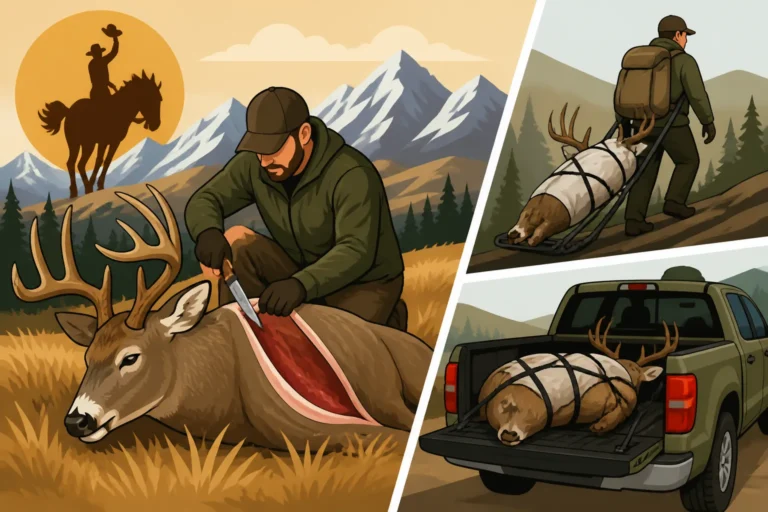
Ethical hunting doesn't end with a successful shot; it extends well into the post-harvest phase. Once an animal is down, your responsibilities shift to proper tagging, field dressing, and meat care. Wyoming law requires you to immediately validate your tag and attach it to the carcass as specified in the regulations. Failing to do so can result in serious penalties. Then comes the critical task of field dressing. Rapidly removing the entrails helps the carcass cool down, which is essential for preserving the quality of the meat, especially in warmer early archery seasons.
You also need to be mindful of Wyoming's "wanton waste" regulations, which stipulate that all edible portions of game must be salvaged. This means ensuring that no good meat is left to spoil in the field. Plan how you'll get the animal out of the field – whether by quartering and packing it out, using a game cart, or relying on horses if you're with an outfitter. Having game bags, a sharp knife, and possibly a bone saw in your pack are essential. Rapid cooling is paramount, particularly if you're several miles from your vehicle or a cooler. A well-executed shot followed by meticulous meat care honors the animal and provides you with high-quality wild game for your table.
Disclaimer
Please remember that hunting regulations, seasons, and requirements can change. While this guide provides comprehensive and up-to-date information, it is your responsibility to consult the most current Wyoming Game and Fish Department regulations before planning or undertaking any hunting activity. Always confirm specific rules for your chosen hunt area and species. This guide is for informational purposes only and should not be considered legal advice.