Where Outfitters May Set Camp on Public Land
One of the trickiest parts of planning a big game hunt in Wyoming, especially for those considering an outfitted experience, is understanding where outfitters can actually set up shop on public land. It's not as simple as just rolling up to a beautiful spot and pitching tents. There's a maze of regulations, permits, and land designations that dictate exactly where a commercial operation, like an outfitter, can establish their camp. This guide will walk you through the nuances of public land camping for outfitters, helping you understand the rules and why they're in place, so you can make informed decisions about your next hunting adventure.
Understanding Public Land Designations for Outfitters
Wyoming boasts an incredible amount of public land, a hunter's dream come true, but not all public land is created equal when it comes to commercial use. Outfitters operate under a different set of rules than individual, private hunters. They are running a business on public resources, and as such, they need specific authorization to set up camps, conduct guiding activities, and manage their clients across these vast landscapes. Ignoring these rules can lead to hefty fines for the outfitter and a ruined hunt for clients.
National Forest Lands and Special Use Permits
When you think of mountainous, timbered elk country in Wyoming, you're often picturing National Forest land. These areas, managed by the U.S. Forest Service, are prime hunting grounds and frequently utilized by outfitters. However, establishing a camp on National Forest land isn't a simple matter of choosing a flat spot near a water source.
Outfitters operating on National Forests are required to obtain a Special Use Permit. This isn't a one-and-done application; these permits are specific to certain areas, durations, and types of operations. Think of it as leasing a specific slice of the forest for their commercial activities. The Forest Service allocates these permits based on various factors, including environmental impact, existing usage, and the outfitter's operational plan. They're trying to balance public access, wildlife conservation, and commercial enterprise, which is a mighty tough job. An outfitter might have a permit for a designated area within the Bridger-Teton National Forest Hunting in Wyoming but not an adjacent one, even if they look identical on a map. These permits often dictate the number of clients, the season of use, and even the type of structures allowed, whether it's wall tents or more permanent facilities.
Many Forest Service permits also come with stipulations about where within their designated area an outfitter can camp. There might be restrictions on camping too close to perennial water sources, too near popular hiking trails, or within sight of a main road. The Forest Service might designate specific "outfitter camp" locations, or they might allow for more dispersed camping within a defined permit boundary, but with strict leave-no-trace principles enforced. This means an outfitter can't just move their camp on a whim if they think the hunting is better elsewhere; they are tied to the terms of their special use permit.
BLM Lands and Commercial Use Authorizations
Beyond the forested mountains, Wyoming's landscape transitions into vast expanses of sagebrush and wide-open basins, much of which falls under the management of the Bureau of Land Management (BLM). These lands are iconic for antelope and mule deer hunting, and many outfitters specialize in these open-country hunts. Similar to the Forest Service, the BLM has its own system for regulating commercial activity.
Outfitters operating on BLM lands need a Commercial Use Authorization (CUA). These authorizations function very much like the Forest Service's Special Use Permits, granting an outfitter permission to conduct their business within a specific BLM management area. The BLM's goals are similar: to manage natural resources, provide for public use, and allow for commercial operations without degradation. A CUA will outline the specific activities allowed, the geographical boundaries, and the duration of the authorization. For example, an outfitter might have a CUA to operate in a specific Wyoming Antelope Unit Density but not in an adjacent one.
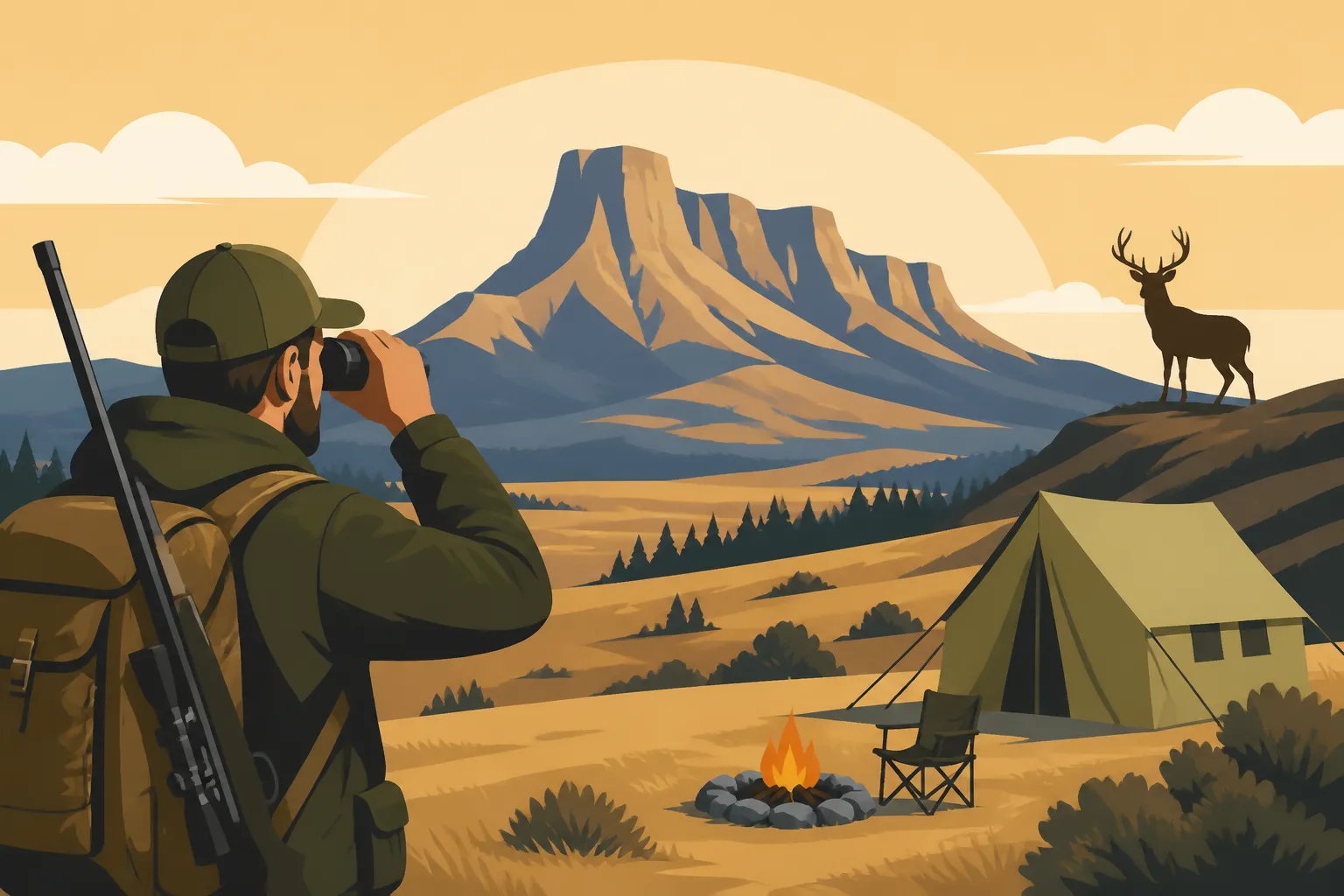
On BLM land, outfitter camps are often more mobile, given the open nature of the terrain. However, "mobile" doesn't mean unregulated. CUAs will often specify rules regarding the duration of stay in any one spot, proper waste disposal, and minimizing disturbance to the landscape. For outfitters setting up spike camps or temporary bases for archery antelope hunts, understanding these rules is crucial. There's a strong emphasis on dispersed camping principles, but when it's a commercial operation, the scrutiny is higher. It's a system designed to prevent a single outfitter from monopolizing prime locations or causing cumulative damage over time.
Factors Influencing Outfitter Camp Locations
The permits and authorizations are just the beginning. The actual placement of an outfitter's camp is a complex decision, influenced by a myriad of practical, regulatory, and ethical considerations. A good outfitter doesn't just look for a scenic spot; they're strategizing around access, game movement, and the stringent rules designed to protect Wyoming's natural resources.
Wilderness Areas and Their Strict Regulations
Wyoming is home to some truly wild and remote places, designated as Wilderness Areas. These are special federal lands where the highest level of protection is applied, meaning no motorized vehicles, no mechanized equipment, and a philosophy of minimal human impact. For hunters, these areas offer an unparalleled back-country experience, but for outfitters, they come with a unique set of rules.
Most notably, Wyoming's Wilderness Guide Law for Nonresidents dictates that non-resident hunters pursuing big game within designated wilderness areas must be accompanied by a licensed Wyoming guide or a resident companion. This rule immediately ties outfitter operations to these areas. However, setting up a camp in a wilderness area is far more restrictive than on general public land. Outfitters must adhere to strict "Leave No Trace" principles, often packing out everything they pack in, including human waste. Camp sizes might be limited, and the duration of stay in one location is typically shorter than in non-wilderness areas.
Because of the "no motorized vehicles" rule, any outfitter camp in a wilderness area must be accessed by horseback or foot. This means logistics are incredibly complex, requiring pack strings to transport clients, gear, and supplies. A large, established camp in a wilderness area would likely be set up for a specific period and then entirely dismantled, leaving no trace. This commitment to preservation ensures that the wild character of places like the Wind River Wilderness Access in Wyoming remains intact for future generations, but it places a significant burden on the outfitter to operate with extreme care and efficiency.
Seasonal Closures and Wildlife Considerations
Wyoming's wildlife is migratory, and their movements dictate not only where hunters can find them but also where outfitters can ethically and legally set up camps. Public lands, especially National Forests and BLM lands, often have seasonal closures designed to protect wintering wildlife or calving/fawning grounds. These closures are absolute, regardless of whether you're a private hunter or a commercial outfitter.
Imagine an outfitter planning a late-season elk hunt in an area that includes critical winter range. Even if their permit covers that specific geographic area, a seasonal closure might make it entirely off-limits during those critical months. These closures are put in place by land management agencies in coordination with the Wyoming Game and Fish Department (WGFD) to ensure that elk, deer, and antelope have undisturbed areas to survive the harsh Wyoming winters. For example, some areas might be closed to human entry from December 1st to May 15th. An outfitter can't just move into these areas because they found an elk herd there; they must respect the closures, even if it means altering their hunt plans. You can often find information about these closures on the WGFD website or the relevant Forest Service/BLM district offices. These restrictions are critical for maintaining healthy populations of species like the Wyoming Range deer herd.
Beyond official closures, responsible outfitters also consider wildlife disturbance. A great camp location might be near a known game trail or a crucial water source. However, setting up a large, active camp directly on such a feature could push game out of the area, making hunting less successful and potentially stressing the animals. A good outfitter balances accessibility and comfort with minimizing their footprint and avoiding unnecessary disruption to the wildlife they are pursuing.
Access and Infrastructure for Outfitter Camps
Logistics are king when it comes to outfitter camps. Even with all the necessary permits and an understanding of wildlife movements, a camp is useless if it can't be adequately supplied or accessed by clients. This brings in a whole host of practical considerations that dictate camp placement.
For many outfitters, especially those running drive-in camps or base camps for day hunts, road access is paramount. They need to be able to get trailers, supplies, and clients to the camp safely and efficiently. This often means camps are situated near designated forest roads or BLM two-tracks. However, these roads might have seasonal closures due to snow, mud, or fire restrictions. An outfitter needs to factor in the reliability of access throughout their hunting season. A camp that's perfect in early September might be snowed in by October, rendering it unusable.
For remote, pack-in hunts, water sources are critical. Hauling in all the water for a week-long camp of multiple clients and guides is simply not feasible. Camps are often located near reliable springs, creeks, or rivers, ensuring a steady supply for drinking, cooking, and sanitation. However, being too close to water can have environmental impacts, hence the restrictions often found in permits about minimum distances from riparian areas. Additionally, firewood availability (if fires are permitted) or the ability to pack in propane is a consideration.
Finally, waste management is a huge factor. Outfitters, by virtue of bringing in multiple people for extended stays, generate more waste than a single hunter. Proper disposal of garbage, gray water, and human waste is not just an ethical concern but often a permit requirement. This means having a plan for packing out trash, filtering gray water, and potentially establishing latrine systems that minimize environmental impact. The best camp locations allow for these logistical needs to be met while still offering a quality hunting experience. Outfitters often use tools like the Wyoming Hunt Planner and detailed topographic maps to scout these critical elements before committing to a camp location.
Working with the Wyoming Game and Fish Department
While the Forest Service and BLM issue the land use permits, the Wyoming Game and Fish Department (WGFD) plays an integral role in the overall hunting experience and indirectly influences where outfitters can set up camp. Their regulations on hunting units, species management, and ethical practices are the ultimate framework within which an outfitter must operate.
Coordinated Efforts and Area Management Plans
The WGFD defines the Hunt Areas and Herd Units across the state, dictating which species can be hunted, when, and with what licenses. An outfitter’s land-use permit from the Forest Service or BLM will almost always be tied to specific WGFD hunt areas. This means an outfitter can only set up a camp in a location that aligns with both their land-use permit and the hunt area they intend to operate in. You wouldn't find an outfitter with an antelope CUA setting up camp in a timbered elk unit, for instance.
The WGFD's management plans for specific herd units, such as the Wyoming Elk Herd Units and Winter Range, directly impact where game will be found and, consequently, where an outfitter might want to place a camp. For example, if a hunt area is known for early-season elk migrating into high-country wilderness, an outfitter will likely plan a pack-in camp there. Conversely, if late-season cow elk hunts are popular in specific lower-elevation areas, outfitters will look for permitted camp locations accessible to those areas. These agencies work together to create a cohesive management strategy, and outfitters are expected to understand and comply with both sets of regulations.
Ensuring Compliance and Sustainable Practices
The Wyoming Board of Outfitters and Professional Guides is the governing body for outfitters in the state. They license outfitters and guides and ensure they operate ethically and legally. Part of that legal operation involves adhering to all land agency regulations regarding camp placement and environmental impact. An outfitter found to be camping outside their permitted area, causing undue environmental damage, or violating any terms of their land-use authorization could face penalties from the land agency and the Board of Outfitters. This could range from fines to revocation of their operating license.
This emphasis on compliance and sustainable practices isn't just bureaucratic red tape; it's about preserving the hunting heritage and natural beauty of Wyoming for generations to come. Outfitters are essentially stewards of public land during their operations. They're expected to leave camps cleaner than they found them, minimize soil disturbance, prevent pollution of water sources, and generally operate with a minimal footprint. This includes things like properly disposing of game carcasses and adhering to food storage rules in grizzly country. For clients researching an outfitter, it's always a good idea to verify their credentials with the Wyoming Board of Outfitters and even ask about their environmental practices. Reputable booking services like BookYourHunt often vet their listed outfitters for these kinds of compliance measures, and research platforms like GoHunt provide valuable information on unit specifics that might help you choose an outfitter operating in the right areas.
Outfitter Camp Considerations on Public Land
Here's a quick comparison of general considerations for outfitter camps on different public land types:
| Feature | National Forest (e.g., Shoshone, Bighorn) | BLM Lands (e.g., Red Desert, Sweetwater) | Wilderness Areas (e.g., Teton, Popo Agie) |
|---|---|---|---|
| Primary Authorization | Special Use Permit | Commercial Use Authorization (CUA) | Special Use Permit (often stricter terms) |
| Camp Location Types | Designated sites, dispersed within permit boundary, spike camps | Dispersed camping within permit boundary, more mobile spike camps | Pack-in camps only, extremely minimal footprint |
| Access Methods | Road access (forest roads), pack trails | Two-track roads, cross-country (with restrictions), some pack trails | Foot or horseback only (no motorized vehicles/equipment) |
| Environmental Impact | Moderate scrutiny, "Leave No Trace" encouraged | Moderate scrutiny, "Leave No Trace" encouraged | Highest scrutiny, "Leave No Trace" mandatory, pack everything out |
| Structures Allowed | Wall tents, temporary shelters; often size/material restrictions | Wall tents, temporary shelters; often size/material restrictions | Lightweight, temporary shelters; minimal impact materials |
| Water Source Proximity | Often restricted distance from perennial water | Often restricted distance from perennial water | Critical for remote camps, but careful use and filtration required |
| Seasonal Restrictions | Common for winter range, road closures due to snow/mud | Common for winter range, limited road access in wet conditions | Often year-round access, but hunting seasons still apply, may be snowed in high country |
| Client Guide Ratio | Standard Wyoming ratio (e.g., Wyoming Requires One Guide for Every Two Nonresident Hunters) | Standard Wyoming ratio | Standard Wyoming ratio, often a "resident guide" requirement for non-residents in wilderness |
The complexities of where outfitters can set camp on public land in Wyoming highlight the intricate balance between providing hunting opportunities, supporting commercial enterprises, and rigorously protecting the state's invaluable natural resources. It's a system built on permits, regulations, and a deep respect for the land. When you choose an outfitter, you're trusting them not only with your hunt but also with their adherence to these vital rules. Understanding these foundational principles helps you appreciate the effort that goes into a truly ethical and legal Wyoming hunting experience.
Disclaimer
This article is for general informational purposes only and does not constitute professional advice. Laws, prices and regulations vary by location and change over time. Consult a qualified professional for guidance on your specific situation.