Pronghorn Eyesight and the Stalking Distance It Forces
Trying to sneak up on a pronghorn in Wyoming's wide-open country can feel like trying to hide an elephant in a bathtub – they see everything. Their incredible eyesight is legendary among hunters and is the number one reason why many stalks fall apart before you even get close. This guide will dive deep into just how phenomenal their vision is and, more importantly, how you can adapt your stalking strategies to overcome this challenge and finally get within shooting range, saving you countless frustrating hours on the prairie.
The Unmatched Eyesight of the Pronghorn
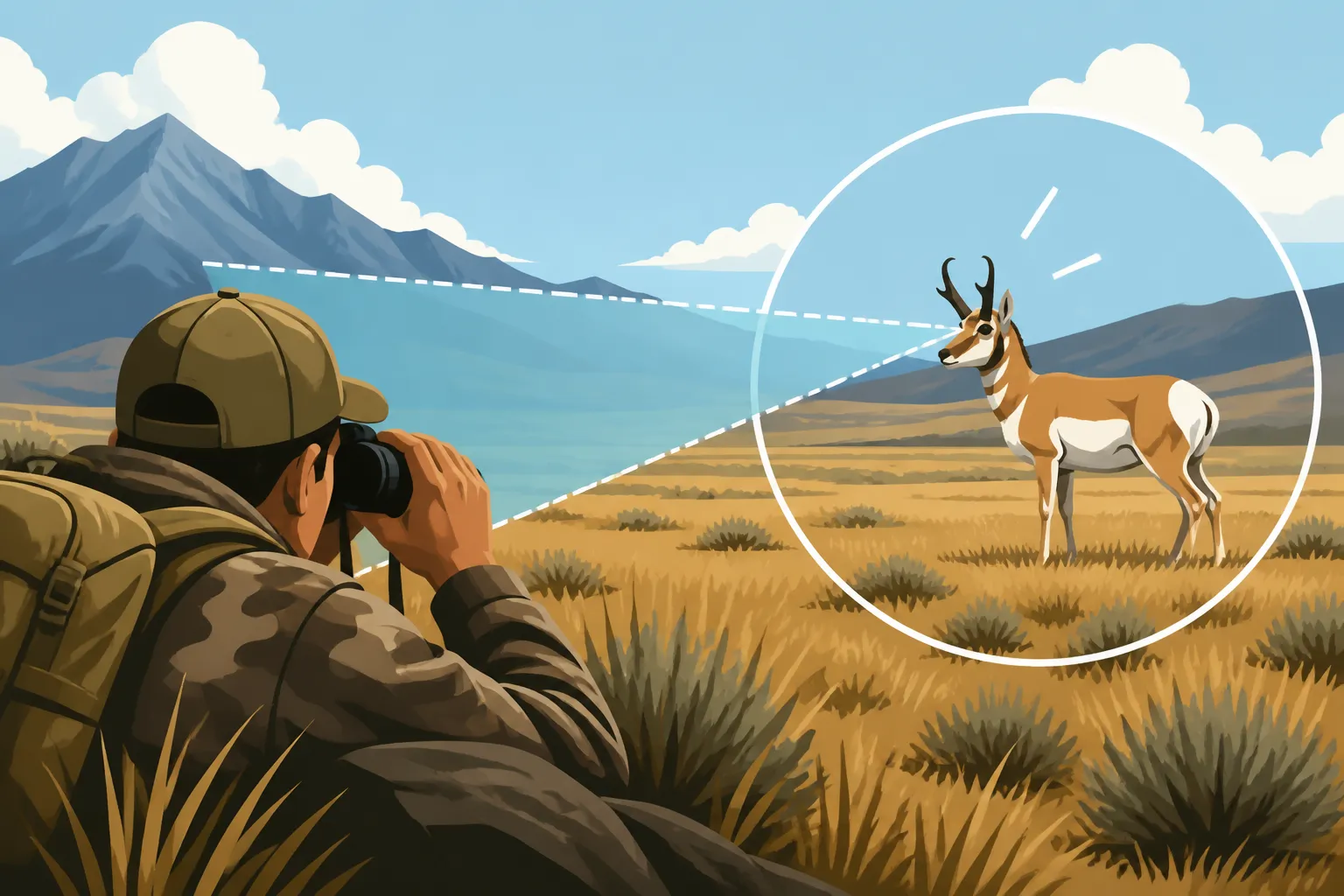
Pronghorn aren't called "speed goats" just for their blistering pace; they're also equipped with some of the most powerful vision in the animal kingdom. Imagine having a pair of built-in binoculars always at the ready, even without glassing. That's essentially what a pronghorn has. Their eyes are massive relative to their head size, giving them an incredibly broad field of view and an almost unbelievable ability to spot movement and detail at extreme distances. This isn't just a slight advantage; it's a fundamental difference that dictates everything about how they survive and how we must hunt them.
A Panoramic View of the Prairie
One of the first things you'll notice about a pronghorn's eyes is their placement – set high and to the sides of their head. This anatomical marvel grants them a nearly 360-degree field of vision, meaning there are very few blind spots. They don't have to turn their head much to scan their surroundings, which is a huge advantage in flat, exposed environments like the Wyoming prairie. While our human eyes might give us a good 180-degree forward-facing view, a pronghorn is taking in almost everything around them, all the time. This constant vigilance means that any movement, no matter how slight, from virtually any direction, is immediately registered. It's truly a testament to evolution in an open-country setting.
Built for Distance and Detail
Beyond the panoramic sweep, pronghorn eyes are equipped with an impressive level of detail perception, especially at long range. Experts often suggest their vision is equivalent to an 8x binocular for a human. Think about that: they can discern shapes, colors, and subtle movements that we would need high-powered optics to even begin to detect. This isn't just about seeing movement; it's about identifying what that movement is. A waving piece of grass is one thing, a camouflaged hunter slowly trying to creep closer is another. They're constantly processing visual data, making them incredibly difficult to surprise. This is particularly true when it comes to unnatural colors or patterns that don't match the sagebrush and prairie grasses they call home. If your camo breaks up your outline but doesn't blend in with the actual hues of the landscape, they're likely to pick you out.
Why Stalking Pronghorn is So Different
Hunting mule deer in the timber or elk in the mountains, you often rely on broken terrain, thick cover, and dense foliage to conceal your approach. With pronghorn, especially in classic Wyoming antelope country, those luxuries simply don't exist. This absence of cover, combined with their extraordinary vision, forces a completely different tactical approach. You can't just "still hunt" a pronghorn like you might a whitetail. The game is played out in plain sight, demanding patience, precise planning, and often, a touch of creative deception.
The Open-Country Challenge
Wyoming's vast plains, rolling sagebrush hills, and stark landscape offer incredible beauty, but precious little in the way of concealment for a hunter. Every rise, every draw, every clump of sage seems to be under constant surveillance by multiple sets of pronghorn eyes. This means that a conventional stalk, where you simply try to keep a tree or a ridge between you and your quarry, is often impossible. You might find a small cutbank or a sparse juniper, but these rarely provide the kind of sustained, complete cover needed to close hundreds of yards. The sheer scale of the landscape means that what looks like a small dip from a distance often turns out to be barely enough to hide a prairie dog, let alone a crouching hunter. This reality is a frustrating lesson for many first-time antelope hunters.
The "Eyes First" Detection System
While deer and elk use a combination of sight, smell, and hearing, pronghorn are predominantly visual animals. Their nose is good, and their ears are decent, but their eyes are their primary defense. This means that wind direction, while still important for human scent control, isn't always the absolute deal-breaker it is for, say, a mature bull elk. Instead, any visual anomaly in their field of view is a red flag. A quick movement, a flash of reflective gear, an outline against the sky – these are the things that send a pronghorn rocketing across the prairie at incredible speeds. You can have a perfect wind, be dead silent, but if they see you, the jig is up. This is why paying meticulous attention to your silhouette, your movement speed, and your camouflage becomes paramount.
Strategies for Closing the Distance on Antelope
Given their incredible eyesight and the open terrain, successfully stalking a pronghorn in Wyoming requires a specific set of skills and tactics. It's a game of patience, terrain exploitation, and often, a little bit of trickery. Forget everything you know about sneaking through thick woods; this is a completely different ballgame. The goal isn't just to move silently, but to move unseen, or at least, un-identified.
Utilizing Terrain and Topography
This is your number one asset. Every small dip, every wash, every subtle fold in the land becomes your best friend. Instead of walking directly towards an animal, you'll be making massive detours, often crawling on your hands and knees or even belly-crawling through dry creek beds. This is where detailed scouting and mapping tools like those offered by GoHunt become invaluable. Before you even set foot on the ground, you can use satellite imagery to identify potential Using Cutbanks and Draws to Close on Antelope or rolling hills that can offer momentary breaks in their line of sight.
You need to think like water flowing downhill, always seeking the path of least resistance from the pronghorn's perspective. If there's a slight rise 300 yards to their left, and you're 800 yards to their right, you might need to make a massive loop to get behind that rise. It's often a much longer journey than it looks on a map, but it's the only way to stay hidden. Remember, you're not just hiding from one pronghorn, but often an entire herd, each with their own vigilant eyes.
The Art of the Slow and Steady Approach
Once you've exhausted all available terrain features, you might find yourself in a situation where you need to move across a relatively open stretch. This is where the "slow and steady" mantra becomes critical. Think glacial movement. Any quick, jerky motion will instantly be picked up. Instead, move in agonizingly slow increments, often freezing for several minutes after each small movement to allow the animals to relax their guard.
Here's a technique that works: when a pronghorn is looking away or has its head down to feed, initiate a slow movement. The moment its head comes up, freeze completely, even mid-step. Remain perfectly still until it drops its head again. This can be mentally exhausting and physically demanding, especially when Stalking Pronghorn Across Wyoming's Open Sagebrush and the sun is beating down. But it’s the only way to fool those hyper-perceptive eyes. Consider practicing this kind of deliberate movement before your hunt, even in your backyard, to build the necessary patience and muscle memory.
Decoys as a Visual Distraction
Pronghorn are incredibly curious animals, especially during the rut. This curiosity can be exploited with the clever use of decoys. A well-placed decoy can draw a buck in, or at the very least, distract an entire herd long enough for you to close those last few critical yards. When The Decoy Distance That Actually Pulls Antelope Bucks is usually somewhere between 100 and 200 yards, it creates a unique challenge.
If you're hunting with a partner, one person can deploy the decoy while the other sneaks in from a different angle, using the decoy as a visual magnet. Even solo, a mobile decoy can be a game-changer. You might need to carry it collapsed and only deploy it when you've closed most of the distance. Remember that pronghorn curiosity can also turn to suspicion quickly if the decoy doesn't look natural or if they detect movement associated with it. Positioning is key; consider having the decoy facing slightly away or broadside, mimicking a challenging buck or an inviting doe.
The Role of Wind and Sun
While pronghorn are primarily visual, neglecting their other senses is a mistake. Wind direction is still crucial for controlling your scent, especially when you start closing the distance. Playing Wind Direction on an Open Sagebrush Stalk means understanding that thermals can shift, especially in the mornings and evenings. Always try to keep the wind in your favor, blowing your scent away from the animals. Even a slight shift in wind can carry your scent further than you'd expect on the open prairie.
The sun's position can also be a significant factor. Trying to stalk with the sun at your back, directly into the pronghorn's eyes, can give you a tactical advantage, causing glare that makes it harder for them to see you clearly. Conversely, if the sun is in your eyes, it can hinder your ability to see them, or worse, create a glare off your optics or skin that instantly gives you away. Plan your approach with the sun in mind, using it to your benefit or mitigating its potential drawbacks.
Essential Gear to Outsmart Pronghorn Vision
Having the right gear won't replace good stalking technique, but it can certainly amplify your efforts and give you an edge against the pronghorn's phenomenal eyesight. When every movement counts and every detail matters, investing in quality tools makes a palpable difference in your success rate. From what you look through to what you wear, your gear contributes to your ability to remain undetected.
High-Quality Optics are Non-Negotiable
This cannot be stressed enough: good optics are your absolute best friend when hunting pronghorn. You need binoculars for wide-area scanning and a spotting scope for detailed observation at extreme distances. Remember, you're trying to see them before they see you, and that often means picking them out as tiny specks miles away. A 10×42 binocular is a good starting point for general viewing, but a spotting scope (20-60x or even 27-80x power) on a sturdy tripod is indispensable for evaluating bucks, determining their location relative to terrain features, and planning your approach. The article Optics Power for Wyoming's Long Sightlines emphasizes just how important magnification can be.
You'll spend more time behind glass than actually stalking, so ensure your optics are high-quality, clear, and comfortable to use for extended periods. This also applies to any digital tools. Services like GoHunt, with their detailed mapping layers, can help you e-scout potential glassing points and identify subtle terrain features that might offer cover on a stalk, long before you arrive in the field. This combination of physical and digital optics gives you the best chance to beat their natural advantage.
| Gear Type | Recommended Use | Key Features for Pronghorn Hunting |
|---|---|---|
| Binoculars | Initial spotting, general landscape scanning | 10×42 or 12×50, lightweight, good low-light |
| Spotting Scope | Detailed animal identification, long-range planning | 20-60x or higher magnification, sturdy tripod |
| Rangefinder | Precise distance to animal and landmarks | Long-range capability (1,000+ yards), angle compensation |
| Mapping App | E-scouting, public land identification, terrain analysis | Satellite imagery, topographic lines, private land overlays |
| Decoy (Optional) | Distraction, drawing in bucks during rut | Lightweight, realistic, easy to deploy |
Camouflage That Blends, Not Just Hides
In the wide-open spaces where pronghorn live, breaking up your human silhouette is crucial, but it's not enough. Your camouflage needs to truly blend with the colors and textures of the landscape. Forget deep forest patterns; you need patterns designed for arid, open country – sagebrush, dry grass, rock. Avoid anything with stark contrasts or shiny surfaces. Even a glossy rifle barrel or a shiny boot buckle can catch the sun and act as a beacon to a pronghorn’s discerning eyes.
Pay attention to your face and hands as well. They are often exposed and can reflect light or stand out as unnatural shapes. Face paint, a face mask, and gloves are simple additions that can make a huge difference in breaking up those obvious human forms. Your movement is your biggest enemy, but if you do have to move across open ground, having camouflage that truly melts into the background will make you harder to identify, even if they catch a glimpse of movement.
Disclaimer
This article is for general informational purposes only and does not constitute professional advice. Laws, prices and regulations vary by location and change over time. Consult a qualified professional for guidance on your specific situation.