Telling a Whitetail From a Mule Deer
There’s nothing quite like the heart-stopping moment you spot deer in the vast, beautiful landscape of Wyoming. But for many hunters, especially those new to the state or hunting areas where different species overlap, a common frustration quickly sets in: "Is that a mule deer or a whitetail?" It’s a critical question, not just for the thrill of the chase, but for legal tagging and management purposes. This guide is dedicated to helping you confidently distinguish between these two magnificent species, ensuring you make the right call in the field every time.
The Core Physical Differences Between Whitetail and Mule Deer
While both whitetail and mule deer are, well, deer, they have evolved with distinct physical traits that suit their preferred habitats and lifestyles. Once you learn to look for these key identifiers, they'll start to stand out like neon signs. It’s not just about antlers; there’s a whole host of subtle (and not-so-subtle) characteristics that give them away.
Antler Configuration: The Branching Story
Let's start with the feature most hunters are probably looking for first: the antlers. This is often the most obvious differentiator, but it can also be a source of confusion, especially with younger bucks or abnormal growth.
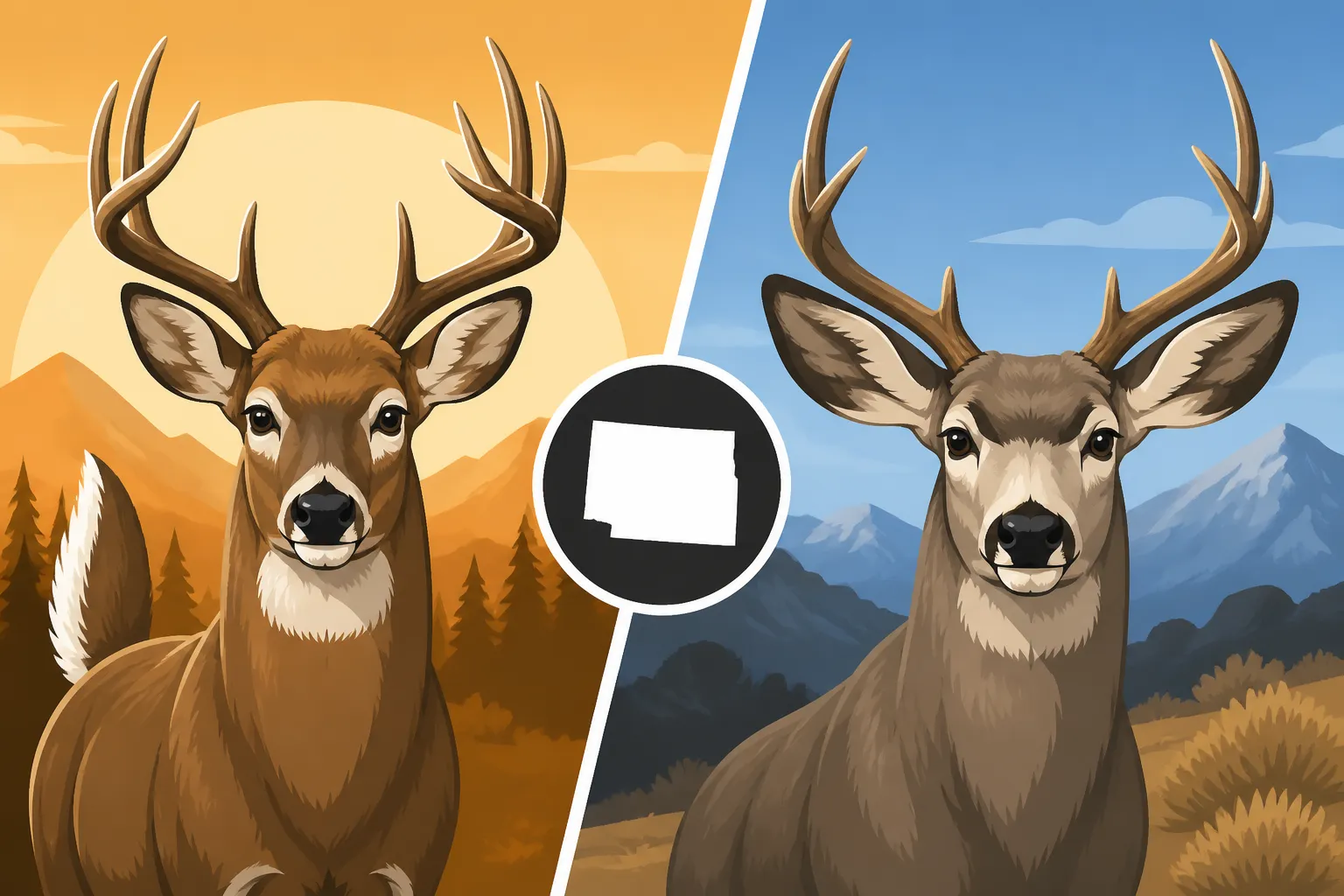
Mule deer antlers typically fork. What I mean by that is the main beam comes off the head and then forks into two points. Each of those two points can then fork again, creating a deep "Y" shape. So, a typical mule deer four-point (often called a 4×4) will have two distinct forks on each side, with no brow tines or G1s extending forward from the main beam. Of course, brow tines can and do exist, but the dominant branching pattern is usually unmistakable. You’ll see the main beam rise and then split, and then each of those splits will split again. It's a double-forking design that gives them that iconic multi-tined look.
Whitetail deer, on the other hand, have antlers where all points (or tines) typically grow off a single main beam. This main beam usually curves forward and inward, and the tines shoot upwards from it. Imagine a comb where the teeth are the tines and the back of the comb is the main beam. A typical whitetail will have a strong brow tine, often called a G1, and then subsequent G2, G3, and G4 tines all originating directly from that forward-sweeping main beam. While non-typical whitetail racks can certainly throw a wrench in this, especially those with drop tines or cheaters, the foundational growth pattern is usually quite different from a mule deer.
Ear Size and Shape: The Namesake Feature
This is one of the easiest and most reliable ways to differentiate between the two, even when antlers might be ambiguous or completely absent (like with does or shed bucks). It’s right there in the name: "mule deer."
Mule deer have very large ears, significantly larger than a whitetail's. They are long, broad, and can swivel independently, giving them excellent hearing. When a mule deer is relaxed, its ears might look a little droopy or floppy, but when alert, they stand out prominently. Think of the ears of a mule – long, oval, and noticeable. In fact, if you see a deer and your first thought is, "Wow, those are some big ears," you're almost certainly looking at a mule deer. These large ears are an adaptation for their often open, sparse habitats, allowing them to detect distant threats.
Whitetail deer have ears that are proportionally smaller and more rounded. While still excellent at picking up sounds, they are much less conspicuous than a mule deer's. They fit the head more snugly and don’t have that "donkey-ear" appearance. When you compare the two side-by-side, or even just see a whitetail after observing a mule deer, the difference is striking. If you're looking at a deer and its ears seem "normal" or even a bit small in relation to its head, you're likely on the right track for identifying a whitetail.
Tail Color and Movement: A Key Indicator
The tail is another incredibly consistent and telling feature, both in its appearance and how the deer carries and moves it. This can be especially helpful for fleeting glimpses or when a deer is running away.
Mule deer have a relatively narrow, rope-like tail. The most defining characteristic, however, is its color: it's typically a creamy white or yellowish-white, with a distinct black tip. Some mule deer might have a more brownish top to the tail, but the black tip is almost universally present and makes for a clear identifier. When a mule deer is alarmed and running, it typically holds its tail down, or at least not erect. It might swish it from side to side, but it won’t "flag" it high in the air. This dark tip against the light tail is a strong clue.
Whitetail deer possess a much broader, flatter tail that is dark brown on top and pure white underneath. This is where the term "whitetail" truly comes from. When a whitetail is spooked and running, it will almost always "flag" its tail straight up in the air. It’s an unmistakable, high-held white banner, flashing as they bound away. This "flagging" motion is a clear warning signal to other deer and a signature behavior. If you see a deer with a big, white flag waving goodbye, you've just seen a whitetail. You can often tell it’s a whitetail by its tail even before you process other features.
Body Size and Build: Subtle But Present
While not as definitive as antlers, ears, or tails, the overall body shape and size can also offer clues, particularly when you've gained some experience observing both species.
Mule deer tend to be larger and more robust in build than whitetails in the same general area. They have a more compact, muscular body, with a deeper chest and sturdier legs. Their face is often described as broader, and their neck can appear thicker. They often carry their head and neck higher when alert, giving them a statuesque appearance. When they stand, they tend to look more "square" or blocky.
Whitetail deer are typically more slender and athletic in appearance. They can be incredibly graceful, with a more elongated body and often a more refined, pointed face. Their neck tends to be thinner, and their legs can look longer in proportion to their body, giving them a more "leggy" appearance. While a big whitetail buck is certainly a powerful animal, they generally have a less stocky build than a mature mule deer buck.
Locational Cues: Where Each Species Prefers to Live in Wyoming
One of the greatest aids in identification isn't just what the deer looks like, but where you're seeing it. Wyoming's diverse landscape means that while there are areas of overlap, each species generally sticks to its preferred haunts. Understanding these habitat preferences can significantly narrow down your identification challenge.
Whitetail Habitat: River Bottoms and Dense Cover
In Wyoming, if you're talking whitetail deer, you're primarily talking about eastern Wyoming's river bottoms and dense riparian areas. These deer thrive in thick cover – think cottonwood groves, willow thickets, dense brush along creeks, and agricultural fields that provide both food and concealment. They are masters of using topography and vegetation to disappear. Areas like the North Platte River drainage, the Black Hills region (specifically the eastern slopes and timbered draws), and various creek bottoms on the plains are prime whitetail country. If you're hunting in thick timber or dense brush along a waterway, especially in the eastern half of the state, the odds are much higher that you’re encountering a whitetail. You can find more specific details by consulting a resource like A Whitetail Range Map for Eastern Wyoming. These deer are built for evasion within cover, preferring to sneak away or make a short, explosive dash rather than bounding across open spaces.
When you're out Hunting the Whitetail River Bottoms of Eastern Wyoming, you'll notice their behavior is closely tied to the cover. They’ll often hold tight, relying on their camouflage, and only flush at close range. They aren’t typically seen out in the wide-open prairie for extended periods, unless they are quickly crossing a field from one patch of cover to another. Their entire defense strategy revolves around being unseen.
Mule Deer Habitat: High Country and Open Sagebrush
Mule deer, the true icons of the American West, are masters of open, rugged, and often high-elevation terrain. They are at home in the vast sagebrush flats, aspen forests, juniper-studded canyons, and the timbered slopes of mountain ranges across Wyoming. Think of places like the Wyoming Range, the Bighorn Mountains, the Red Desert, or the vast landscapes around Pinedale and Lander. Their preferred habitat gives them expansive views to spot predators from a distance, and their bounding gait is perfectly suited for covering rough ground quickly.
If you’re glassing a vast basin, a sprawling sagebrush flat, or climbing through broken timber and rocky outcroppings, you're almost certainly in mule deer territory. Their color, often a more uniform grayish-brown, blends perfectly with the high-desert and mountain environments. The large ears are designed for detecting sounds across wide-open spaces, and their behavior reflects their reliance on early detection and then covering ground. They are also highly migratory, often moving between high summer ranges and lower wintering grounds, such as described in The Red Desert Mule Deer Migration Explained or Wyoming's Longest Recorded Mule Deer Migration. This ability to travel long distances and utilize varied terrain is central to their survival.
Overlap Zones: Where Confusion Begins
Now, here’s where it gets tricky. While their preferred habitats are distinct, there are areas in Wyoming where their ranges overlap. These are often transition zones where river bottoms meet foothills, or where agricultural lands border more rugged, open country. For instance, in areas where eastern Wyoming’s river systems push west into the plains and meet the beginnings of the mountain ranges, you might find both species within the same general region, sometimes even on the same piece of property.
Along the edges of mountain ranges, where dense timber gives way to open sage flats, you can encounter both. Or in areas of fragmented habitat, such as scattered timbered draws across grasslands that are otherwise mule deer country, whitetails might colonize those pockets of cover. In these overlap zones, you absolutely cannot rely solely on location for identification. This is when paying close attention to the specific physical and behavioral cues becomes paramount. A buck you jump from a thick stand of willows could be either, and that's when you need to be prepared to make a quick, accurate assessment of its ears, tail, and antler structure.
Behavioral Telltales: How They Act When Spooked
Beyond their physical appearance, the way these deer react when they sense danger or are actively fleeing is perhaps one of the most definitive ways to tell them apart. Their escape strategies are as distinct as their tails.
The Mule Deer's Bounding Gait: A Classic Jump
The mule deer's most iconic escape behavior is its bounding gait, often called "stotting" or "pronking." When alarmed, a mule deer will launch all four feet off the ground simultaneously, landing on all four feet at once, in a stiff-legged, springy jump. They look like a pogo stick with antlers, covering ground with surprising speed and agility over uneven terrain. This high, bouncing motion is incredibly efficient for navigating rocky slopes, downed timber, and dense sagebrush, allowing them to clear obstacles and gain elevation quickly. It also allows them to pause briefly mid-bound to survey their surroundings.
As they stot away, their narrow, black-tipped tail will typically be held down, or at most, slightly out, never flagging high in the air. If you see a deer springing across the landscape with a rhythmic, four-footed bounce, and its tail isn't waving a white flag, you've got a mule deer. This is a behavior ingrained through generations, perfected for escape in their often wide-open, mountainous habitat.
The Whitetail's Flagging Tail and Sprint
In stark contrast to the mule deer, a whitetail deer, when spooked, will almost always lower its head, drop its neck, and launch into a powerful, explosive run or sprint. And as it runs, it will raise its broad, white-underside tail straight up in the air, creating that unmistakable "white flag." This flagging motion is believed to serve several purposes: a warning to other deer, a signal to the predator that it has been detected, and possibly to disorient a chasing predator by drawing attention to the rapidly moving white patch.
The whitetail's sprint is built for speed and quick turns, ideal for escaping through dense cover and timber. They don't typically bound like a mule deer; instead, they stretch out, using long, powerful strides to cover ground. If you see a deer tear off through the woods with its entire white tail raised high and waving, it's a whitetail. This difference in escape behavior is so consistent that it's often the first and most reliable field identification cue for many experienced hunters, especially in situations where you only get a quick glimpse of a departing animal.
General Demeanor and Alertness
While harder to quantify, there are subtle differences in their general demeanor that can sometimes offer clues. Mule deer, often living in more open environments, tend to be more vigilant and prone to scanning their surroundings with those large ears. They might appear a bit more wary and reactive, covering ground quickly if they feel exposed. When standing, they often have a proud, almost regal posture, head held high, ears constantly swiveling.
Whitetail deer, being more reliant on cover, can sometimes seem a bit more secretive or nervous in dense brush. They might slink away undetected, or freeze completely, using their camouflage to hide. When they do move into open areas, they often do so with a cautious, almost furtive air, always looking for the quickest path back to safety. Of course, a mature buck of either species is going to be incredibly cunning and wary, but these general tendencies can sometimes lend a little extra weight to your identification.
Practical Tips for Field Identification in Wyoming
Making a confident identification in the field can be challenging, especially when the adrenaline is pumping. But with the right approach and tools, you can minimize uncertainty and ensure you're always making the correct call.
Using Optics for Detailed Observation
One of the absolute best tools a hunter can carry in Wyoming is a good set of optics. Whether it's high-quality binoculars or a powerful spotting scope, these tools are your best friends for detailed observation from a distance. Often, deer won't let you get close enough to see all the distinguishing features with the naked eye, or the light might be flat and playing tricks on you.
When you spot a deer, take your time and put your glass on it. Don't rush. Look for those telltale signs:
- Antlers: Can you see the distinct forking pattern of a mule deer, or the tines rising off a main beam like a whitetail? Look for brow tines as a primary whitetail indicator.
- Ears: Are they disproportionately large, like a mule's, or smaller and more rounded?
- Tail: Is it rope-like with a black tip, or broad and dark on top with a pure white underside? If the deer moves, how does it carry its tail?
- Body: Does it look stocky and blocky, or more slender and graceful?
Even in difficult lighting or at long range, good optics can help you discern these details. I always recommend carrying at least 10×42 binoculars, and a spotting scope is invaluable for really dissecting distant animals, especially in open country. Consider what Optics Power for Wyoming's Long Sightlines is most appropriate for your hunt area, or choosing a Binocular Size That Survives an All-Day Glassing Session.
Combining Clues for Certainty
While one single feature can often be a strong indicator, rarely should you rely on just one. The most experienced hunters combine multiple clues to form a confident identification. For example, if you see a deer with large ears and a black-tipped tail that it holds down, you're almost certainly looking at a mule deer. If you see a deer with smaller ears and a broad, white-flagging tail, it's a whitetail.
Consider the habitat you’re in. If you’re deep in the thick cottonwoods along the Belle Fourche River, and you see a deer with antlers coming off a single main beam and smaller ears, it's highly likely a whitetail. If you’re high in the Big Horns glassing a timbered slope, and you see a deer with big ears and forking antlers, it's a mule deer. The more clues you can gather, the higher your confidence in your identification will be. Sometimes, it’s like solving a puzzle, and each piece you confirm adds to the overall picture.
Leveraging e-Scouting Tools
In today's hunting world, technology offers incredible advantages, even for something as fundamental as deer identification. E-scouting tools, mapping software, and online resources can help you understand deer distribution before you even set foot in the field. Services like GoHunt are fantastic for overlaying habitat types, public/private land boundaries, and even historical harvest data, which can give you a strong indication of which species is more prevalent in a given area.
Before your hunt, spend time using these tools to understand the specific characteristics of your chosen hunt area. Identify riparian corridors, dense timber patches, and open sagebrush basins. This groundwork, a form of E-Scouting a Unit Before the Season Opens, helps you predict what kind of deer you're most likely to encounter in different parts of your unit. While e-scouting can't tell you what a specific deer is, it can significantly reduce the "unknowns" and allow you to focus your attention on the key identifying features once you're in the field. Understanding Where Doe and Fawn Deer Licenses Remain might also offer clues about population distribution. By knowing the most likely species for a given terrain type, you can mentally prepare to look for the right characteristics.
Wyoming Deer Identification Cheat Sheet
| Feature | Whitetail Deer | Mule Deer |
|---|---|---|
| Antlers | Tines branch off a single main beam | Main beam forks into two, which may fork again |
| Ears | Shorter, more rounded, proportional to head | Very large, long, mule-like ears |
| Tail | Broad, flat; dark on top, pure white underneath | Narrow, rope-like; white with a distinct black tip |
| Tail Movement | "Flags" high in the air when spooked | Held down (or slightly out) when spooked |
| Gait (Spooked) | Powerful sprint, lower to the ground | Stiff-legged, four-footed "stot" or bound |
| Body Build | More slender, graceful, often "leggy" | More robust, blocky, compact body |
| Preferred Habitat | Dense cover, river bottoms, riparian areas | Open sagebrush, canyons, mountain slopes |
Ultimately, becoming proficient at telling a whitetail from a mule deer comes with practice and time in the field. But by focusing on these key differences in antlers, ears, tail, movement, and preferred habitat, you'll gain the confidence to make quick, accurate identifications. It’s a skill that will not only enhance your hunting experience but also ensure you’re abiding by all regulations and respecting the incredible wildlife of Wyoming.
Disclaimer
This article is for general informational purposes only and does not constitute professional advice. Laws, prices and regulations vary by location and change over time. Consult a qualified professional for guidance on your specific situation.